
Visiting Furniture Factories in Foshan and Lecong: What to Check Before You Sign
The short answer: go to Foshan with a finished RFQ, not with an idea. The furniture cluster around Lecong, Longjiang and the Chancheng and Nanhai districts is a network of showroom malls and factory villages rather than one industrial park, so a buyer who only walks the showrooms will meet trading companies, not production managers. The visit earns its cost when it is used to verify a shortlist you already have: which is what the checklist below is for.
This article is written from a sourcing office based in Foshan, which means the focus here is what a buyer should verify on the ground, regardless of who walks the floor with them. It covers when the trip is worth the money, what must be ready before you book, how to tell a showroom from a plant, the nine areas to ask to see in a factory, the documents to collect on site, how to negotiate without over-committing, a realistic three-day itinerary, and what to do when you cannot travel at all.
When a visit is worth it, and when it is not
Every sourcing guide tells you to visit Foshan. Most of them are written by people who charge you to guide you around when you do, and that bias deserves a moment of honesty before any of the checklist below. A Foshan-based sourcing service’s published comparison of visiting versus remote sourcing (May 2026) concedes the most useful point directly: sometimes the visit is the wrong use of the money, and the difference matters more than most buyers realise before they book a flight.
A visit adds genuine value in four situations. First, a large or complex project where material and finish decisions are consequential: for a hotel of eighty or more rooms, a big villa, or a commercial fit-out, touching the foam, comparing leather grades side by side, and seeing how a lacquer finish behaves under different lighting genuinely changes decisions in ways a photograph cannot. That same service’s guidance puts the trip comfortably justified above roughly $50,000 of order value and hard to justify below roughly $30,000 of standard catalogue furniture; those are one operator’s rules of thumb, not a market benchmark, and the deciding arithmetic is the share of your own order. Second, a long-term supply relationship: a buyer who has stood in the plant and met the production manager becomes a known customer, which in practice leads to faster responses and more direct production updates than a purely remote contact. That is relationship economics, and it matters most when you plan to reorder, not for a one-time container. Third, meaningful custom production: unusual dimensions, proprietary finishes, or bespoke hardware need production-level dialogue, and being in the room with the production manager and an interpreter saves weeks of back-and-forth email. Fourth, sample sign-off on high-specification items, where physically evaluating the piece against the specification beats a photo-review cycle.
The same guidance is equally blunt about when a visit does not pay. An undeveloped brief is the most expensive mistake: buyers who arrive hoping the market will clarify what they want leave three days later with a folder of business cards and no orders, because an enormous physical space with no framework beats nobody. A fully specified price buyer gains little by being present, since the factories that quote the best walk-in prices are not always the ones making the best product. And a tight timeline argues against the trip: a productive visit takes a minimum of three full working days, and with two days of travel on either side most international buyers need a full week, which a fast-moving project rarely has.
| A physical visit makes sense when | Remote sourcing makes more sense when |
|---|---|
| Order value is meaningful and material choices are consequential | The spec is standard catalogue furniture and the order is small |
| You are establishing a long-term supply relationship | You do not have a confirmed brief yet, and expect the visit to produce one |
| The project has significant custom specification | Your primary goal is price on a fixed spec |
| You want to approve a high-specification sample in person | Your timeline cannot absorb a week of travel |
| You can commit a full week including travel | You are reordering an approved product from a factory you know |
The economic framing helps more than the lists: for a hotel FF&E package running to several hundred thousand dollars, a trip budget in the low thousands is a planning cost, not a line item; against a single-container order of catalogue goods it is a meaningful share of margin. The same service’s published trip-planning figures put an all-in Foshan visit at roughly $1,200–3,500 depending on origin and duration, which, against a $30,000 order, is under 7% of value and, against a $10,000 order, is 20%. Those shares are illustrative arithmetic built on that service’s published planning figures rather than a market rule; the figure that decides is your own order value, and running that arithmetic before booking is the first decision of the trip.
What to prepare before you book
The single most important variable in a productive Foshan visit is arriving with a specific brief. Not a mood board, not “nice furniture”: a room-by-room list of what you need, approximate dimensions, style references, and a realistic budget. Buyers who arrive with a brief leave with confirmed orders; buyers who arrive to explore the market leave with catalogues and confusion. That observation is consistent across every credible account of the market, including the Foshan furniture market guide published by Maple Sourcing (updated August 2026).
The practical preparation is unglamorous and matters as much as the commercial pack. Visa rules change year to year, and several nationalities now benefit from visa-free or transit arrangements; check the current status for your passport and apply early if a visa is required. If you rely on apps and services that are not accessible from inside China, install and test a VPN before arrival, because setting one up after you land is harder; travellers who do not depend on those services are usually fine without one. WeChat is the standard communication tool and should be set up and connected with your contacts before you fly. Download floor plans, dimensions, and style references to the phone rather than relying on cloud access. Payment is simpler for visitors than it used to be: Alipay and WeChat Pay now support linking many international cards, so most travellers can pay by phone as they would at home. Foreign cards still do not work everywhere and some merchants expect a local payment method, so confirm payment with your contacts in advance and carry some cash for small transactions. And book the hotel near Lecong rather than in Foshan city centre, because that is where the showrooms and the daily distances are.
Lecong, Longjiang, and the factory villages: what each one is
Foshan is not a furniture market; it is a furniture city, and the distinction shapes the whole trip. Almost all of the trading happens in Lecong, a town in Shunde District strung along National Highway 325, where a run of connected malls covers more than 1.6 million square metres of showroom space. The complexes are big enough that a week of walking would not cover them all, and they are not interchangeable. The Maple Sourcing guide maps them usefully: Louvre sits at the top of the range and is the place to set a design benchmark; Sunlink North runs mid to high across living room, bedroom, and office; Sunlink South is the older stretch, heavier on sofas and beds; and Tuanyi is the walk to make if office furniture is what you came for. Each showroom inside them represents either a factory selling its own range or a trading company buying from several factories, and a buyer cannot tell which is which from the entrance.
The factories are somewhere else. Many of them sit around Longjiang, about twenty minutes from the showrooms, which is the production heartland: less showroom, more plant, and the right stop for custom production rather than catalogue selection. Around the wider cluster, in the Chancheng and Nanhai districts and the industrial villages between, sit the smaller mills, panel suppliers, spray shops, and hardware houses that feed the big makers. The single fact that shapes a Foshan trip is that selling and making happen in different towns: the showroom piece and the production piece are physically separate, and a day in the malls tells you what exists and what it sells for while the factory visits tell you what it costs to make and who can actually make it.
Foshan also sits about an hour from Guangzhou, which is why buyers combining furniture with other goods often pair the two cities in one southern China trip. The mechanics do not carry over, because furniture runs on a different logic: an approved sample, a traceable factory, packing designed around volume. If all you need is custom hotel production, the capability question has its own treatment in the custom hotel furniture in Foshan guide; this article is about the trip that verifies it.
Showroom vs plant: the questions that expose the difference
Factories and trading companies occupy the same showrooms and both describe themselves as manufacturers. Neither is a problem in itself: a good trading company pulls several factories’ ranges together and takes smaller orders, while a factory prices better on volume and controls what happens on the line. The problem is signing a production order with a showroom while believing you signed with a plant. Three questions, in the form Maple Sourcing recommends, settle most of it before any price talk:
Two hard checks back the questions. First, the business licence: the registered name and address on it should match the plant you visit, not just the showroom. Second, the drive: a genuine factory has an address you can stand at, with its own gate, its own machinery, and its own inventory. Maple Sourcing’s guide is explicit that experienced trading companies answer production questions fluently, which is exactly why conversation alone settles nothing and a plant visit or a documented plant address is what actually decides it.
The pricing gap between the two worlds is worth knowing before negotiation: showroom prices are not factory prices. Prices quoted in the showroom carry the showroom operator’s margin, the building rental, and a negotiation buffer, and one sourcing service’s published estimate puts the first-quoted showroom price in the 20–40% range above a direct factory price. That spread is a single operator’s estimate rather than a market benchmark: the real gap varies with the showroom type, the building, and the negotiation. The durable point is structural, not numeric: showroom price and factory price are different numbers for the same item. Showrooms remain the fastest way to see and compare a wide range, but the order should be placed with the factory that makes it, wherever possible.
Factory walkthrough: nine areas to ask to see
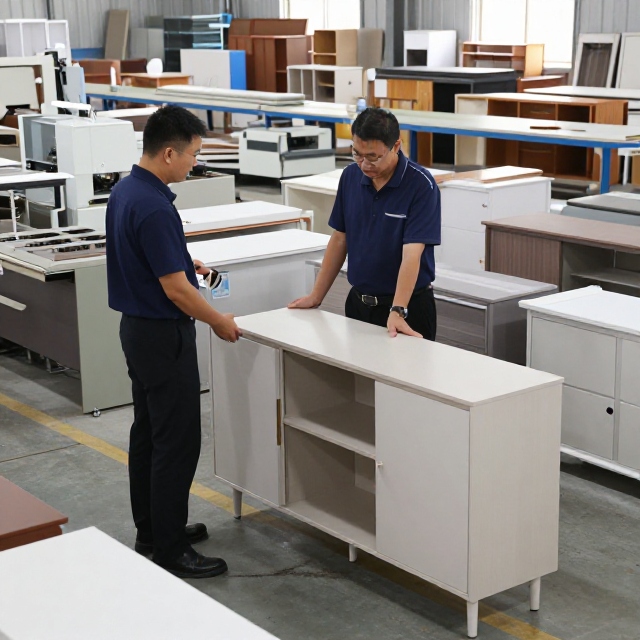
Once you are inside a genuine plant, the value of the visit is decided by what you ask to see. The short version of the structure below is the informal checklist of a sourcing trip; buyers with a big first order usually want the heavier, scored version, which is what the China factory audit guide covers. For the visit itself, ask to walk through the whole building in this order.
Two habits make the walkthrough worth more than the sum of its stops. Photograph and note everything during the walk, including the pieces that are not for sale, because the quality of the production conversation is a better predictor than the quality of the showroom. And ask for the same walk at a real working hour: a factory that schedules your visit around the lunch break is showing you a quieter building than the one that will build your order.
When you are comparing two or three factories for the same order, standardise the walk. Take the same specification to each plant, ask for the same nine areas in the same order, and photograph the same details: the timber store, the edge-banding line, the QC bench, the packing spec. The notes of a standardised walk become a comparison table you can read next week, when the memory of the flights has faded, and they force the conversation onto production differences rather than showroom charm. The factories that win on this comparison are usually the ones that win the order, and the visit report is the evidence the buyer keeps for the decision.
Documents and capabilities to verify on site
The visit is the one moment you can collect the paperwork that photographs cannot prove. Anything missing from this list should be requested in writing before you leave, because a claim added after the visit is worth nothing.
Capability questions belong on the same list. Ask what the factory actually does in-house versus subcontracts: a maker that outsources its finishing or its upholstery is not wrong, but the buyer should know which third parties are in the chain, because quality claims travel across every hand in it. Ask about seasonal capacity and the lead time on your exact model rather than a generic average, and verify the spare-parts habit: extra hardware, touch-up finish, and a small quantity of cushion covers requested during the run cost almost nothing and turn most warranty problems into a same-week fix.
One more export detail is worth collecting on site because it is cheaper to fix in the host country than at the destination: the commercial invoice and the packing list must match the cartons that will stand in front of a customs inspector. Verify the shipping marks on a packed carton, the piece count against the packing list, and the declared values against the invoice before the container loads. Mismatches between documents and cartons are a destination-clearance cost, and they are the one defect that photographs of the production line will never show.
What the hotel buyer verifies that the retail buyer does not
A hotel order runs the same walkthrough as a retail order, with a heavier set of questions underneath. Hospitality furniture lives a different life: casegoods with a daily drawer cycle, upholstery under constant seating, casters on rolling pieces, hardware opened and closed thousands of times a year, and finishes cleaned with chemicals the design studio never mentions. The retail buyer can accept the showroom grade as the answer; the hotel buyer needs the visit to confirm the pieces are built for the grade.
- Hardware grades. Ask what hinges and drawer slides are fitted and who makes them. The difference between a hardware line built for light residential use and a line rated for commercial cycles is written on the specification sheet; at the plant it can be checked in the fitting area. The hardware brand and model belong in the order confirmation, not in the showroom brochure.
- Foam and fabric grades with test reports. Hotel upholstery needs a specified foam density and a fabric grade that survives cleaning protocols. The factory’s test reports must match the exact product and your market’s flammability requirements; a report for a similar sofa from last year is not evidence for this one.
- Edge and surface durability. The corners that carts and cleaning trolleys hit every day are the first casualties of a hotel room. Ask how edges are reinforced and how the specified surface, whether vinyl, HPL, or a film, behaves under impact, then weigh the answer against the traffic the piece will actually see.
- Moving-part wear. Drawer runners, door hinges, and casters wear differently in a hotel than in a home. At the QC bench, ask what cycle tests are done on moving parts, if any, and whether the hardware supplier’s rating covers the intended use.
- The mock-up path. For a serious hotel programme the verification chain does not end at the factory visit or even at the approved sample; it ends at a full mock-up room assembled before bulk production. The mock-up is where the design intent, the materials, the ergonomics, and the FF&E budget are locked together, and it is a separate discipline covered by its own mock-up room guide.
The pattern behind all five is the same: the hotel buyer should leave the factory having confirmed that the hospitality grade, not the residential grade, is what will be built and documented. Every one of these checks belongs in the approved-sample record so that the batch, and the inspection that samples it at the end of production, is measured against the commercial specification rather than against a memory of the showroom.
Negotiating in person without over-committing volume
Being on site changes negotiation in two directions you can use without being careless. First, the price conversation is real: factory quotes differ from showroom prices, and the buyer who has walked the plant negotiates from the cost side, not the sticker. Second, the relationship works in your favour only if the visit is treated as a relationship deposit rather than a purchase: the factories that respond fastest after a good visit are the ones where the buyer behaved like a serious repeat customer, not like a one-time walk-in.
The constraints worth knowing: minimum orders in Foshan vary from factory to factory; they are often set per model, material, or colour, or as a total order value, frequently in a way that has nothing to do with filling a shipping container. Confirm the minimum per factory and per line before planning around it. Whether the goods then fill a container is a shipping question, and mixed loads across several models are normal. That is useful because it means a small trial order on a new model is usually possible, at a higher per-unit cost that reflects setup, and it should be taken anyway on a new design, since a sofa or a cabinet is one of the few products where the sample is the only honest preview of the batch.
Two rules keep the negotiation safe. Do not commit volume on the first day: the purpose of the trip is a shortlist and pricing structure, and the purpose of the follow-up week is the order. And keep the balance payment behind the result: once the money has moved, an inspection report only records what went wrong instead of fixing it. The payment structure itself, and what a buyer should and should not pay before inspection passes, is a topic with its own detail, but the on-site version of it is simple: agree the payment trigger in the order confirmation and do not let the meeting end with a vague “we’ll sort the deposit later”.
A three-day itinerary
A realistic Foshan visit for a buyer with a brief and a working local coordinator looks like this, based on the published three-day structure recommended by the Foshan-based sourcing service referenced throughout this article:
| Day | What happens | What it produces |
|---|---|---|
| Day 1 | Showroom visits with a pre-selected list of 8–12 showrooms relevant to the brief; walk, note, photograph, shortlist | A shortlist of around 15–25 items across 4–6 showrooms. Not orders, a shortlist |
| Day 2 | 2–3 factory visits scheduled from the shortlist: production tour, material review, price discussion, sample examination | Factory prices (different from, and usually below, showroom prices), production timelines, sample availability |
| Day 3 | Follow-up: revisit shortlisted showrooms with decisions made, confirm prices, place deposits on confirmed items | Confirmed orders with deposits, proforma invoices, production timelines agreed |
| Half-day buffer | One more conversation before departure; orders that seemed confirmed on day three sometimes need it | A buffer that turns “probably” into “confirmed” |
Three productive days with pre-arranged appointments and a brief produces confirmed orders. Three days without appointments, without a brief, and without Mandarin communication is a walking tour of very large showrooms with prices quoted in a language the buyer does not speak. The discipline of the visit is the discipline of the preparation: six well-chosen showrooms with confirmed relevance beat twenty seen superficially, and factory visits belong on day two, not day one, because they are most productive when they start from a shortlist of specific products rather than from curiosity.
The trip budget, using the same service’s published planning ranges, is deliberately modest: international return flights typically $600–2,500 depending on origin, four nights of accommodation in the Lecong area around $200–600, local transport (taxi or ride-hailing between Lecong, Longjiang, and the port areas) $50–120, and meals and incidentals $150–300, for an all-in trip of roughly $1,200–3,500 before any order deposits. Timing matters too: the Chinese New Year period closes most factories for two to four weeks and leaves showrooms on skeleton staff, the trade-fair weeks fill the hotels and the roads with crowds, and the quieter working windows of spring and autumn are when a buyer gets a full, unhurried factory. The dates of the trade fairs change each session, so check them against your travel window rather than assuming.
What to do when you cannot travel
A Foshan visit is a verification tool, not a requirement for buying well. Buyers who cannot travel still run the same discipline through other hands: a complete specification, a capable local coordinator, a documented sample, and a formal inspection at the end of production. The mechanics of that choice, and where the trade-offs sit between an in-house team, an agent, and going direct to the factory, belong to the sourcing agent versus direct factory comparison.
Three substitutes cover most of what the trip would provide. A WeChat video walk of the showroom and the plant, requested on a working day, verifies that the factory exists and runs; it does not verify the quality of a finish, but it removes the “screen identity” risk. A physical sample sent by courier, evaluated against the written specification, replaces the in-person sample review for standard items. And the formal checks at the end of production, covering materials on the floor and the finished batch against an agreed sampling plan, do the quality work that the visit’s QC-bench stop previews. Remote sourcing is not the consolation prize; for small catalogue orders it is frequently the correct answer, and the buyer keeps the trip budget for the order that actually needs it.
Questions buyers ask next
Is a factory visit worth the cost for my project?
It depends on order value and complexity. One sourcing service’s published rule of thumb, quoted in the first section above, puts a comfortable line at roughly $50,000 of project value and treats standard catalogue orders under roughly $30,000 as better sourced remotely; treat that as one operator’s arithmetic rather than a market benchmark. A hotel FF&E programme in the hundreds of thousands makes the trip a planning cost; a single container of catalogue goods rarely justifies it.
How many days do I need in Foshan?
Three full working days is the minimum realistic structure: one day of showroom coverage to shortlist, one day of factory visits, one day of follow-up and order confirmation, plus a half-day buffer before departure. With two days of travel on each side, most international buyers should plan the trip as a full week.
How do I tell a factory from a trading company?
Ask who runs the showroom and who produces the goods, ask for production detail on the exact model, and ask to visit the plant this week. Then check the business licence name and address against the plant you stand at, and drive there. Conversation alone settles nothing, because experienced trading companies answer production questions fluently.
What should I ask to see during the walkthrough?
Follow the production flow: timber store and dryers, cutting shop, edge-banding, spray booth, metal line, foam and upholstery, the QC bench, the warehouse, and the packing area. At each stop, verify the claims that matter for your piece: moisture control for timber, where solid-wood substitutions hide, how the specified surface and finish are applied, and what the packing specification protects.
Should I buy from the showroom or from the factory?
Showrooms are for seeing and comparing; the order belongs with the factory that makes the goods. The showroom price carries margin, rent, and a negotiation buffer, so the same item is priced differently at the plant, with one sourcing service estimating a wide first-quoted spread. Use the showroom to shortlist, then take the shortlist to the plant and price there.
Can I visit factories without speaking Chinese?
Yes, with the right preparation. A local coordinator who communicates at production level in Mandarin changes the value of every meeting, because the production conversation, not the showroom conversation, is the one that matters. WeChat video calls, written specifications in both languages, and an interpreter in the room for custom specification dialogue cover the rest.
What documents should I collect on the visit?
The business licence, test reports tied to your exact product and destination market, any certified-timber paperwork covering the material in your order, the approved-sample record with species, foam grade, finish, hardware and packing, and design ownership in writing if the factory develops the piece with you.
What happens after I approve the sample?
The approved sample becomes the reference in the order: document it, and make the order confirmation reference it. Production then runs against that record, with materials checked on the floor early and the finished batch sampled against the same standard. Keep the balance payment behind the inspection result, and request spares and touch-up quantities while the run is still open, when they cost almost nothing.
The whole discipline in one sequence: finish the RFQ pack and the destination requirements before you book, send the brief two weeks ahead, walk the showrooms on day one to shortlist, walk the plants on day two through the nine areas, collect the documents on day three, negotiate price from the cost side while keeping volume and payment triggers in the order confirmation, and use a half-day buffer before you fly. Done in that order, a Foshan trip changes from an expensive showroom tour into a verification of the exact factories, materials, and prices your order will actually run on.