
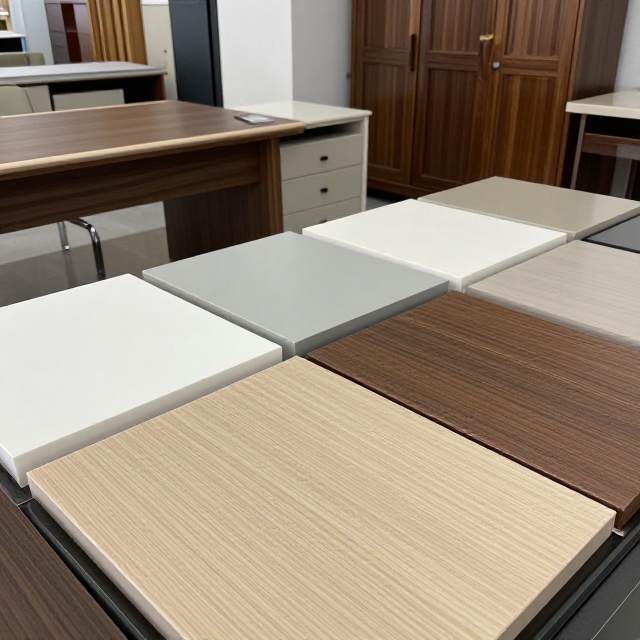
HPL, Melamine or Wood Veneer for Hotel Casegoods: How to Choose and What It Costs Over Time
The short answer: put HPL on high-traffic horizontal surfaces (desk tops, luggage rack tops, minibar counters) where cleaning crews and luggage corners do the damage, use melamine-faced board on vertical, low-impact surfaces when the budget is doing the deciding, and specify real wood veneer only where the design intent or the tier of the property justifies a refinishing cycle. Most hotel FF&E schedules end up using all three. The mistake is choosing by appearance before choosing by zone.
These are three different materials with three different failure modes, and the conversation usually collapses them into one question: which one is better. It is the wrong question for a FF&E schedule, because a guestroom is not one surface. The desk top and the headboard wall take completely different abuse, and a single material choice applied across the room is where projects overspend on one side and underperform on the other.
What follows is the zone-by-zone recommendation first, then what each material actually is, the two measurements buyers rarely ask for and should, the moisture behaviour that decides bathroom and minibar failures, the lifecycle cost logic without invented price tables, the fire and emissions questions that actually bind, and the specification and supplier questions that keep a factory honest.
Short answer: the zone-by-zone recommendation
Supplier guides and design teams converge on the same two-axis logic, and it holds up in practice: sort every surface by contact frequency against visual priority. High contact and low visual weight is where laminate earns its place. Low contact and high visual weight is where veneer earns its cost. The difficult surfaces are the ones that are both, which is why the nightstand top is the most argued-over line in most schedules.
| Zone or component | What it takes | Where the surface usually lands | What to pin down in the spec |
|---|---|---|---|
| Desk worktop | Laptops, keys, cleaning chemicals, hot cups | HPL | Grade, edge detail, sealed cable ports |
| Luggage rack top | Wheels, metal corners, repeated impact | HPL, or compact laminate | Impact and edge chipping, replaceability |
| Minibar and coffee station | Water, spills, appliance heat | HPL | Seams, backsplash joint, core moisture rating |
| Wardrobe doors and fronts | Low contact, large visual area | Melamine-faced board on budget, veneer on midscale and up | Decor code, banding, gloss match across doors |
| Nightstand top | Visual and tactile, plus beverage risk | HPL, or veneer with a tested finish | Approved golden sample, stain and heat test |
| Headboard wall | Large focal surface, light contact | Veneer | Species, cut, match, sequence, finish sheen |
| Bathroom vanity top | Sustained moisture, standing water | HPL or a sealed solid surface | Edge sealing, substrate rating, no veneer |
| Corridor and lobby paneling | Cart strikes, cleaning trolleys, visual exposure | HPL or veneer by tier | Impact detail at trolley height, joint alignment |
| Casegood carcasses, shelves, interiors | Hidden or low impact | Melamine-faced board | Board grade, emission class, all-edge banding |
Read down the third column and the pattern is obvious: the material is following the zone, not the star rating. An economy property can run a defensible schedule almost entirely on HPL and melamine-faced board with veneer on the headboard wall only. A luxury property can keep HPL on the desk top without anyone noticing, as long as the visible vertical surfaces and the focal wall carry the wood. What reads as cheap is never the laminate. It is a mismatch: a veneer wall next to a high-gloss laminate edge, or a printed grain that changes direction between the wardrobe and the nightstand.
What each material actually is
HPL: high-pressure decorative laminate
HPL is manufactured by hot-pressing layers of resin-impregnated kraft paper under a decorative paper and a wear overlay, at pressure. HPL is defined by its manufacturing process and performance requirements under standards such as ISO 4586; avoid using a single pressure figure as the practical dividing line between HPL and other decorative panels. The resulting sheet is then bonded to a substrate, usually MDF or plywood, to make a panel. It arrives as a thin decorative sheet for post-forming or flat-bonding, and also as compact self-supporting board for tops, partitions and lockers where no substrate is wanted.
Because it is a manufactured product with a fixed specification, its performance is described in standards rather than in adjectives. The ISO 4586 series is the main international reference for HPL. ISO 4586-3:2018 covers classification and specifications for HPL sheets less than 2 mm intended for bonding to supporting substrates, while ISO 4586-2 specifies the relevant test methods. Suppliers also cite ANSI/NEMA LD 3, the older North American publication; standards listings show the 2005 edition has been rescinded, so when a factory sends a test report, the useful question is not “is it certified” but “which standard, which edition, and which properties”.
Two practical consequences follow. First, batch consistency is a genuine strength: the same decor code produces the same surface across every room in a 300-key order, which is exactly what a chain standard needs. Second, deep damage cannot be sanded out. A gouged laminate panel is a replacement panel, which is why spare panel stock belongs in the purchase order rather than in a later negotiation.
Melamine-faced board: the budget surface that gets confused with HPL
Melamine in furniture is a different process. Decorative paper impregnated with melamine resin is fused directly onto the board during manufacture, so the surface becomes part of the panel rather than a separate sheet bonded to it. Panel makers describe it as a melamine laminate board, and the category is widely known as thermally fused laminate. The face is hard, smooth, easy to wipe and available in the same woodgrain and solid decors as laminate, which is why the two get mixed up in quotations.
The difference shows up in how much punishment the surface takes. Board makers state the intended application themselves: melamine decors are recommended for vertical and low-impact horizontal applications. Their own abrasion figures make the same point. One major panel producer publishes Taber abrasion results to UNE 7265 of a minimum of 500 cycles for solid colours and a minimum of 150 cycles for printed decors, where the test ends when the printed design wears through. Those numbers are not comparable to a high-pressure laminate, and they are not meant to be: melamine-faced board wins on fabrication cost and speed, not on wear.
So melamine is not a cheap HPL. It is the right material for carcass interiors, shelf boxes, wardrobe fronts in economy stock and any vertical panel that will be looked at more than touched. The failure mode that matters for it is not the face. It is the edge, which is covered later in this article.
Wood veneer: a real material with a specification attached
Veneer is a thin slice of real hardwood bonded to a substrate and protected by a finish system. It keeps the grain, the variation and the warmth of solid timber at a fraction of the weight and material cost, and it is the only one of the three that cannot be reproduced identically from panel to panel. That last property is the whole reason veneer needs a specification, and why the vocabulary of architectural woodwork exists.
The standards body that writes these specifications, the Architectural Woodwork Institute, defines the decisions a designer has to make in the schedule: species of veneer, method of slicing (plain, quarter, rift or rotary), matching of the leaves (book, slip or random), matching between doors, drawers and adjacent panels (non-sequenced, sequenced or blueprint), and grain direction. ANSI/AWI 0642 uses Premium, Custom and Economy aesthetic grades for wood paneling and sets different levels of control over materials, workmanship and appearance. Its veneer requirements also address sequencing and panel matching. Note that ANSI/AWI 0642 for wood paneling covers wood veneer applied to core materials and decorative laminate clad panels in the same document: the grading discipline applies to both, which is a useful argument when a project wants a mixed schedule without a mixed standard of appearance.
On thickness, the frequently repeated rule that five-star hotels require veneer above a fixed thickness has no basis in the AWI standards. The useful procurement point is not a universal hotel veneer thickness. Veneer requirements depend on the specified panel construction, grade, matching and finish system, so the RFQ should lock those details rather than rely on a single thickness rule.
Why solid wood keeps entering the conversation
Solid wood appears in bed frames, legs, edge profiles and decorative details, and it is rarely the face of a large casegood panel. It moves with humidity, it is heavy enough to affect freight and installation, and on a big wardrobe front it costs materially more than veneer over the same substrate for no additional visual gain at viewing distance. When a comparison chart puts solid wood next to HPL as if they were alternatives for the same surface, it is comparing a structural and tactile choice with a surfacing choice.
The two measurements buyers never ask for
Almost every comparison table in this category runs on stars and adjectives: scratch resistant, excellent, premium. Two families of measurement cut through that, and a buyer who asks for them gets an entirely different quotation back.
Abrasion: which test, on which material
The first trap is mixing up textile abrasion tests with hard-surface tests. Wyzenbeek and Martindale are used for upholstery fabrics, while hard decorative surfaces use different test methods. A buyer should therefore never compare an abrasion number unless the test method, unit and material are stated beside it.
For a hard decorative surface, the Taber machine is the right instrument, and it appears in standards written for exactly this job: AS/NZS 4266.20 covers abrasion of decorative surfaces on low-pressure overlaid particleboard and MDF, and ASTM D4060 covers organic coatings. HPL performance is specified and tested through the applicable ISO 4586 requirements; a supplier may also provide test results against a North American laminate standard, but the standard and edition should be stated explicitly. Melamine-faced board is described on the panel datasheet, Taber cycles included. Veneer has no single abrasion rating, because its durability lives in the finish build rather than in the face material.
The buying move is simple: ask each bidder to name the test method next to the number. A quotation that says “abrasion resistant, 40,000 cycles” without a method is telling you nothing, because 40,000 Martindale cycles on a fabric and 40,000 Taber cycles on a coating are not the same fact.
Impact, chipping and the edge
Hotel damage is rarely a flat-surface problem. It is luggage corners against a desk edge, a service trolley against a panel at 900 mm, a door handle against a wardrobe stile, a vacuum cleaner against a nightstand corner. The edge of the panel is where all three materials are weakest, and it is where the specification decides the outcome rather than the surface choice.
HPL handles impact well on the face but needs an edge detail: a wrapped or post-formed edge with a correct back-bevel, or a matched banding. Melamine-faced board is typically finished with matching PVC or ABS edge banding, and the datasheet advice from panel makers is explicit: protect the edges from moisture with PVC, ABS, melamine banding or moulding on all edges of the piece. Veneer edges chip and absorb moisture if they are not detailed, and a chipped veneer corner cannot be wiped away like a mark on laminate. ISO 4586-2 includes impact test methods for HPL, including ball-impact tests. For melamine-faced board and veneer, the relevant performance evidence depends more heavily on the specified panel construction, edge treatment and finish system.
What the numbers do not tell you
Three variables move real-world results more than the headline figure does. The first is gloss: a dark high-gloss surface shows every fine scratch that a medium-gloss or textured surface hides, so a “less durable” spec can look better at month 24. The second is cleaning chemistry: hotel housekeeping is not residential cleaning, and aggressive chemicals will attack a film finish long before they attack a resin face. The third is the edge and joint detail, covered in the moisture section below, because most field failures arrive there rather than in the middle of the panel.
Durability in the room: abrasion, scratch and heat
On a desk top, HPL behaves predictably: it resists the daily abrasion of laptops and keys, it takes most commercial cleaning agents, and it holds its decor code across a large order. It will still scratch, and a scratched dark gloss will show it, which is why patterned and medium-gloss decors are the practical choice on heavy-use horizontals. On the same desk top, a film-finish veneer will take the abuse too, for a while, until the finish wears thin at the hand position and the wood underneath starts to take marks it cannot be wiped off.
Heat behaves the same way in relative terms. Laminate faces tolerate short contact with cups and small appliances. Veneer finish systems mark more easily under hot objects, and the fix is either a detail (a stone or metal insert under the coffee station, a coaster zone in the spec) or a different material for that surface. Melamine handles dry heat adequately for a cabinet interior and for a wardrobe front, which is not the same as a claim about a hot cup on a nightstand.
Repairability is where the ranking inverts. Laminate damage means panel replacement: the surface cannot be sanded and refinished, which is a supply-chain problem rather than a material defect, and it is solved by holding spare panels for the decor codes in the building. Veneer can be sanded and refinished, repeatedly, by someone who can colour match, which is a real maintenance advantage in a property with a carpenter and a downtime tolerance. Melamine damage on a face is usually terminal for that component, while damage on a carcass is invisible. The honest summary is that the cheapest surface to buy has the cheapest replacement, and the most expensive one is the only one that can be renewed in place.
None of this becomes a lifecycle answer until the cleaning regime and the refurbishment cadence of the specific property are on the table, which is the next section.
Moisture and edge behaviour: where melamine fails first
This is the section that no comparison page leads with, and it is the one that generates the angry phone call after the first year of operation. The face of a melamine panel is close to impervious to water. The core is not, and the edge is where water gets in.
The mechanism is ordinary: an unsealed or poorly sealed edge, an unsealed cable port, a screw hole left open, a joint that sits under a running tap. Water reaches the board core, the core swells, the banding lifts, and the damage is permanent. Panel makers publish the number that describes this: 24-hour thickness swelling to EN 317, listed on the datasheet by thickness. Published 24-hour thickness-swelling values vary significantly by board type, thickness and moisture-resistant grade. Ask the factory for the EN 317 result for the exact board being quoted rather than applying a generic swelling percentage to all melamine-faced panels. The board does not care how good the printed grain looks; it swells from the inside where the water entered.
The same datasheets carry the handling advice that follows from those numbers: protect the edges with banding or moulding on all edges, and use moisture-resistant board grades for humid areas. In a guestroom that translates directly into four spec lines. The vanity top is not melamine and not veneer. The minibar and coffee station top gets a sealed edge detail and a substrate rated for the exposure. The cable port and grommet on the desk top get sealed at fabrication, not left as an open bore. And the wardrobe in a property with a steam-heavy bathroom next door gets the moisture-resistant core.
HPL behaves better here because the face is a dense non-porous resin layer, and because the fabrication details that protect it are standard: wrapped edges, sealed ports, tight backsplash joints. It is still a bonded panel, and a water path to the core is still a water path to the core, so the edge discipline does not disappear just because the face is laminate.
Veneer is the most exposed of the three. Moisture at an edge or a joint raises the grain and can delaminate the face, and a sustained-wet environment will defeat even a good finish. The practical rule for a FF&E schedule is short: veneer stays out of wet zones, out of vanity tops and out of any surface below a splash line. Where veneer appears near a wet area, the carcass stays dry, the edges are sealed, and housekeeping instructions rule out standing water. Wood is also hygroscopic in service, so a veneered panel in a room with wide humidity swings needs the same joinery and finish thinking that solid timber needs.
For procurement the takeaway is a testable one. Ask each bidder which board grade they are using, what its 24-hour swelling value is, and how the edges are finished. Those three answers predict the warranty claims better than any surface comparison.
Full-cycle cost: purchase price versus replacement cycle
A unit-price comparison of these three materials is close to meaningless, and not only because published prices per square metre come from suppliers marketing their own product. A surface price excludes the parts that decide the total: fabrication labour, matching and waste, finishing passes, edge treatment, freight, and what happens in years three through ten.
The cost drivers split cleanly by material.
On the other side of the ledger sits the cycle: how often a surface is touched up, refinished or replaced, how many spare panels are held, and how many room-nights are lost while a desk is out of service. Here the comparison must be run on the property’s own numbers, because the maintenance regime is the variable. A property with a fast housekeeping cycle, aggressive chemistry and a refurbishment plan will weight the decision one way; a boutique operation with a carpenter on staff and a tolerance for sanding and refinishing will weight it the other way.
Two rules for building the model. First, disclose the denominator. Supplier guides make this point about their own value-engineering claims, and it is right: a saving expressed as a percentage of the surface package is a different fact from the same saving expressed as a percentage of the FF&E budget, which is different again from the development budget. Any percentage you are shown should arrive with the base scope attached. Second, compare only identical bills of materials. Three quotations that differ in substrate, edge detail, finish build and sample basis are not three prices for the same thing, and the cheapest of them is often the one with the thinnest specification behind it.
Where a mixed schedule is the answer, and it usually is, the hybrid approach allocates material by zone rather than by room grade: laminate where the contact is, veneer where the eye is, melamine where neither is. The saving is then a function of how much of the package was veneer to begin with, which is why it cannot be quoted as a blanket figure.
Fire and formaldehyde: what actually applies
Two separate requirements live under this heading, they bind different things, and mixing them up wastes a month of submittals.
Formaldehyde: it is a core question, not a surface question
Panel cores are bonded with formaldehyde-based resins, so the emission class attaches to the board, and a veneered panel inherits the class of its substrate just as a laminated one does. E1 is a commonly specified European emission class, but the applicable test method and limit depend on the board standard and product type. Ask the factory to state the exact emission class, test method, test report and board manufacturer rather than accepting “E1” as a standalone claim.
For goods entering the United States, the requirement is federal. EPA’s composite wood product rules under TSCA Title VI set emission standards identical to California’s CARB Phase 2, and the agency publishes the numbers: 0.09 ppm for particleboard, 0.11 ppm for MDF, 0.13 ppm for thin MDF, and 0.05 ppm for hardwood plywood, whether veneer core or composite core. For US-bound goods, TSCA Title VI establishes formaldehyde emission requirements for regulated composite wood products and finished goods containing them, with third-party certification, labeling and documentation requirements. Ask the supplier for the applicable TSCA Title VI compliance evidence and EPA-recognized third-party certifier information.
So the two questions to put in the RFQ are: which emission class, by which test method, and for US-bound scope, which third-party certification number. A quotation that answers “E1” without a method has not answered yet.
Fire: ask for the classification of the actual build-up
Reaction-to-fire classification depends on the exact wood-based panel, thickness, density, construction and installation conditions. EN 13986 provides the framework for wood-based panels, but a project should not assume a fire classification from the melamine décor alone. Ask the factory for the classification and test evidence for the exact build-up being offered. What a project is required to meet comes from the brand standard, the local authority and the owner, so the useful spec line is not a wish for “fire rated”. It is: state the required classification, ask the factory to quote the classification for the exact build-up being offered, and attach the test report for that build-up.
Upholstery is a different regime again, and it matters wherever the FF&E schedule contains seating, banquettes or padded elements. TB 117-2013 is California’s smolder-resistance standard for materials used in upholstered furniture: cover fabrics, barrier or interliner materials, resilient filling and decking, tested to a method based on ASTM E1353. The U.S. Consumer Product Safety Commission’s mandatory upholstered-furniture flammability standard incorporates TB 117-2013. It applies to covered upholstered furniture manufactured, imported or reupholstered on or after June 25, 2021, with the federal labeling requirement taking effect June 25, 2022. If your project scope includes upholstered pieces going to a US-market property, the flammability clause and the test standard belong on those lines by name, next to the fabric code.
What to write in your RFQ specification
A finish described as “walnut look” is a description. A finish line that names the material, the grade, the standard, the sheen and the sample it was approved against is a specification, and only one of the two can be enforced when a substitution arrives. Surface material belongs in the schedule line by line, not in an appendix, and the boundary of what is included belongs where scope is agreed: a surface that is not named in the RFQ scope and exclusions is a surface that will be value-engineered by default.
What goes in, per material:
- All three: substrate type and thickness, emission class with test method, edge treatment, gloss or texture reference, approved golden sample with an ID, cleaning and care instructions, and a no-substitution clause with a notification duty.
- HPL: decor code and grade, the standard and edition behind any test claim (ISO 4586 or the applicable regional standard), the substrate, substrate preparation and bonding method, the edge detail (post-formed, wrapped or banded, with back-bevel), and sealed cable ports.
- Melamine-faced board: board grade, standard or moisture-resistant, decor and texture code, the abrasion result with its method and unit, edge band material and thickness, and banding on all edges.
- Veneer: species, cut method, leaf match, panel match and sequence, flitch registration, colour range against the approved sample, finish system with sheen, touch-up protocol, and spare flitch or panel stock.
Which document carries these lines depends on how the package is being bought: on a bill of quantities the material line sits against the item, while an RFQ carries it in the specification section and the exclusions make the rest explicit. The two routes are covered in the BOQ versus RFQ comparison for hotel FF&E, and the scope discipline that stops surfaces drifting out of the package is set out in how to write hotel FF&E scope and exclusions.
One approval detail earns its cost every time: a golden sample per zone that includes both materials where they meet. A veneer wall with an adjacent laminate shelf should be approved as one panel showing the transition, under the actual room lighting. Samples approved separately, under showroom light, are how two finishes that matched on paper arrive mismatched on site.
Supplier questions that expose a substitution
Substitution in this category is rarely dramatic. It is a board changed to a cheaper grade, a decor code that is close rather than identical, a species that reads the same in a photograph, or a finish system with one fewer coat. The questions below are the ones that surface the difference before production starts rather than at handover.
- Which board manufacturer and grade, by name, and what is its 24-hour swelling value and emission class with the test method?
- For laminate surfaces, which standard and edition does the test report refer to, and which properties does it cover?
- For melamine surfaces, what is the abrasion result, by which method, in which unit, and is the core standard or moisture-resistant?
- For veneer, what is the species, the cut and the match, and do you lock the flitch for this order?
- What is the edge band material and thickness, and is it applied on all edges?
- What is the finish system: how many coats, what sheen, and was it tested for adhesion, staining and heat on the approved veneer assembly?
- Can we see first-article panels before the run, including the transition detail between two materials?
- If a decor or a species is discontinued mid-order, what happens, and how much notice do we get?
- How many spare panels per decor code are quoted, and at what price, fixed for the order?
- What in your construction changes if we reject the first article?
The third question on that list ends most negotiations, because a factory that has not measured the abrasion of its melamine face will answer with an adjective. The verification steps themselves, what to look at during production and how first articles are approved, sit in the hotel furniture manufacturing process guide.
When custom is worth specifying
Custom work in this context means veneer selection and matching beyond a standard range, shaped or curved components, integrated details, and finish samples developed for a brand. It is worth specifying when the surface is a focal point the guest stands in front of, when the brand standard names a species, or when the geometry of the piece has no catalogue equivalent. It is not worth specifying on the inside of a wardrobe box or on a shelf that carries a safe.
The allocation question is therefore a budget question with a design answer attached: how much of the visible area in the building must be real wood, and what does the rest look like when it sits beside it. Getting that answer in writing before the RFQ goes out is cheaper than resolving it during submittals, and the manufacturing side of the decision, what a factory needs from you to build custom work without guesswork, is set out in the custom hotel furniture manufacturing and factory-direct sourcing guide.
Then approve it in the conditions it will be judged in. A mock-up room or a first-article panel viewed under the property’s actual lighting, with both materials present, settles gloss, grain scale and joint alignment in one meeting. Those three variables are what make a mixed schedule look deliberate or look improvised.
Questions buyers ask next
Is HPL the same thing as melamine?
No. HPL is a separate sheet pressed at high pressure from many resin-impregnated layers and then bonded to a substrate. Melamine-faced board is decorative paper fused onto the panel during the board’s own manufacture, making the surface part of the panel. They can look similar in a decor book, but they are manufactured differently and should not be treated as interchangeable specifications. The appropriate choice depends on the required performance, construction and application.
Which is cheaper, HPL or melamine?
Melamine-faced board is consistently the lower-cost option to buy and to fabricate, and HPL costs more for the face and the edge work while still being standardised to produce. Compare quotations only on identical bills of materials: substrate, edge detail, finish build and approved sample basis. The cheapest quotation is frequently the one with the least specification behind it.
Can wood veneer be used on a bathroom vanity?
Not on the top or anywhere water can stand. Veneer edges and joints take up moisture, which raises the grain and can delaminate the face. Veneer is reasonable on dry-zone cabinetry with sealed edges and a housekeeping rule against standing water. Vanity tops belong to HPL, solid surface or stone.
Does HPL look fake next to real wood?
Modern textured and synchronized-embossed decors read convincingly at viewing distance, and on a large vertical panel most guests will not identify the material. Where the design intent depends on grain variation and touch, that is a reason to place veneer on the focal surfaces and let laminate carry the working ones. The mismatch between the two, at a joint or in gloss, is what looks cheap rather than either material on its own.
How long will these surfaces last?
There is no single number, and any figure quoted without the cleaning regime, the gloss level, the edge detail and the maintenance cadence attached to it is marketing. What can be said more reliably is that laminate and melamine faces are generally replaced rather than refinished, while properly constructed and finished veneer can often be repaired or refinished. The actual lifecycle depends on the finish, construction, maintenance regime and availability of replacement parts. The lifecycle question is decided by your housekeeping chemistry and your refurbishment plan more than by the material.
What is the difference between Taber and Wyzenbeek numbers?
They measure different things on different materials. Wyzenbeek and Martindale are textile abrasion methods used for upholstery fabrics, published as guidelines by the Association for Contract Textiles, which also states that results do not reliably predict fabric lifespan and that the two methods do not correlate with each other. Taber is a rotary abrasion method used for hard surfaces and coatings, including decorative surfaces on wood-based panels. A number without a method named beside it cannot be compared with anything.
Do I need fire-rated panels?
You need whatever classification the brand standard, the local authority and the owner require for that location, stated for the assembled panel. Ask the factory to quote the classification of the actual build-up being offered and to attach the test report. Where the scope includes upholstered pieces for a US-market property, TB 117-2013 applies to those components, with the test standard named in the specification.
What emission class should I specify?
Specify the class together with the test method, on the core board. E1 by EN 120 or the EN ISO 12460 series is the common European answer. For US-bound goods, TSCA Title VI and CARB Phase 2 certification is required for composite wood products, with published limits by product type and third-party certification numbers on the panels. Ask the question of the substrate, because a veneered or laminated face does not change what the core emits.
The surface decision is really a zone decision with a cost model behind it. Sort the room by contact and by visual weight, write each zone into the RFQ with its material, grade, standard and sample, and make the factory answer for the board under the finish rather than the picture of it. The schedule that follows those rules survives its first refurbishment cycle without a change order.