
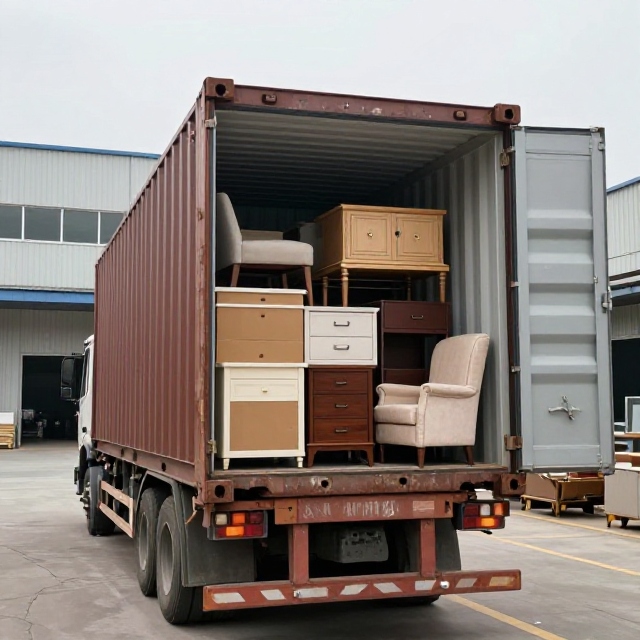
Shipping a 40ft Container of Hotel Furniture from China to Gulf Ports: How the Cost Is Built
Quick answer: there is no single “40ft container price” from Foshan to the Gulf. The number you pay is the sum of five separate cost blocks: origin charges in China, ocean freight, destination port charges, customs duty and VAT, and the risk costs created by timing, damage or documentation errors. Hotel furniture makes the calculation harder than general cargo because it is bulky, mixed, partly assembled and often needed on a fixed installation date. The only reliable way to budget is to price those five blocks separately, using a dated forwarder quote and your own packing list — not a per-container figure copied from a marketplace listing.
This guide is written for the buyer or project manager shipping a hotel FF&E package from Foshan, Guangzhou or Shenzhen into Jebel Ali, Jeddah, Dammam, Hamad, Shuwaikh, Sohar or another Gulf port. It explains what drives the cost, what to put in a freight enquiry, how to compare quotes like a procurement professional, and where hotel furniture behaves differently from palletised goods. It does not publish freight rates, because rates move weekly and any number quoted without a date, a route and a cargo description is fiction.
Conformity paperwork is a separate subject. If your destination is Saudi Arabia, the SABER and SASO requirements are covered in the SASO and GCC conformity guide for furniture imports. This article deals with the freight, port, tax and delivery cost of the container itself.
Key takeaways
- Cost is built from five blocks, not one rate: origin, ocean, destination, duty/VAT, and risk. A quote that shows only “freight” is incomplete.
- Hotel furniture is usually volume-limited, not weight-limited. A 40ft high cube holds roughly 76 m³ in theory; cartons, pallets and loading access mean you should plan on less usable volume.
- Chargeable volume is not the same as container volume. For LCL, carriers charge by volume or weight, whichever produces the greater revenue; confirm the conversion with your forwarder.
- Saudi Arabia and the UAE tax imports differently. Saudi VAT is 15% on the customs value plus duty; UAE VAT is 5%. Duty depends on the tariff line, not on the word “furniture”.
- Free time is a contract term, not a favour. Demurrage and detention start when the clock runs out, and hotel furniture is vulnerable because clearance depends on conformity documents as well as freight documents.
- Do not plan installation from a generic transit time. Ask for port-to-port and door-to-door schedules separately, then add clearance and site delivery.
Why a 40ft container of hotel furniture is not a simple freight calculation
A container of guestroom furniture looks like one shipment on a packing list. In cost terms it is several different problems travelling together.
- It is bulky and irregular. Wardrobes, headboards, vanities, desks and lounge chairs do not nest neatly. Carton dimensions, not the number of pieces, determine how many containers you need.
- It is mixed. One container may hold wooden casegoods, upholstered seating, mattresses, lamps and metal accessories. Those lines can sit under different HS codes, different duty rates and different conformity routes.
- It is fragile at the edges. Powder-coated frames, veneered panels, mirror glass and polished metal are damaged by movement, moisture and poor loading. Packaging and loading quality show up later as replacement cost, not as freight cost.
- It is schedule-critical. Furniture arriving after the fit-out contractor has demobilised creates storage, re-handling and labour cost that no freight quote includes.
- It may be partly assembled. Knock-down construction reduces volume and damage risk but adds site assembly. Assembled furniture protects factory quality but consumes container space. That is a design and procurement decision with a freight consequence.
The practical consequence is that the cheapest freight quote can produce the most expensive project. A forwarder who quotes a low ocean rate but allows only a short free period, or who consolidates your furniture with unrelated cargo, is not necessarily cheaper once demurrage, damage and re-delivery are counted.
First, choose the container: 20GP, 40GP or 40HC
For hotel furniture, the choice is usually between a 20ft standard container (20GP), a 40ft standard (40GP) and a 40ft high cube (40HC). The high cube matters because furniture is tall: headboards, wardrobes and assembled chairs benefit from the extra internal height. The table below gives typical ISO-series figures. Treat them as planning values only; the CSC plate on the actual container governs payload, and road weight limits at origin and destination can be lower than the container rating.
| Container | Typical internal volume | Typical maximum payload | Best use for hotel furniture | Main constraint |
|---|---|---|---|---|
| 20ft standard (20GP) | About 33 m³ | About 28,000 kg | Small guestroom package, samples, phased delivery, heavy stone or tile | Floor area runs out before weight does on bulky furniture |
| 40ft standard (40GP) | About 67 m³ | About 28,000–28,800 kg | Full guestroom or public-area package where height is not critical | Tall items may not stand upright |
| 40ft high cube (40HC) | About 76 m³ | About 28,600 kg | Wardrobes, headboards, tall casegoods, mixed FF&E | Still limited by door opening and carton shape |
Do not plan against the theoretical volume. Loading access, pallet footprints, carton stacking limits and the need to protect finishes typically reduce usable volume. A realistic loading plan is produced from carton dimensions and a container loading diagram, not from dividing total CBM by 76. If your supplier has not produced a loading plan, ask for one before you approve the freight booking.
The five cost blocks you must price separately
Every container shipment can be decomposed into the same five blocks. Keeping them separate does two things: it shows you where the money actually goes, and it prevents a forwarder from hiding a margin inside an “all-in” number.
| Cost block | What sits inside it | Who usually quotes it | What to confirm in writing |
|---|---|---|---|
| 1. Origin charges in China | Pickup or factory loading, inland trucking to port, export customs declaration, terminal handling, documentation, CO or certificate of origin, wood packaging treatment where required | Factory, origin forwarder or sourcing partner | Whether the quote is ex-works, FOB or includes origin charges; whether trucking is from Foshan or from a consolidation warehouse |
| 2. Ocean freight | Base sea freight, bunker and currency surcharges, carrier security fees, peak-season surcharges where applicable | Freight forwarder or NVOCC | Validity date, surcharges included, port pair, direct or transhipment service |
| 3. Destination charges | Terminal handling, port dues, documentation, release fees, customs broker, inspection or scanning if selected, delivery order | Destination forwarder or broker | Whether charges are paid at destination or prepaid; what is included in the delivery order |
| 4. Customs duty and VAT | Duty by tariff line, import VAT, customs service fees, any anti-dumping or safeguard measure that applies | Broker or importer of record | HS code per line, customs value basis (CIF), duty rate, VAT rate, whether the importer can recover VAT |
| 5. Risk and time costs | Demurrage, detention, storage, re-delivery, damage, replacement production, site waiting, currency movement, financing | Nobody quotes these until they happen | Free days at destination, who pays if clearance slips, insurance cover and exclusions, replacement lead time |
Block five is the one buyers underestimate. It is also the block a sourcing and coordination partner can influence most, because it is created by sequencing, documentation and inspection — not by the carrier. Customs value is built from the goods price plus international freight and insurance, with adjustments for certain origin costs where they are not already included in the price; demurrage, detention, destination storage, damage and financing are commercial costs and are not part of the CIF declaration.
What drives the ocean freight number
Ocean freight is a market price, not a cost-plus calculation. Two buyers shipping identical containers on the same route in the same week can pay different amounts because of contract status, booking timing, carrier allocation and the surcharges in force. The variables that matter most are:
- Port pair. Nansha, Shekou and Yantian are common South China load ports. Jebel Ali, Jeddah, Dammam, Hamad, Shuwaikh, Sohar and Salalah are common Gulf discharge ports. A “China to Gulf” rate is not specific enough to compare.
- Service type. Direct service versus transhipment changes transit time and the number of handlings. Transhipment is not automatically worse, but it adds a failure point.
- Equipment. A 40HC is not priced the same as a 40GP, and equipment availability can differ by port and season.
- Surcharges. Bunker adjustment, currency adjustment, peak-season surcharge, carrier security and low-sulphur charges may be separate. Ask which are included and which are “subject to change”.
- Contract versus spot. A forwarder with an allocated contract rate may be cheaper and more stable than a spot booking, but the allocation may not cover your equipment type or sailing.
- Booking timing. Rates and space tighten near peak periods. A quote issued for a sailing three months away is an estimate, not a commitment.
This is why a responsible freight quote carries a validity date and a list of exclusions. If a quote has neither, treat it as an indicator and budget a contingency rather than treating it as a fixed cost.
FCL or LCL? The answer for hotel furniture is usually FCL
Full container load (FCL) means your cargo occupies the whole container. Less than container load (LCL) means it shares a container with other shippers’ cargo and is consolidated at a warehouse.
| Factor | FCL | LCL |
|---|---|---|
| Cost basis | Per container, plus origin and destination charges | Per cubic metre or per tonne, whichever is greater; plus consolidation and deconsolidation fees |
| Damage exposure | Your cargo is loaded once and not mixed | Multiple handlings and shared space increase scratch and crush risk |
| Clearance | One bill of lading, one consignment | Co-loaded consignments can be held by another shipper’s documentation problem |
| Timing | Sailing depends on your booking | Depends on consolidation cut-off and co-loader schedule |
| Best for | Full guestroom packages, phased project deliveries, mixed FF&E | Samples, spares, small loose furniture orders, early-project mock-up items |
LCL is not wrong for every hotel order. It can be sensible for a mock-up room, a replacement batch or a small loose-furniture buy. The mistake is using LCL for a full floor of guestrooms because the per-cubic-metre rate looked lower than a container rate. Once damage, delay and deconsolidation are counted, the comparison often reverses.
If you do use LCL, ask for the volumetric conversion the forwarder applies. The common convention is one cubic metre equals 1,000 kg, but the exact factor and minimum charge vary by co-loader and trade lane. Confirm it before you compare quotes.
The Foshan and Guangzhou origin side
Foshan is a manufacturing base, not a deep-sea port. Furniture produced in Foshan usually moves by truck or barge to a South China load port, or to a consolidation warehouse, before ocean loading. That inland leg is part of your cost and part of your damage risk.
Questions to settle at origin:
- Factory gate or warehouse? Is the forwarder collecting from each factory, or are suppliers delivering to a consolidation warehouse? Multi-factory pickup adds trucking and coordination but reduces the risk of one factory missing the cut-off.
- Who loads the container? Factory loading is normal, but a loading plan and photo record are not. Ask for pre-loading carton counts, container number, seal number and photos at each stage.
- Export declaration. The exporter named on the customs declaration must match the seller and the invoice. If a trading company or sourcing partner exports, the documentation chain must be consistent.
- Wood packaging. Solid wood packaging must meet ISPM 15 and carry the mark. Plywood crates are common for furniture and are treated differently from solid wood; confirm what your supplier actually uses.
- Origin charges. THC, documentation, customs, trucking and any certificate of origin fees should be itemised. “FOB all-in” can still exclude some origin costs.
For a project package, the origin sequence is usually: factory completion and pre-shipment inspection, carton labelling, trucking to the load port or warehouse, export declaration, container loading, seal, VGM submission, then sailing. Each step has a cost and a failure mode. The cheapest origin quote often removes the inspection or the photo record, which is exactly where damage and short-shipment disputes are won or lost.
The Gulf destination side
Destination cost depends on the port, the importer’s registration, the broker and the mode of onward delivery. The main Gulf gateways for hotel projects include:
- UAE: Jebel Ali is one of the region’s largest container gateways and a common re-export point; Khalifa Port and Sharjah also handle container and project cargo. Onward delivery to Dubai, Abu Dhabi and the northern emirates is by road.
- Saudi Arabia: Jeddah (Red Sea), Dammam (Arabian Gulf) and the Riyadh dry port are the usual entries. A container discharged in the UAE and trucked into Saudi Arabia is a second customs entry, not a domestic delivery.
- Qatar, Kuwait, Bahrain and Oman: Hamad, Shuwaikh, Khalifa Bin Salman and Sohar/Salalah are the common ports. Each has its own broker requirements, free time and delivery constraints.
Two destination costs are routinely missed. The first is delivery order and release fees, which are charged even when the ocean freight is prepaid. The second is onward delivery access: a 40ft container may not fit the site entrance, may need a smaller vehicle, or may require offloading by forklift at a warehouse rather than at the building. Hotel sites in city centres often cannot accept a 40ft trailer. That transfer cost belongs in the budget, not in the “local delivery” line of a forwarder quote.
Customs duty and VAT: the part that is arithmetic
Duty is assessed on the customs value, which is normally the CIF value: goods plus international freight plus insurance to the port of import. The rate depends on the tariff line, not on a broad product description. Furniture lines in Chapter 94 of the harmonised system can carry different rates, and a mixed container may contain several lines.
| Destination | Duty basis | VAT | What else affects the number |
|---|---|---|---|
| Saudi Arabia | GCC common external tariff applied to CIF; many lines at 5%, but exceptions and higher rates exist | 15% on the customs value plus duty and other taxable charges | SABER shipment certificate for the consignment; conformity route per HS line; customs service fees; possible inspection |
| UAE | GCC common external tariff applied to CIF; rate depends on the tariff line | 5% | ECAS or other conformity requirements where the product is regulated; broker and port charges |
| Other GCC states | GCC common external tariff in principle, with national exceptions | Varies by state | Local registration, broker requirements and port practice |
A simple budgeting identity, using Saudi Arabia as the example:
Customs value (CIF) = goods value + international freight + insurance.
Duty = CIF × the rate for the tariff line.
Import VAT = 15% × (CIF + duty + other taxable charges).
Simplified VAT example — illustration only, not a quotation and not a market rate. If CIF were $100,000 and the applicable duty rate were, for the sake of arithmetic, 5%, duty would be $5,000 and Saudi VAT would be 15% of $105,000, or $15,750. The cash outlay at clearance would be $120,750 before broker, port and delivery charges. Some customs service fees and other dutiable charges can also enter the taxable base, so treat this as a minimum calculation rather than a final assessment. The 5% is an assumption used to show the method, not a statement of the Saudi rate for this product; confirm the actual rate for each tariff line with the broker. A VAT-registered importer may be able to recover the import VAT, depending on its own tax position; that is a question for the importer’s finance team, not for the forwarder.
Do not assume a 5% rate for every furniture line. Confirm the tariff line with the importer’s broker, check the current schedule published by the destination customs authority, and make sure the same HS code appears on the invoice, packing list, certificate of origin and conformity file. A classification change after the goods arrive is one of the most expensive mistakes in the whole shipment.
How to build a container budget you can defend
Use a line-item budget rather than a single “shipping” allowance. The table below is the structure; the numbers come from your forwarder, broker and supplier. Leave the risk lines in even if you expect them to be zero.
| Budget line | Basis to request | Source of the number | Common omission |
|---|---|---|---|
| Factory-to-port trucking | Per truck or per container, by pickup address | Forwarder or factory | Multi-factory pickups and waiting time |
| Export customs and documentation | Per declaration | Origin forwarder or broker | Amendment fees if the invoice changes |
| Origin terminal handling | Per container | Forwarder | Documentation and seal fees |
| Ocean freight and surcharges | Per container, with validity date | Forwarder or carrier | Peak-season and bunker surcharges |
| Marine insurance | Percentage of CIF, with clauses | Insurance broker | Exclusions for packing or insufficient securing |
| Destination terminal and release | Per container | Destination forwarder | Delivery order and release fees |
| Customs duty | Per tariff line | Broker | Wrong HS code or an unclaimed preference |
| Import VAT | On CIF plus duty | Broker or importer finance | Cash-flow timing before recovery |
| Broker and inspection | Per declaration or per inspection | Broker | Scanning or examination fees |
| Port storage and demurrage | Per day after free time | Terminal tariff | Free time counted from discharge, not from booking |
| Detention | Per day after free time | Carrier tariff | Container return location and appointment delays |
| Onward delivery | Per truck, by site access | Haulier | Site cannot accept a 40ft trailer |
| Unloading and positioning | Per hour or per floor | Installer or site contractor | Lift access and protection of finished areas |
| Damage and replacement | Allowance based on risk | Project contingency | Replacement production lead time |
A useful discipline is to ask every forwarder to quote the same line items in the same order. If one quote includes destination charges and another excludes them, the totals are not comparable. Normalise the quotes before you compare, and put the exclusions in a separate column rather than in a footnote.
What to send a forwarder to get a comparable quote
Most weak freight quotes are caused by a weak enquiry. “One 40ft container of furniture from Foshan to Dubai” gives the forwarder no choice but to guess. Send the following and you will get a quote that can actually be compared:
- Exact pickup address or addresses, and whether the supplier can load a container at the factory.
- Destination port and full delivery address, including floor, lift availability and site access restrictions.
- Ready date at origin, and the date the furniture must be on site — not the date you would like it to sail.
- Packing list with carton count, dimensions, gross and net weight, and total CBM.
- Container type requested, or a request for the forwarder to recommend one from the loading plan.
- Incoterm: EXW, FOB, CIF, DAP or DDP. State who is responsible for origin charges, freight, insurance, duty and delivery.
- Commodity description and HS code per line, plus whether any line is regulated at destination.
- Whether the cargo is stackable, whether any item is fragile, and whether the supplier will provide a loading plan.
- Cargo insurance requirement and the declared value.
- Any project requirement for a specific carrier, sailing date, free time or container inspection.
Reading a freight quote: the line items that decide the real cost
| Term in the quote | What it means | Question to ask |
|---|---|---|
| THC (terminal handling charge) | Charge for handling the container at the terminal | Is it origin, destination or both, and is it included in the all-in figure? |
| BAF / CAF | Bunker and currency adjustment factors | Are they fixed for the sailing or subject to change? |
| PSS | Peak-season surcharge | Does it apply to my sailing date and equipment type? |
| Free time | Days allowed before demurrage or detention starts | Does free time start at discharge, at availability, or at container pickup? |
| Demurrage | Charge for keeping a container inside the terminal beyond free time | Who pays if customs or conformity clearance slips? |
| Detention | Charge for keeping the container outside the terminal beyond free time | Where must the empty container be returned, and is the return slot guaranteed? |
| Delivery order | Document that releases the cargo to the consignee | Is the fee included, and what is needed to release it? |
| VGM | Verified gross mass declaration required before loading | Who submits it, and what happens if the weights differ from the packing list? |
| DDP | Delivered duty paid; seller handles import clearance and duty | Is the duty rate fixed, and who is the importer of record? |
Two warnings about “all-in” quotes. First, an all-in number can still exclude demurrage, detention, inspection and storage. Second, a DDP quote shifts the customs risk to the seller but can obscure the duty rate and the importer of record. For a project, visibility is usually worth more than a single number, especially where VAT recovery and conformity liability matter.
Where hotel furniture shipments go wrong
| Failure | What it costs | Control |
|---|---|---|
| Packing list CBM is wrong | Wrong container size, re-quoting, or a short-loaded container | Measure cartons, not products; reconcile with the loading plan |
| Container loaded before inspection | Defects discovered at destination, with no practical remedy | Pre-shipment inspection before loading, with photo evidence and a signed report |
| Conformity documents missing | Container sits at the port while the file is opened | Start the destination conformity file before production ends; see the SASO guide |
| HS code changes after booking | Duty re-assessment, amended declaration, delay | Agree HS codes at order confirmation and keep them consistent across documents |
| Free time too short | Demurrage and detention charges | Negotiate free time before booking; build clearance days into the plan |
| Delivery address cannot take a 40ft trailer | Trans-loading, smaller vehicles, double handling | Site access survey before the freight quote is finalised |
| Furniture arrives before the rooms are ready | Storage, re-handling, damage, dust | Phase deliveries by floor or room type; agree the storage plan with the fit-out contractor |
| Poor loading and securing | Scratched panels, broken legs, compressed cartons | Loading plan, corner protection, moisture barrier, photo record, and a carrier who understands furniture |
Phasing: the cost lever most buyers ignore
A hotel project rarely needs every item on the same day. Phasing shipments by guestroom floor, by room type or by installation zone can reduce destination storage, free up cash flow and lower the risk of a single large container being held by one document problem. It can also increase total freight because you may ship more containers or pay multiple origin charges. The right answer depends on the project schedule, not on a generic rule.
A practical sequence for a new-build hotel is: mock-up room items first, then the first guestroom floors, then public areas, then loose furniture and accessories. The mock-up shipment is often small enough for LCL or a shared container; the production shipments are usually FCL. Keep the mock-up approval milestone separate from the production release, because a change after the mock-up can invalidate both the packing plan and the conformity file.
Documents that should travel with the container
- Commercial invoice showing goods value, freight and insurance separately where possible.
- Packing list with carton count, dimensions, gross and net weight, and marks.
- Bill of lading, with the consignee and notify party matching the import file.
- Certificate of origin where required, issued through the chamber of commerce or CCPIT.
- Fumigation or ISPM 15 mark evidence for solid wood packaging.
- Product specification sheets and bills of materials for the conformity file.
- Test reports where the destination conformity route requires them.
- Pre-shipment inspection report and loading photos.
- Insurance certificate, with the correct clause and insured value.
- Destination conformity certificate or shipment certificate, where applicable.
A realistic way to compare “China price” with “local price”
Buyers often compare a Chinese FOB price with a local delivered price and conclude that China is cheaper. That comparison is incomplete in both directions. The local price may include delivery, installation, warranty and a local contact; the Chinese price may exclude freight, duty, VAT, inspection, damage and site assembly. Build a landed-cost comparison on the same scope:
- Same specification, same quantities, same finishes and same warranty period.
- Same Incoterm and same delivery point.
- Same packaging standard and same loading plan.
- Same inspection regime and same replacement remedy.
- Same payment terms and same currency basis.
- Same installation scope: who assembles, who fixes to the wall, who removes packaging.
- Same after-sales route: who handles a defect in year two, and at what cost.
Only then does the container cost become a meaningful comparison rather than a number that flatters one option.
Cost questions buyers ask
How much does it cost to ship a 40ft container of hotel furniture from China to the Gulf?
There is no fixed figure. The total is origin charges plus ocean freight plus destination charges plus duty and VAT plus risk costs. Ocean freight changes with the port pair, sailing date, equipment and surcharges; duty and VAT depend on the tariff lines and the customs value. Ask for a dated, line-item quote against your actual packing list, and keep a contingency for demurrage, detention and delivery access.
Is a 40ft or 40ft high cube better for hotel furniture?
A 40ft high cube is often better for wardrobes, headboards and tall casegoods because it gives about 9 m³ more internal volume and a taller door opening than a standard 40ft. The decision should come from the loading plan, not from the container name. If the cargo is heavy rather than tall — stone, tile or dense casegoods — a standard container may be sufficient, and road weight limits may bind before volume does.
How many cubic metres are in a 40ft container?
A typical 40ft standard container has about 67 m³ of internal volume and a 40ft high cube about 76 m³. Those are theoretical figures. Usable volume is lower because cartons do not fill every gap, pallets consume floor space, and some items cannot be stacked. Plan on a realistic loading diagram rather than the nominal capacity.
Should hotel furniture ship FCL or LCL?
Full container load is usually the better choice for a complete guestroom or public-area package because it reduces handling, damage and co-loading delays. LCL can make sense for samples, mock-up items, spares or a small replacement batch. Compare the total delivered cost, not the rate per cubic metre.
What is the difference between demurrage and detention?
Demurrage is charged when a container stays inside the terminal beyond the free period. Detention is charged when the container stays outside the terminal — for example, at your site or warehouse — beyond the free period. Both are daily charges, and both are avoided by clearing documents and returning equipment on time. Ask for the free days in writing before you book.
Do I pay duty on the furniture or on the freight too?
Customs value is normally CIF: goods plus international freight plus insurance to the port of import. Duty is calculated on that value at the rate for the tariff line. Import VAT is then calculated on the customs value plus duty and other taxable charges. Confirm the exact basis with the importer’s broker, because national practice and incidental charges can affect the declaration.
Can I ship furniture to Saudi Arabia through a UAE port?
Yes, but treat it as two customs events. The goods enter the UAE under UAE rules and then cross into Saudi Arabia under Saudi rules, including Saudi conformity and duty/VAT. A Saudi certificate does not clear the UAE entry, and a UAE entry does not satisfy Saudi requirements. Model the route, the brokerage and the tax position separately.
What should I do if the container arrives before the site is ready?
Arrange storage before the vessel arrives, not after. Confirm whether the forwarder can hold the container at a bonded warehouse, whether the terminal offers extended free time, and who pays for re-delivery. Furniture stored in a humid or dusty environment can be damaged even if the cartons remain sealed, so inspect the storage conditions and keep the cartons off the floor.
Does cargo insurance cover furniture damage?
It depends on the clause and the cause. Marine cargo insurance commonly excludes loss caused by insufficient packing or inadequate securing, and it may require the shipper to use a particular packing standard. Read the exclusions before you ship, declare the correct value, and keep loading photos and inspection records. If the damage is caused by poor packing, the claim may be against the supplier rather than the insurer.
How early should I book freight for a hotel project?
Book once the production completion date and the packing list are credible, not once the order is placed. A freight booking made before the factory schedule is stable tends to be amended, and amendments cost money. For a project with a fixed installation date, work backwards from the site date through clearance, delivery, sailing and production, and add a contingency for the documents that are outside your control.
Practical takeaway
Container shipping cost is a structure, not a price. The buyers who control it are the ones who can answer five questions precisely: what is in the container, how many cubic metres it really occupies, which port pair and service it moves on, which tariff lines and taxes apply at destination, and how many days of free time and contingency the project can absorb. Everything else is a quote that expires.
Build the budget from the packing list outward, demand line items rather than all-in numbers, and keep the conformity file on a separate workstream. If you are sourcing a hotel FF&E package from Foshan, the freight conversation should start at the same time as the supplier selection, not after production. The earlier the loading plan and destination requirements are known, the fewer expensive surprises travel with the container.
For the wider buying sequence, see the hotel procurement from China guide and importing from China. The FF&E and OS&E split is explained in the FF&E versus OS&E guide, and supplier-side exposure is covered in the China procurement risks guide. Skyline Trading Co., LTD is a China-based B2B procurement and manufacturing coordination company working with factories across Guangdong, with headquarters in Foshan.
Shipping, documentation and risk questions
What is included in a door-to-door container quote?
A genuine door-to-door quote should include pickup, export clearance, origin terminal charges, ocean freight and surcharges, destination terminal and release, import clearance, duty and VAT where the seller is responsible, and delivery to the named address. It should state exclusions, free time and the validity date. If any of those are missing, the quote is not door-to-door in any useful sense.
Who is the importer of record, and why does it matter?
The importer of record is the party legally responsible for the import declaration, duty and VAT, and for conformity at clearance. In Saudi Arabia, the SABER file is operated by the importer or its authorised representative, not by the Chinese factory. In the UAE, the applicant needs a UAE trade licence. Decide who holds that role before the order is placed, because it determines who must receive the documents and who carries the liability if they are wrong.
Can the factory arrange shipping?
Some factories can arrange freight, and some cannot. A factory-arranged quote may be convenient, but it may also be an all-in number that hides the ocean rate, the destination charges or the free time. If you use it, ask for the underlying line items and confirm who is the shipper, who is the importer of record, and who pays if the container is held. The factory’s core competence is production, not project logistics.
How do I check that the container is not overloaded?
The verified gross mass (VGM) declaration is the control. The shipper must provide the packed container weight before loading, and the carrier will not load without it. Compare the VGM with the sum of the packing list weights and the container tare. If the numbers do not reconcile, stop and investigate before the container leaves the yard. Overloading is a safety issue and can also invalidate insurance.
What documents does the broker need before the vessel arrives?
At minimum: bill of lading, commercial invoice, packing list, certificate of origin where applicable, and the destination conformity or shipment certificate where the product is regulated. The broker may also need the importer’s registration, a letter of authorisation and product test reports. Send drafts early and ask the broker to review them before the originals are issued; corrections after sailing are slower and more expensive.
Is it cheaper to ship one full container or several partial containers?
It depends on the total volume and the schedule. One full container usually has a lower cost per cubic metre than several LCL shipments, but it concentrates risk and may arrive before the site is ready. Several partial shipments can align with installation phases but add origin charges, documentation and handling. Model both against the project schedule rather than assuming one is always cheaper.
How does currency affect the landed cost?
Ocean freight and Chinese factory prices are often quoted in US dollars, while duty and VAT are paid in local currency. A movement in the exchange rate between quote and payment changes the local-currency cost even if the dollar price is unchanged. For large orders, ask your finance team whether a forward contract or a currency clause is appropriate. Do not treat the exchange rate as a fixed assumption in a project budget.