
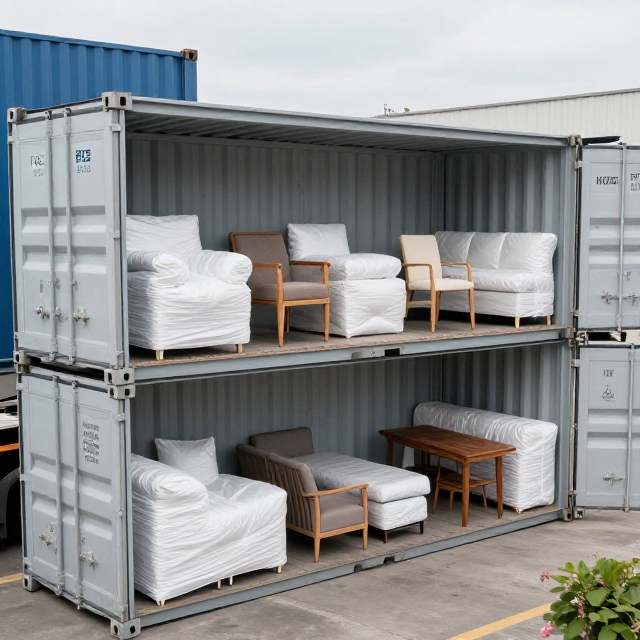
Mixed-Container Loading for Hotel Projects: Consolidating FF&E + OS&E from Multiple Factories
A hotel fit-out is rarely produced by a single factory. FF&E casegoods, seating, lighting, bathroom fittings, outdoor furniture, aluminum items and commercial kitchen equipment usually come from specialist factories, and OS&E — linen, tableware, textiles and operating supplies — comes from a different group of suppliers again. Each factory has its own production schedule, its own readiness date and its own packing standard. Left alone, that produces a long sequence of small partial shipments that arrive out of order, get handled multiple times and leave the site holding inventory it has nowhere to store. Mixed-container loading consolidates goods from two or more suppliers into the same container under one planned loading window, so the project receives fewer, larger and better-sequenced deliveries instead of many small ones. For hotel procurement from China, this is a planning decision made before the goods are finished, not a logistics decision made at the port.
Quick Answer
Mixed-container loading — also called container consolidation — means loading goods from two or more suppliers into one shipping container. Each supplier’s items are packed, marked and labelled separately, then loaded in a planned sequence so the container is filled efficiently without damaging anything in transit. For hotel projects, the method is used to consolidate FF&E and OS&E from multiple factories into a smaller number of shipments, all released against one agreed loading window and one site delivery plan. It is a consolidation decision, not simply a cheaper freight decision: the goal is a single controlled delivery sequence rather than the lowest possible per-container cost.
The main cost of mixed loading is scheduling. It works when every supplier’s goods are confirmed ready within the same window. It fails when one factory is late, because a container with a fixed sailing date cannot wait indefinitely for the last pallet. That is why readiness confirmation, CBM and weight per supplier, and a frozen loading plan are the three items that decide whether consolidation succeeds or turns into storage, demurrage and a re-booked container.
1. Who This Guide Is For
This guide is written for the people who have to make consolidation work on a live hotel project:
- Hotel owners, developers, asset managers and procurement teams
- Project managers handling multi-factory hotel FF&E programmes
- Procurement and logistics coordinators who book the containers
- Buyers sourcing FF&E and OS&E from different factories in China
- Interior designers and architects who need to know what arrives, and when
- Teams trying to control freight cost and delivery timing at the same time
2. What Is Mixed-Container Loading?
Mixed-container loading is the practice of loading goods from different suppliers into a single container, instead of shipping a small partial load from each factory separately. Each supplier’s goods remain identifiable throughout — packed to their own specification, marked with their own reference, and recorded in their own packing list — but they share the same container and consolidated shipment arrangement.
The loading is planned rather than improvised. Container dimensions, doorway height, stack limits and weight distribution decide which items can sit where, and the sequence is set before the goods leave the factory: heavy and dense items on the floor, fragile and high-value items on top, with blocking, bracing and dunnage between them. Consolidating an FF&E package means treating the container as a single engineered space rather than a set of separate pallets dropped in arbitrary order.
For hotel projects with multiple factories, consolidation keeps the delivery plan manageable and lets shipments be matched against site readiness — floor-by-floor, room-type by room-type, or phase by phase — instead of arriving in whatever order the factories finished.
3. Why Hotel Projects Need Mixed-Container Loading
A full hotel fit-out almost never comes from one factory. Loose furniture, casegoods, seating, outdoor furniture, aluminum items, commercial kitchen equipment and OS&E are split across specialist manufacturers, and each has its own capacity, tooling and lead time. Sourced separately, that split produces many partial shipments: more bookings, more handling, more customs entries, more demurrage exposure at destination, and a site team trying to receive furniture it has nowhere to store yet.
- Consolidates multiple suppliers — combines FF&E and OS&E from several factories into planned loads
- Uses container space more efficiently — small loads from different suppliers share the volume one of them would have wasted
- Reduces partial shipments — fewer deliveries for the site team to receive, inspect and clear
- Protects the project timeline — shipments align to a planned loading window rather than to whichever factory happened to finish first
- Improves coordination — one consolidated shipment is easier to track, document and escalate than many partial ones
- Sequences delivery against site readiness — which matters more than the freight saving once rooms are ready or a floor is closed
4. FF&E vs OS&E in Mixed Loads
FF&E — Furniture, Fixtures and Equipment — covers loose furniture, casegoods, seating, lighting fixtures, bathroom fittings and loose-delivery built-ins. OS&E — Operating Supplies and Equipment — covers linen, textiles, tableware, smallwares and operating supplies. The two categories are frequently sourced from completely different factory groups, which is precisely why consolidation is needed to keep freight and delivery under control.
They also behave differently in a container, and that difference drives the loading plan. FF&E is often heavier and more rigid, with damage risk concentrated at corners and edges; many OS&E items are lighter and more compressible, and are often moisture-sensitive. A mixed container planned as though every item behaves the same way is the most common cause of transit damage on hotel projects.
| Factor | FF&E | OS&E |
|---|---|---|
| Typical contents | Casegoods, loose furniture, seating, lighting, bathroom fittings | Linen, textiles, tableware, smallwares, operating supplies |
| Weight profile | Heavy and dense | Light and compressible |
| Main damage risk | Impact, corner and edge damage, crushing, frame distortion | Moisture, abrasion, contamination, compression |
| Packing approach | Sea-worthy crating or heavy carton with edge protection | Cartons or bales with moisture barrier, kept clear of metal edges |
| Container position | Floor and lower tiers, weight distributed evenly | Upper tiers, separated from sharp or heavy items |
| Typical sourcing pattern | Specialist furniture factories, split by product category | Textile and supply suppliers, often split by category |
When the two are consolidated, plan by size, weight, packaging type and loading order rather than by category name. Heavier items are loaded first on the container floor, lighter and fragile items last, and textiles are kept physically separated from anything with a hard edge or a fixing that could puncture packaging.
5. When to Use Mixed-Container Loading vs. Full Container Per Factory
Consolidation is not automatically the cheaper option. It trades freight efficiency for scheduling discipline, and the right answer depends on how full each factory’s own containers would be and how tight the site delivery window is.
| Situation | Recommended | Reason |
|---|---|---|
| Each factory fills one or more full containers | FCL per factory | No consolidation benefit to gain, and consolidation only adds timing risk and handling |
| Multiple factories with small volumes each | Mixed-container (consolidation) | Avoids many LCL or partial shipments and reduces the number of deliveries the site must receive |
| Tight delivery window to site | Planned mixed-load | Matches the consolidation window to the date the site actually needs the goods |
| Multi-phase hotel delivery | Planned by phase | Controls delivery sequence so each phase opens with the furniture it needs |
| One factory is structurally behind schedule | Ship that factory separately | Holding a full container for one late supplier affects every other factory in the load |
| Fragile or high-value items dominate the load | FCL per factory where possible | Reduces handling events, and each item is less exposed to movement caused by another supplier’s packing |
A useful rule: consolidate when the sum of several partial loads fills a container, and separate when one factory’s goods already fill it. Consolidating goods that would have travelled well on their own introduces a dependency for no freight gain.
6. Key Planning Steps for Mixed-Container Loading
These seven steps decide whether a mixed load works. Each one closes a gap that otherwise appears as a charge or a delay at the port.
- Confirm ready dates. Get confirmed readiness from each factory, not an estimate. Readiness is the critical path for a mixed load, because the container cannot sail until every supplier’s goods are in it.
- Define the consolidation window. Agree one loading window that all suppliers must meet, and state what happens to the container if one of them misses it.
- Prepare packing lists per supplier. Separate for each supplier, with item counts, carton numbers, CBM and gross weight. A consolidated packing list built later from memory is where identification errors come from.
- Create the loading plan. Plan the loading sequence, stack order and weight distribution against the container’s actual internal dimensions and door opening.
- Label clearly. Mark every carton by supplier, and by room, area or delivery phase where the site needs to install in sequence. Markings must survive sea transit and be readable at the container door.
- Check dimensions in advance. Verify oversized items against container door height and internal length before loading, so nothing is refused at the depot.
- Confirm load feasibility. Maximise usable space without exceeding safe weight distribution or the stacking strength of the packaging.
7. Packaging, Loading Order & Protection
Safe mixed loading depends on packing that is planned for the container, not for the factory’s loading bay. A carton packed to stand upright on a factory floor is not necessarily packed to survive being stacked with other suppliers’ goods for six weeks at sea.
- Heavy items first. Load at the container floor, distributed across the full length so the load does not concentrate at one end.
- Light and fragile items last. Upper tiers only, to avoid crushing from the weight above.
- Block and brace. Secure items to prevent shifting in transit. Dunnage, blocking and strapping are what stop a load moving when the vessel rolls.
- Protect surfaces. Use foam, edge protection, corner guards and blankets as the item requires. Edges and corners are where most hotel furniture damage starts.
- Use sea-worthy packing. Pack to a standard suitable for ocean transport, not for road delivery. Check who specifies that standard, because a factory’s default may not be export-grade.
- Avoid cross-contamination. Separate by packaging type, and keep textiles and food-contact items away from anything that could abrade, stain or puncture them.
- Leave no empty voids. Unfilled space allows movement. Void-fill between packages is part of the loading plan, not an afterthought.
| Loading position | What goes here | Reason |
|---|---|---|
| Container floor, front and middle | Heavy casegoods, beds, large seating | Keeps centre of gravity low and weight spread along the length |
| Container floor, rear | Heavy items that can be received first | Reduces the distance heavy goods travel at the destination end |
| Middle tiers | Medium-weight furniture, mattresses | Balances the load without exceeding the strength of the cartons below |
| Upper tiers | Light, fragile and high-value items | Minimises the load carried by any fragile item and reduces drop risk |
| Last loaded, nearest the door | Textiles, tableware, small items needed first on site | Reduces unloading time and site handling |
| Separated zones | Moisture-sensitive textiles, fragile surfaces | Keeps sensitive goods away from hard edges, fixings and condensation points |
8. Documentation for Mixed-Container Loads
Mixed loads carry more documentation risk than single-supplier containers, because there are several sets of documents inside one shipment. If they disagree, or if one supplier’s set is missing, the whole container can be held at destination. Clear documentation is what keeps mixed loading from turning into a customs or receiving problem.
- Packing list per supplier. Shows each supplier’s goods, carton numbers, item counts and marks clearly, so the site can identify a supplier’s items without opening every carton.
- Consolidated packing list. A single overview of the full container contents, showing which supplier’s lines are in which carton range.
- Commercial invoices per supplier. Issued in the form each destination requires, matching the packing lists line for line.
- Loading diagram or plan. A reference for the loading sequence, so the receiving team knows what comes off first and where each supplier’s goods are positioned.
- Marks and numbers. Clear, durable carton markings for identification on arrival, consistent with the packing list and the loading plan.
- Shipping documents matching the plan. Bill of lading details, container contents and the consolidation plan must describe the same goods in the same way.
- Certificates and test reports. Any fire, conformity or material documentation required at destination, issued per supplier where the requirement applies.
One practical rule: every supplier’s paperwork should be identical in format, item coding and reference style. When three factories use three different item codes, the consolidated list becomes a translation exercise rather than a check — and that is where identification errors at receiving originate.
9. Benefits and Trade-Offs
Mixed-container loading trades freight efficiency for control. Both sides of that trade are real, and the decision only works if you know which side your project is on.
| Benefits | Trade-Offs |
|---|---|
| Better container utilisation | Requires strict timing — every supplier must be ready in the same window |
| Fewer partial shipments | Needs strong coordination between factories that may not work together |
| Simpler delivery planning for the site team | Less flexible if one supplier delays — the whole container waits |
| Can reduce overall freight complexity and handling | Loading plan must be confirmed and approved in advance |
| Easier to match phased hotel deliveries to site readiness | Requires clear labelling, per-supplier documentation and consolidation paperwork |
| Each supplier keeps its own commercial identity and paperwork | Transshipment or deconsolidation may add a step before the goods reach their final destination |
The trade-off is worth taking when several factories are supplying small volumes against one site date. It is not worth taking when one factory’s goods already fill containers and the others are minor additions.
10. Risks & How to Control Them
Consolidation concentrates risk in a single window. Each risk below has a specific control, and each control is cheap if agreed early and expensive if left until loading day.
- Supplier delays. Lock a realistic consolidation window and confirm readiness early. Decide in advance which supplier’s delay causes the container to ship without them rather than hold everyone.
- Last-minute changes. Freeze the load plan once confirmed. Changes after the plan is approved mean the loading sequence, the void fill and the documentation no longer match the goods.
- Loading errors. Approve the loading diagram in advance and verify the key points at loading — heavy items low, fragile items high, labels facing outward, nothing blocking access to the door.
- Damage in transit. Use proper blocking, bracing and sea-worthy packing. This is one of the most costly failure modes on consolidated hotel loads.
- Mix-up at receiving. Clear carton marking by supplier and by area or phase, matching the packing list, so the site team identifies items without unpacking the container.
- Space loss. Share CBM and gross weight per supplier early, so the loading plan is built on real figures rather than estimates.
- Documentation mismatch. Confirm each supplier’s paperwork is complete and consistent before the container is sealed, because a document gap discovered at destination holds the entire load.
- Overweight or unbalanced load. Distribute weight along the container length and confirm the loaded weight before the container leaves the depot.
11. Mixed Loading for FF&E + OS&E: Practical Guidelines
When consolidating FF&E and OS&E together, six guidelines decide whether the load arrives intact and identifiable:
- Separate by sensitivity. Keep textiles and soft goods away from sharp edges, fixings and heavy items. Fabric damage from abrasion is invisible at loading and obvious at installation.
- Distribute weight. Balance the load for safe transport rather than filling the front of the container first, so the container is not front-heavy on the vessel.
- Protect against moisture and abrasion. Keep fabric items off the container floor and separated from surfaces that can abrade or condense.
- Maintain clear segregation by supplier. Group each supplier’s goods in identifiable zones with their own marking and their own line range on the packing list.
- Load by delivery phase. For multi-phase hotel projects, load so each phase can be unloaded and installed without dismantling an earlier phase. Where the site has no storage, this matters more than container utilisation.
- Match the load to the installation sequence. The room or area that opens first should be the last thing off the truck and the first thing off the container, not an afterthought once the container is sealed.
12. How Skyline Trading Co., LTD. Manages Consolidation
Skyline Trading Co., LTD., based in Foshan, Guangdong, China, coordinates multi-factory hotel projects through structured manufacturing and supplier coordination. For mixed-container loading, readiness dates, packing lists, CBM, gross weight and loading plans are confirmed in advance against one controlled consolidation window, so the goods that arrive on site are the goods that were planned, packed and documented from the start.
The emphasis is on planning and documentation rather than freight cost alone, because on a consolidated load the delivery date is decided by the factory that finishes last, and the condition of the goods is decided by the packing that was agreed before production. Both are set well before the container is booked.
One practical reason to settle scope before consolidation: a mixed container that includes fixed joinery or MEP references can be priced, excluded or priced at a different standard from one factory to the next. Writing the responsibility split into the RFQ before quotation is what stops that ambiguity from appearing at loading day. Our hotel FF&E scope and exclusions guide sets out how to fix that boundary in writing.
13. Final Checklist
Confirm every line before the container is loaded and sealed.
- [ ] Confirmed readiness dates obtained in writing from all factories
- [ ] Consolidation window agreed and locked, with a stated rule for a late supplier
- [ ] CBM, gross weight and carton count collected per supplier
- [ ] Loading plan approved, including sequence, stack order and weight distribution
- [ ] Oversized items verified against container door height and internal dimensions
- [ ] Sea-worthy export packing confirmed per supplier, not factory default
- [ ] Fragile and textile items identified and their loading positions fixed
- [ ] Blocking, bracing and void-fill arrangement agreed with the loading team
- [ ] Packing lists finalised per supplier, plus one consolidated overview
- [ ] Commercial invoices issued per supplier in the format required at destination
- [ ] Certificates and test reports collected where the destination requires them
- [ ] Carton labels and marks verified as readable and consistent with the packing list
- [ ] Loading diagram issued to the loading team and to the site team
- [ ] Load plan frozen before loading day
- [ ] Loaded weight and balance verified before the container leaves the depot
- [ ] Actual loading verified against the approved plan, with photos taken
- [ ] Documentation set confirmed complete before sealing
- [ ] Delivery sequence agreed with site against installation phases
14. FAQ
What is mixed-container loading for hotel projects?
It means loading goods from multiple factories — FF&E and OS&E suppliers together — into the same container under one planned loading window. Each supplier’s items stay packed, marked and documented separately, but they share the same container and consolidated shipment arrangement, with one planned delivery sequence, so the project receives fewer shipments and can plan installation against a known delivery date.
When should I use mixed-container loading instead of FCL?
Use it when no single factory fills a full container, or when several specialist factories supply one hotel project and need to ship inside the same consolidation window. Keep FCL per factory when a factory’s goods already fill containers on their own, because consolidating goods that would have travelled well anyway only adds timing risk and an extra handling event.
Can FF&E and OS&E be loaded together?
Yes, provided the load is planned by weight, size, fragility and loading order, with correct protection and clear labelling. FF&E is generally heavier and edge-sensitive, so it goes on the container floor and lower tiers. Many OS&E items are lighter and moisture-sensitive, so they go on the upper tiers and are kept away from sharp edges and any item that could abrade or puncture the packaging. Both need sea-worthy packing specified in advance, not left to the factory’s default.
What is the biggest risk with mixed loads?
Timing. If one supplier is delayed, it affects the entire consolidation window, because the container cannot sail until every supplier’s goods are inside it. The control is early written confirmation of readiness from every factory, plus a decision made in advance about which supplier’s delay causes the container to ship without them rather than hold everyone else. Damage in transit is the second biggest risk, and it is controlled by packing agreed before production.
Does mixed-container loading affect customs?
It can, because several suppliers’ goods travel in one container. The documentation has to make each supplier’s goods identifiable: a packing list and commercial invoice per supplier, plus one consolidated packing list showing the full container contents, and marks on the cartons that match both. When those documents are consistent and complete, the shipment clears as one consignment. When they disagree or one supplier’s set is missing, the gap holds the whole container rather than one supplier’s lines.
Related Guides
- Hotel FF&E Scope & Exclusions: How to Prepare a Clear RFQ for China Suppliers
- Hotel FF&E BOQ vs RFQ: What’s the Difference and When to Use Each for China Sourcing
- Hotel Procurement Guide from China
- Hotel FF&E vs OS&E: Complete Procurement Guide for Hotel Projects From China
- How to Compare China Supplier Quotes Before Placing an Order
- How to Equip a Boutique Hotel from China
- Hotel Furniture Manufacturing Process: From Design to Delivery
- Hotel OS&E Procurement Guide