
Complete Hotel Project Procurement Guide from China: Furniture, Aluminum Doors, Windows and Commercial Kitchen Equipment
End-to-end China hotel procurement guide for furniture, doors, windows, and commercial kitchen equipment for developers and investors.
At some point in every hotel or resort development, the spreadsheet stops being theoretical. Furniture counts, kitchen equipment lists, and door and window schedules turn into real purchase orders, real deposits, and real shipping dates. That’s the moment most developers start asking the same question: should we source this project from China, and if so, how do we do it without losing months to supplier confusion or a container full of furniture that doesn’t match the sample?
This guide is written for that exact moment. It covers hotel project procurement from China end to end — furniture, aluminum doors and windows, and commercial kitchen equipment — based on how these projects actually run in practice, not how they look in a sales brochure.
Related procurement topics covered in this guide: hotel furniture sourcing, aluminum doors and windows procurement, commercial kitchen equipment sourcing, China factory verification, and full FF&E project management.
📌 Executive Summary
- What this guide covers: the full hotel project procurement process from China — furniture, aluminum doors and windows, and commercial kitchen equipment — from supplier selection through site delivery.
- Why China: manufacturing scale, price, and concentrated expertise in hospitality-grade production that’s difficult to match elsewhere, especially for multi-property or large-unit-count projects.
- Key risk: choosing suppliers on price alone, skipping factory verification, and managing multiple categories with no shared timeline — these cause most of the cost overruns and delayed openings we see.
- Who this is for: hotel developers, resort investors, procurement managers, and hospitality consultants planning to source part or all of a hotel project from China.
- Outcome: Helps reduce procurement risk, cost overruns, and project delays through structured sourcing and verification.
Which Path Fits Your Project? A Quick Decision Checklist
Before going through the full process, it helps to know where your project actually stands. Use this checklist to see which sections of this guide matter most for your situation right now.
| If you are… | Start with |
|---|---|
| Still deciding whether to source directly or through an agent | Alibaba vs Direct Factory |
| About to shortlist suppliers but haven’t verified any factory yet | Factory Verification (below) and the China Factory Audit Guide |
| Sourcing furniture only, not the full project | Hotel Furniture Projects and Luxurious Hotel Furniture |
| Sourcing aluminum doors and windows specifically | Hotel Aluminum Doors & Windows China |
| Trying to understand total cost before budgeting | China Procurement Risks and Aluminum Door Import Cost |
| Coordinating furniture, kitchen, and aluminum together | Managing Multiple Suppliers (below) and the China Procurement Hub |
Why China Is the Global Hub for Hotel Project Procurement
China’s position in hotel project sourcing comes down to manufacturing scale concentrated in a handful of regions, particularly Guangdong province, where furniture, kitchen equipment, and aluminum systems are produced at a price point and volume that’s hard to match elsewhere. A resort or hotel group rolling out across multiple properties might need thousands of identical units, manufactured to the same specification and delivered on a schedule that lines up with construction handover — few manufacturing bases can absorb that volume while still accommodating custom finishes and fire ratings.
That scale is also why many developers now source the entire project — furniture, kitchen equipment, and aluminum doors and windows — through one coordinated process instead of three separate vendor relationships. A hotel opening date doesn’t move just because a kitchen supplier is two weeks behind or an aluminum factory is waiting on a finish detail; when categories are sourced separately, each delay becomes the developer’s problem to chase individually. Coordinated sourcing also means shared logistics planning and a single point of quality accountability, and for hotel groups managing several properties, it’s far easier to maintain the same finish and specification across every project with one sourcing relationship than with a different vendor for each one.
What Products Can Be Procured for a Hotel Project
A hotel project touches far more product categories than most first-time sourcing teams expect. Below is how these typically break down, and what changes from one category to the next.
Hotel Furniture
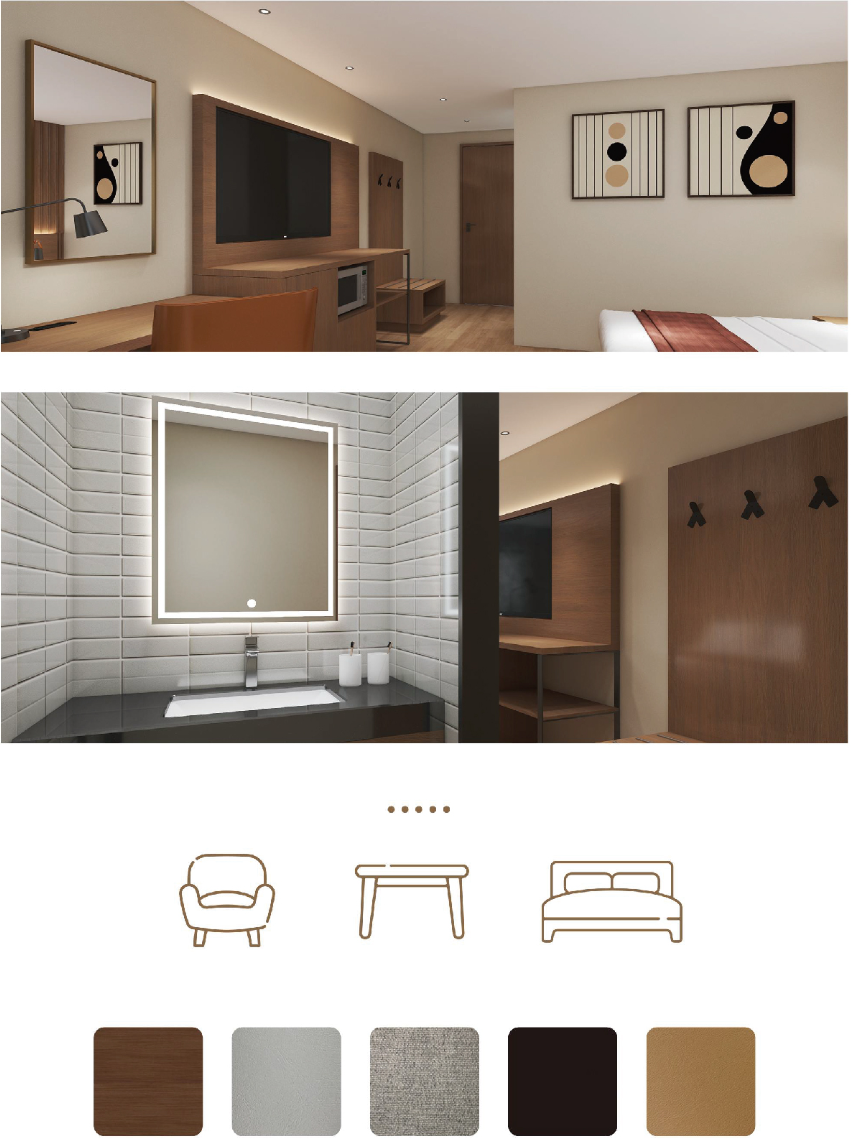
Hotel furniture covers everything from guest rooms to public spaces, and it’s manufactured to a different standard than residential furniture. Joinery has to withstand daily turnover, upholstery has to meet fire-retardant requirements, and finishes have to hold up under commercial cleaning chemicals used by housekeeping teams, not the occasional spot cleaning a home would see. Sourcing partners who specialize in hotel furniture projects understand these distinctions well before production starts, and developers weighing their first set of design options often find it useful to start with a practical breakdown of how to choose the perfect hotel furniture for their property type.
Lobby Furniture
Lobby furniture is the first physical impression a guest forms of the property, and it carries a different set of demands than guest room furniture. Pieces tend to be larger, more design-forward, and often custom-built to match a specific brand identity or architectural concept. Lead times here are usually longer because lobby furniture is rarely off-the-shelf — it’s built from drawings.
Guest Room Furniture
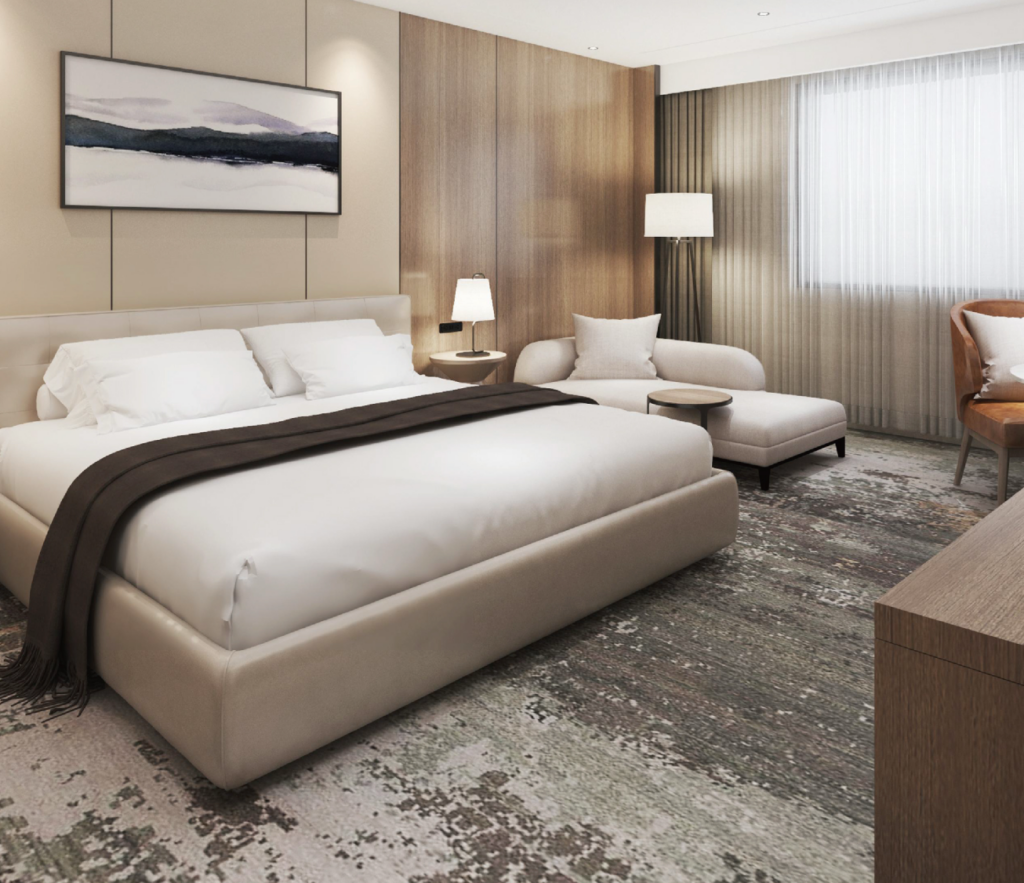
Guest room furniture is where volume matters most. Headboards, nightstands, desks, wardrobes, and seating are produced in the hundreds or thousands for a single property, which makes consistency the priority — every unit needs to match the approved sample exactly, not approximately. This is also where custom manufacturing pays off, since a property can standardize on its own design language across every room rather than relying on factory-standard catalog pieces. Developers exploring this path often start with a custom hotel furniture manufacturing guide before finalizing specifications.
Outdoor Resort Furniture
Resort properties add an entirely different material challenge: furniture that survives pool decks, beachfront exposure, and constant humidity without corroding, fading, or warping. This typically means powder-coated aluminum frames, marine-grade rope or synthetic wicker, and UV-stabilized cushions — materials and treatments that have nothing in common with indoor furniture sourcing and need to be specified separately from day one.
Aluminum Doors and Windows
Aluminum doors and windows for hotels are a structural and compliance category, not just an aesthetic one. Extrusion quality, thermal break performance, and corrosion resistance vary significantly between manufacturers, and a window system that performs fine in one climate zone can fail thermal or condensation testing in another. This category requires the most upfront technical specification of any product group in a hotel project, which is why most experienced buyers follow a dedicated process for how to verify aluminum door suppliers in China before placing any deposit.
Commercial Kitchen Equipment
Commercial kitchen equipment for a hotel project spans cooking lines, refrigeration, ventilation, and dishwashing systems sized for back-of-house operations rather than a single restaurant. Capacity planning here depends heavily on the hotel’s food and beverage concept — a property with multiple restaurant outlets and banquet capability needs a fundamentally different kitchen specification than one with a single breakfast restaurant. The same sourcing logic that applies to commercial kitchen equipment for restaurants scales up for hotel back-of-house operations, just at a higher volume and with tighter coordination against the rest of the project timeline.
Step-by-Step Hotel Procurement Process
Most procurement failures don’t happen because of a bad factory. They happen because a step in this sequence got skipped or rushed. Here’s how the process should actually run.
Project Planning
Procurement planning needs to start alongside architectural and interior design, not after it. FF&E schedules, material specifications, and quantities should be locked in parallel with design development, because changing a finish or dimension after production drawings are approved is far more expensive than catching it during planning.
Budgeting
A realistic procurement budget accounts for more than unit pricing. Ocean freight, customs duties, inland transportation, insurance, and installation labor all sit outside the factory invoice, and a budget built only around quoted unit prices will run short once these line items appear. Building in a contingency for currency fluctuation and freight rate changes is standard practice on multi-month procurement timelines.
Supplier Selection
Not every factory that can make furniture, aluminum windows, or kitchen equipment can make them at hotel project scale. Supplier selection should weigh production capacity, relevant project experience, and export documentation history — not just the unit price on a quotation. A factory with strong residential output but no hospitality project references is a different risk profile than one with a track record of hotel deliveries.
Factory Verification
Verification means confirming, in person or through a trusted representative, that the factory you’re paying actually has the equipment, workforce, and production lines the sales presentation described. This step catches subcontracting arrangements, capacity overstatements, and quality control gaps before they become your problem. A structured China factory audit guide typically covers production capacity checks, quality system review, and on-site material verification.
Sample Approval
Sample approval should be treated as a binding reference, not a formality. Every dimension, material grade, and finish detail approved at the sample stage becomes the standard the entire production run is measured against — which means the sample needs to be evaluated as carefully as the final product, including how it holds up to the cleaning and handling it will face in actual hotel operation.
Production Management
Once production starts, someone needs to be tracking it actively — not waiting for a shipping date to arrive and hoping everything went according to plan. Regular production updates, photo documentation at key milestones, and early flags on material shortages or schedule slippage are what separate a managed procurement process from a hopeful one.
Quality Inspection
Quality inspection has to happen on the full production batch before it’s loaded into a container, not just on the original sample. Factories sometimes use higher-grade materials for the sample and standard-grade materials for the production run, and the only way to catch that gap is to inspect the actual goods being shipped. This is one of the most consistent gaps in projects that source without a formal China supplier verification process in place.
Shipping and Logistics
Shipping a hotel project usually means coordinating multiple containers across multiple suppliers, sometimes from different ports, all needing to arrive in a sequence that matches the construction handover schedule. Container loading plans, customs documentation, and Incoterms all need to be settled before goods leave the factory, not negotiated after a shipment is already at sea.
Site Delivery
The final stage — getting goods from the port to the actual hotel site — is where construction schedules and shipping schedules have to align. Furniture arriving before rooms are ready for installation creates storage problems; furniture arriving after the planned opening date creates a much bigger problem. Staged or phased delivery is common for large projects specifically to manage this risk.
| Procurement Stage | What to Verify |
|---|---|
| Supplier Selection | Production capacity and hospitality project history |
| Factory Verification | Actual equipment, workforce, and quality systems on-site |
| Sample Approval | Material grade, dimensions, and finish against specification |
| Production | Progress tracking and adherence to approved sample |
| Pre-Shipment Inspection | Full batch quality, not just the original sample |
| Site Delivery | Quantities and condition matched against the packing list |
Hotel FF&E and Procurement Cost Ranges by Category
Exact pricing depends on unit count, material grade, and level of customization, but the ranges below give a starting benchmark for budgeting a mid-size hotel project (roughly 100–150 keys) before requesting detailed quotations, Hotel FF&E and OS&E procurement process
Note: All cost ranges are indicative 2026 China factory estimates and vary based on specifications, Incoterms, and market conditions.
| Category | Typical Cost Range (USD) | Main Cost Drivers |
|---|---|---|
| Guest room furniture (per room set) | $800 – $3,500 | Material grade, customization, finish quality |
| Lobby and public area furniture | $40,000 – $250,000+ | Design complexity, scale, custom millwork |
| Outdoor resort furniture (per set) | $300 – $1,800 | Weather-grade materials, UV and corrosion treatment |
| Aluminum doors and windows (per project) | $150,000 – $600,000+ | Thermal break specification, glazing, total opening count |
| Commercial kitchen equipment (full back-of-house) | $120,000 – $450,000+ | Number of outlets, banquet capacity, ventilation scope |
Note: Prices exclude shipping, customs, installation, and local taxes.
These figures cover factory pricing only. Ocean freight, customs duties, inland transport, and installation typically add 15–30% on top of the factory invoice, depending on destination and Incoterms — a gap covered in more detail in our breakdown of China procurement risks and aluminum door import costs.
Common Mistakes That Increase Project Costs
These mistakes show up repeatedly across hotel sourcing projects, regardless of property size or budget. Most of them are avoidable with the right process in place from the start.
- Choosing a supplier on price alone. The lowest quote often reflects a lower material grade or a factory unfamiliar with hospitality-grade specifications, and the gap surfaces during quality inspection — or worse, after installation.
- Skipping factory verification to save time. A factory that looks credible in photos and a sales call isn’t the same as a factory that’s been physically verified to have the claimed capacity and quality systems.
- Approving samples without testing real-world durability. A sample that looks right in a showroom isn’t always the same as a sample that survives commercial cleaning chemicals and daily guest turnover.
- Underestimating total landed cost. Budgeting around the factory invoice alone, without freight, customs, insurance, and inland transport, creates a budget gap that surfaces mid-project.
- Not locking fire safety and building code compliance early. Furniture and materials that pass one market’s fire rating standards may not meet another’s, and discovering this after production is far costlier than specifying it upfront.
- Ignoring realistic production lead times. Custom hotel furniture and aluminum systems take longer to manufacture than standard catalog items, and underestimating this timeline is one of the most common causes of delayed openings.
- Managing multiple suppliers with no central coordination. When furniture, kitchen equipment, and aluminum systems are sourced separately with no shared timeline, delays in one category aren’t caught until they affect another.
- Skipping pre-shipment inspection on the full production batch. Inspecting only the sample — and not the actual goods being loaded into the container — is how material substitutions and quality drift go unnoticed until the shipment has already arrived.
⚠ Warning for Developers:
The single most expensive mistake in hotel project procurement from China is selecting a supplier based on price alone. A lower initial quote can look attractive on a spreadsheet, but rework, re-shipping, or production delays caused by an unqualified supplier routinely cost far more than the original price difference — especially when they push back a hotel’s opening date.
Managing Multiple Suppliers in One Hotel Project
A mid-size hotel project can easily involve a furniture factory, an aluminum extrusion and fabrication plant, a kitchen equipment manufacturer, and several smaller suppliers for soft goods, lighting, or fixtures — each with its own production schedule, lead time, and quality standard.
The risk in managing these independently isn’t usually that any single supplier fails. It’s that nobody is tracking how their individual schedules interact. If the aluminum window factory runs three weeks behind, but nobody flags that against the interior fit-out schedule, the furniture installation team can show up to a building that isn’t weather-sealed yet. If the kitchen equipment supplier ships before the commercial kitchen’s electrical and plumbing rough-in is complete, that equipment sits in storage accumulating risk of damage.
Coordinating multiple suppliers well means maintaining one master timeline that all categories are checked against, with clear visibility into which supplier is on schedule and which one needs attention. This is functionally a project management discipline as much as a procurement one, and it’s the main reason hotel project management in China sourcing contexts has become its own specialized service rather than something procurement teams handle as a side task.
Why Many Developers Use a China Procurement Partner
Direct factory sourcing works well when a developer has the time, language capability, and on-the-ground presence to manage it. Many don’t — and that gap is exactly what a China procurement partner is built to close. A procurement partner typically handles:
- Pre-vetted factory relationships across furniture, kitchen equipment, and aluminum systems — removing the trial-and-error of finding suppliers cold.
- Technical translation for specifications, where a misunderstood material callout or tolerance can affect an entire production run.
- Quality inspection handled as part of one coordinated service, not a separate vendor relationship.
- Shipping coordination and customs documentation managed centrally instead of per-supplier.
For developers running their first project in China, or for hotel groups managing several properties simultaneously, this consolidated approach is usually the difference between a procurement process that runs smoothly and one that consumes far more internal time than expected.
Why Foshan Is the Global Center of Hotel Furniture Manufacturing
Foshan, in Guangdong province, has built its reputation as the center of hotel furniture manufacturing over several decades, and that reputation holds up under scrutiny for a few concrete reasons.
- The largest concentration of commercial furniture factories in China, specifically built around hospitality and contract furniture rather than residential product lines.
- Dense supplier clustering, which allows buyers to visit and compare multiple factories within a short distance, rather than traveling between disconnected industrial zones.
- Large-scale showrooms that let buyers evaluate actual material quality and construction detail before committing to an order, rather than relying on catalog photography alone.
- Decades of hospitality project experience, meaning design and production teams are already familiar with the fire ratings, durability standards, and finish requirements hotel projects demand.
Other industrial cities across China manufacture furniture as well, but Foshan’s specialization in hospitality and commercial furniture specifically — rather than general furniture production — is what keeps it as the default starting point for hotel furniture supplier searches. For buyers comparing options at scale, resources like a guide to commercial furniture manufacturers in China are typically built around Foshan-based supply chains for exactly this reason.
It’s also worth understanding why commercial-grade sourcing matters in the first place. The construction, joinery, and material treatment used in hotel furniture differ substantially from what’s used in furniture built for home use, and the distinction shows up most clearly in how each holds up over years of commercial-grade wear. A closer look at commercial furniture vs residential furniture makes clear why specifying the wrong category is one of the costlier mistakes a project can make.
How Skyltc Supports Hotel and Resort Projects
Skyltc works as a single coordination point across the categories covered in this guide — hotel furniture, aluminum doors and windows, and commercial kitchen equipment — rather than leaving developers to manage separate vendor relationships for each.
- Factory verification before any supplier is recommended for a project.
- Quotation comparison across multiple qualified factories to balance cost against quality.
- Sample review and approval support before full production begins.
- Pre-shipment quality inspection on full production batches, not just initial samples.
- Shipping, customs, and logistics coordination from factory to project site.
- Single-point project management across furniture, kitchen equipment, and aluminum systems, so developers aren’t tracking three separate timelines themselves.
If you’re planning a hotel or resort project and weighing how to approach sourcing from China, we’re glad to walk through the specifics with you before you commit to a supplier.
FAQ
How long does hotel project procurement from China typically take?
It depends heavily on order volume and customization level. Standard catalog furniture and equipment move faster, while fully custom furniture, finishes, or aluminum systems require additional time for sample approval and tooling before mass production begins. Locking the production timeline in writing with the supplier early on is the most reliable way to plan around it.
Can furniture, kitchen equipment, and aluminum systems be sourced from one supplier?
Rarely from a single factory, since each category requires different manufacturing expertise. What’s more common — and more practical — is sourcing all three through one procurement partner who coordinates separate specialized factories under a single project timeline and quality standard.
What is the minimum order quantity for hotel furniture manufacturing in China?
This varies by factory and by how customized the design is. Factories that specialize in hospitality projects are generally set up for full-property order volumes rather than small or mixed individual-piece orders, since their production lines are optimized for consistent, repeated units.
How is quality verified before shipment?
Reliable quality verification happens on the full production batch, immediately before it’s loaded for shipping — not only on the initial sample. This step catches material substitutions or finishing inconsistencies that can occur between sample approval and full production.
Can a hotel project be delivered in phases rather than all at once?
Yes, and phased delivery is common for larger properties or multi-stage construction handovers. It requires close coordination between the construction timeline and the production and shipping schedule, so that furniture and equipment arrive as each section of the project becomes ready to receive it.
Do aluminum doors and windows need different specifications for different climates?
Yes. Thermal break performance, corrosion resistance, and sealing standards that work well in one climate zone can underperform in another, particularly in coastal or high-humidity environments. Specifying climate-appropriate standards before production avoids performance issues that are far more expensive to fix after installation.
What is the typical deposit structure for hotel procurement in China?
Usually 30% deposit, 70% before shipment, depending on supplier agreement and project size.
What Incoterms are most commonly used?
FOB is most common, followed by CIF for simplified logistics management.
Conclusion
Hotel project procurement from China works well when it’s treated as a managed process rather than a series of disconnected purchase orders. Furniture, aluminum doors and windows, and commercial kitchen equipment each carry their own technical requirements, but the projects that run smoothly are the ones where factory verification, sample approval, and quality inspection happen consistently across every category — not just the ones that seem highest-risk at the time.
If you’re planning a hotel or resort project, you don’t need a finished spec sheet to start the conversation. Share your project scope — property size, target opening date, and which categories you need sourced — and our team will review it and respond within 48 hours with initial feasibility and next steps.
Request a Free Procurement Feasibility Review
Tell us about your hotel or resort project. We’ll review it and reply within 48 hours.
Get a structured sourcing plan before you commit to any supplier in China — avoid costly mistakes before production starts.
Related Guides: Hotel Furniture Projects | Factory Audit Guide | Aluminum Door Verification | Procurement Risks in China