
Hotel Furniture Budget Guide: How to Plan FF&E Costs in 2026
A hotel furniture budget is the portion of a hospitality project’s capital plan dedicated to furnishing every guestroom, public space, and back-of-house area — beds and headboards, case goods, seating, lighting, and the freight, installation, and contingency required to put them into service. Planning it early matters because furniture carries long production lead times, volatile logistics costs, and a 7–10 year asset life: once designs are locked and tooling begins, budget mistakes are expensive to reverse. Within the hotel furniture budget, Furniture, Fixtures, and Equipment (FF&E) is one of the largest fluid cost centers — unlike structural concrete or core mechanical systems, FF&E costs vary significantly with design intent, brand standards, tier classifications, and supply chain logistics.
For hotel owners, real estate developers, architects, and procurement managers, calculating the cost to furnish a 100-room hotel is not a matter of multiplying retail furniture prices by room count. It requires an evaluation of industrial manufacturing tiers, custom engineering tolerances, international freight volatility, and specialized on-site installation labor. Miscalculating these variables can lead to project delays, broken investor covenants, or premature asset deterioration.
This commercial procurement guide breaks down the financial frameworks, asset lifecycles, and actual market costs of hospitality FF&E in 2026. By analyzing current pricing benchmarks, multi-variable room configurations, and logistics strategies, this guide provides a practical foundation for asset managers to protect their capital allocations and build accurate budget pro formas.
Quick Answer: How Much Should a Hotel Budget for Furniture?
Most hotels budget $3,300–$15,000 per room for furniture alone (case goods, seating, bedding, and lighting), plus 18–22% for logistics and installation and a 5–10% contingency. Full FF&E budgets — including public areas and back-of-house — run higher. Use this planning formula:
Room count × cost per room + public-area furniture + logistics (18–22%) + contingency (5–10%) = hotel furniture budget
This guide covers how to build and control a furniture budget during planning and procurement. For a full per-key 5-star hotel FF&E cost breakdown including public-area share, design, and project management, see our companion guide.
Key Takeaways (2026)
- 100-room FF&E budget ranges from $520,000 (mid-scale) to $2,375,000 (luxury boutique)
- Cost per room: $3,300 (mid-scale) to $15,000 (luxury)
- Logistics, freight & installation add 18–22% on top of manufacturing cost
- Custom vs. standard: Custom costs 25–40% more upfront but extends asset life by 3–5 years
- Lead time from China: 8–14 weeks production + 2–4 weeks freight
- For OS&E (linens, amenities, tableware), see our Hotel OS&E Procurement Guide
Reading note: the per-room figures above ($3,300–$15,000) price guest room case goods and furniture only (bed, case goods, seating, lighting within the room). They do not include the room’s allocated share of lobbies, restaurants, kitchens, spa, and back-of-house. If you are setting a total furnishing budget — furniture plus public areas, design, project management, and logistics — use our 5-star hotel furnishing cost guide, where full per-key FF&E runs $35,000–$120,000+ with public-area share included.
From Our Sourcing Team
“Treating hotel furniture as a commodity is the fastest way to blow your budget. We’ve seen developers compare bed prices line by line without checking warranty terms or after-sales support. A headboard that delaminates after 18 months costs more than a premium one lasting 10 years — we’ve watched this play out across dozens of Gulf projects. Always calculate total cost of ownership, not just the invoice.”
— Senior Procurement Specialist, Skyline Trading Co., LTD
What Is Included in a Hotel Furniture Budget?
Developers often assume a furniture budget covers only beds, chairs, and tables. In practice, a complete hotel furniture budget spans five cost groups — miss any one of them and the project runs out of funding before opening:
- Guestroom furniture: beds and headboards, nightstands, wardrobes, desks, lounge seating, lighting, mirrors, and luggage benches
- Public and F&B spaces: lobby and reception, restaurant and bar seating, meeting rooms, corridors, and outdoor areas
- Back-of-house (BOH): employee breakrooms, administrative offices, linen storage, laundry sorting, and maintenance areas
- Fixed and millwork elements: wardrobes, vanity units, TV panels, and built-in joinery coordinated with construction and MEP drawings
- Logistics, installation, and contingency: freight, customs, warehousing, white-glove assembly, and a 5–10% buffer
How to Calculate a Hotel Furniture Budget
Hotel furniture cost estimation follows a simple formula once the scope is defined. Start with a per-room anchor price for the target tier, multiply by the number of keys, then layer on public areas, logistics, and contingency:
Cost per room × number of rooms + public & F&B furniture + freight & installation + 5–10% contingency = total hotel furniture budget
- Set the per-room anchor: choose the tier (mid-scale, full-service, or luxury) and define the standard room furniture package. In this guide, that anchor runs $3,300–$15,000 per key.
- Build a furniture inventory: list every item, quantity, material, and finish for guestrooms, public areas, and BOH before requesting quotations.
- Add logistics and installation: budget 18–22% on top of manufacturing cost for ocean freight, customs, warehousing, and white-glove labor.
- Reserve contingency: hold 5–10% for material price shifts, schedule delays, and on-site adjustments — then re-forecast after prototype approval.
Main Factors That Affect Hotel Furniture Costs
Two hotels with the same room count can end up with very different furniture budgets. The gap is driven by five factors that procurement teams should price separately:
- Hotel tier and brand standards: branded properties must meet specific material, fire-rating, and durability specifications that raise unit costs.
- Material and finish selection: natural wood veneers and stone cost 30–50% more than high-pressure laminates and solid-surface alternatives.
- Level of customization: custom-engineered pieces cost 25–40% more upfront but extend asset life by 3–5 years.
- Order volume and standardization: repeating a small number of standard room types unlocks volume discounts and simplifies replacement stock.
- Geography and logistics: distance from manufacturing hubs, ocean freight volatility, and local import duties directly move the landed cost.
2026 Hotel Furniture Market Trends
The hotel furniture market in 2026 is shaped by three key trends that directly impact your hotel furniture budget:
- Sustainability Requirements: Major hotel groups now mandate FSC-certified wood and low-VOC finishes. This adds 5–8% to manufacturing costs but unlocks green certifications (LEED, BREEAM, GSAS). Non-compliant suppliers are increasingly being rejected at the specification stage.
- Smart Furniture Integration: USB-C charging ports, wireless charging pads, and IoT-enabled climate controls are standard in new hotel builds — not just luxury. A typical 100-room property now budgets $15,000–$25,000 for integrated power and smart features alone.
- Supply Chain Realignment: Post-pandemic, global hotel groups are dual-sourcing from China and Vietnam. However, China remains the dominant hub for complex custom FF&E due to its mature manufacturing ecosystem, raw material availability, and shorter lead times for engineered products.
The Strategic Role of FF&E in Hotel Asset Valuation
FF&E is not an administrative expense; it is a core driver of hospitality asset valuation. The physical environment of a hotel guestroom dictates guest satisfaction scores, premium ADR (Average Daily Rate) capabilities, and the structural lifespan of the interior envelope. In commercial real estate development, a hotel’s interior fit-out must balance aesthetic intent with intense operational durability.
Commercial-grade furniture must withstand a high-traffic lifecycle that would destroy residential furniture within months. Case goods must feature heavy-duty commercial veneers or high-pressure laminates (HPL). Seating requires high-density, fire-retardant foams and high-rub-count performance fabrics tested to Wyzenbeek or Martindale standards.
Furthermore, FF&E planning must integrate with other architectural elements. For example, furniture placement and custom millwork must align cleanly with the property’s structural openings, requiring close coordination with providers of specialized hotel aluminum doors and windows to maintain acoustic seals, thermal performance, and design consistency across the building envelope. Achieving this balance is a core focus of modern factory solutions built for the hospitality sector.
Comprehensive FF&E Budget Allocation Framework
When building a comprehensive hospitality pro forma, procurement teams divide the interior fit-out into clear asset categories. For a standard 100-room property, the hotel furniture budget allocation extends far beyond the guestrooms to include public spaces, administrative zones, operational back-of-house infrastructure, and logistics corridors.
The following structural matrix illustrates a typical budget distribution for a mid-scale to upper-mid-scale 100-room commercial hotel:
| Capital Expenditure Category | Representative Budget Allocation | Strategic Operational Focus |
|---|---|---|
| Guestroom Case Goods | 32% | Wardrobes, desks, headboards, nightstands, TV panels |
| Guestroom Upholstery & Bedding | 18% | Mattresses, task chairs, lounge seating, sofa beds |
| Lobby & Public Space Furniture | 15% | Reception desks, communal tables, architectural seating |
| Food & Beverage (F&B) Areas | 12% | Restaurant seating, dining tables, bar counters, buffets |
| Logistics, Freight & Warehousing | 11% | Ocean/land freight, port fees, container consolidation, storage |
| On-Site Installation Labor | 7% | White-glove assembly, millwork anchoring, staging |
| Operational Contingency Fund | 5% | Material cost fluctuations, field changes, schedule adjustments |
Budget Breakdown by Furniture Category
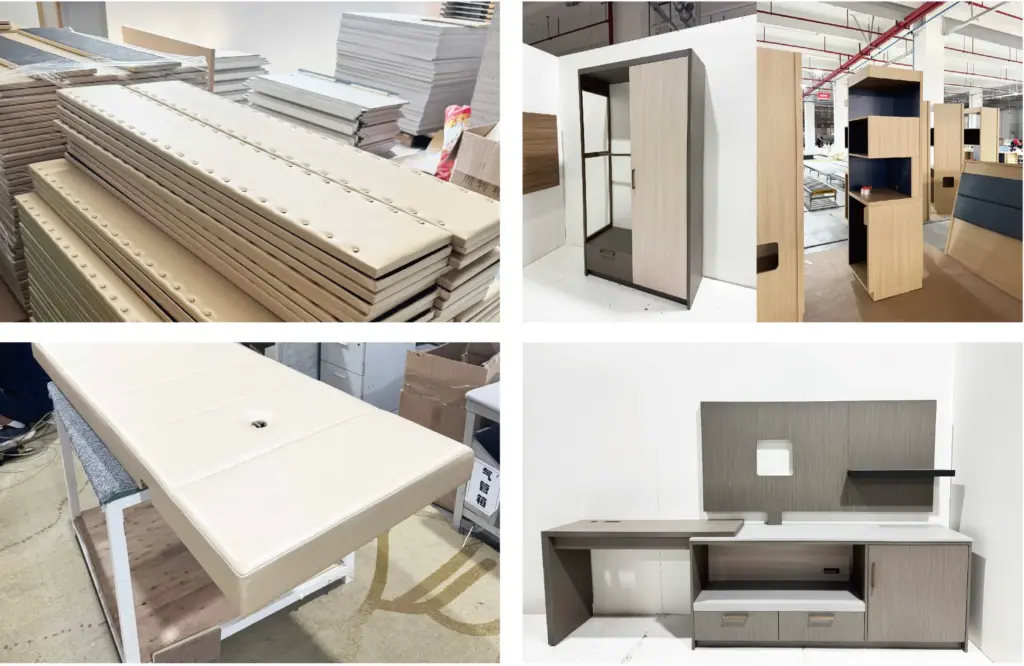
To understand the macro figures of a 100-room project, we must first analyze the line-item costs of individual furniture pieces. Manufacturing costs are heavily driven by material choices, hardware specifications, and integrated technology components.
1. Guestroom Case Goods
Case goods form the structural layout of the guestroom. High-performance properties require moisture-resistant core materials, such as E1-grade Medium Density Fiberboard (MDF) or high-density plywood, finished with commercial wood veneers or scratch-resistant laminates.
- Headboard Panels (With Integrated LED Lighting Channels): $250 – $650 per unit
- Nightstands (With Integrated USB-C Charging Ports): $120 – $280 per unit
- Luggage Benches (With Stainless Steel Wear Strips): $110 – $240 per unit
- Writing Desks / Media Panels Combo Units: $350 – $850 per unit
- Open-Concept / Wardrobe Closets (With Internal LED Strips): $450 – $1,200 per unit
2. Upholstered Seating and Bedding Systems
Upholstered items must meet strict local fire safety standards, such as CAL 133 in North America or BS 5852 in the UK. Double-stitched seams and high-resiliency polyurethanes are standard requirements.
- Commercial Pocket-Spring King Mattresses (Hospitality Grade): $280 – $600 per unit
- Ergonomic Desk / Task Chairs (100,000+ Double Rub Fabric): $95 – $220 per unit
- Lounge Armchairs / Easy Chairs: $180 – $420 per unit
- Two-Seater Sleeper Sofas (Heavy-Duty Mechanism): $400 – $950 per unit
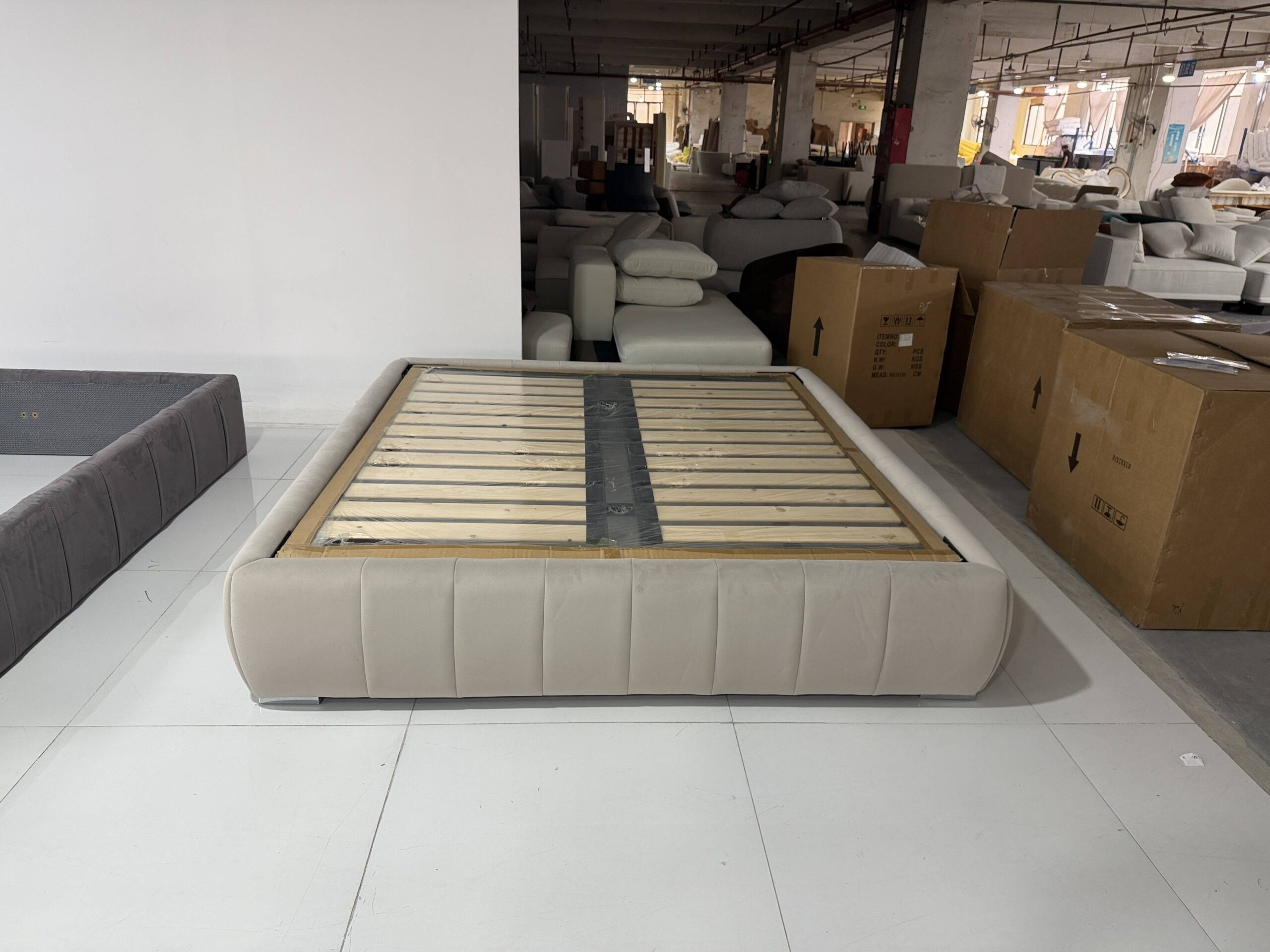
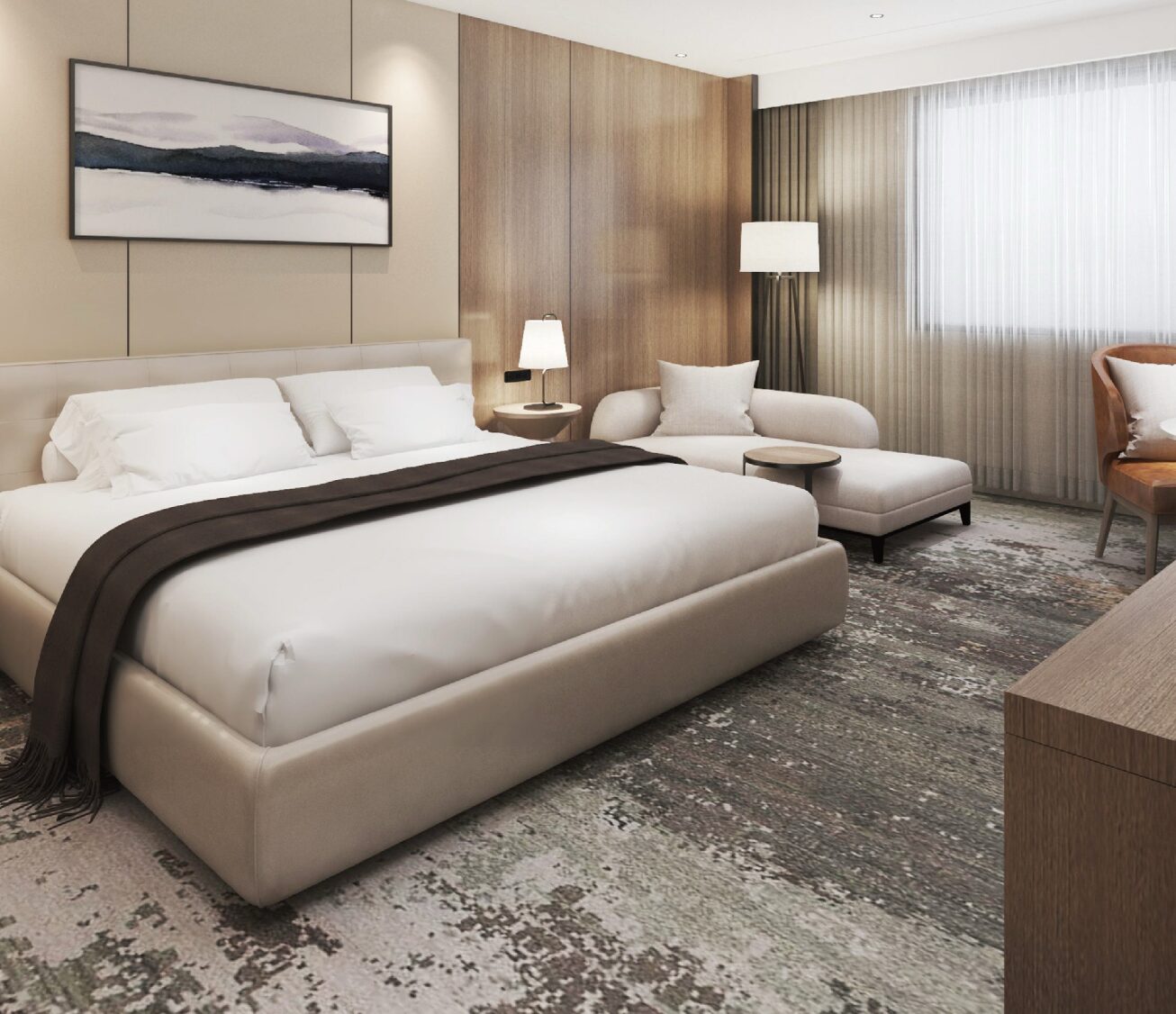
Real project example: The bed pictured below was manufactured in our Foshan partner factory (left) and installed in a 5-star hotel in the Gulf (right). Same frame, same upholstery, same specifications.
3. Public Spaces and Food & Beverage (F&B) Furniture
Public space items carry much higher individual costs because they are heavily customized and designed for maximum traffic. They require solid wood framing (such as kiln-dried ash or oak) and reinforced metal sub-frames.
- Modular Reception Desk (Stone or Solid Surface Tops): $4,000 – $12,000 per system
- Lobby Communal Tables (With Integrated Power Hubs): $1,500 – $4,500 per unit
- Restaurant Dining Chairs (Heavy Commercial Grade): $85 – $180 per unit
- Restaurant Tables (Quartz or Compact Laminate Tops): $200 – $550 per unit
Cost Per Room Examples: Hospitality Tiers Analyzed
To provide clear financial visibility, let’s evaluate the actual cost-per-room (Key) benchmarks across three different market tiers. These projections represent fully loaded costs per room, including standard case goods, seating, and lighting fixtures for a standard king room layout.
Tier 1: Mid-Scale Property (e.g., Select-Service Hotels)
Mid-scale properties focus heavily on durability, repeatable configurations, and cost efficiency. These designs rely heavily on standard dimensions and high-pressure laminates rather than natural wood veneers.
- Case goods package: $1,800
- Seating & Bedding package: $1,100
- Lighting & Decorative elements: $400
- Estimated Cost Per Room (FF&E Only): $3,300
Tier 2: Upper Mid-Scale & Full-Service Property
This tier introduces custom architectural details, natural wood veneers, premium hidden hardware (such as soft-close Blum hinges), and integrated charging systems inside the furniture.
- Case goods package: $3,800
- Seating & Bedding package: $1,900
- Lighting & Decorative elements: $800
- Estimated Cost Per Room (FF&E Only): $6,500
Tier 3: Luxury & Boutique Property
Luxury properties feature 100% custom-engineered designs. They use premium raw materials such as marble, solid brass inlays, genuine leathers, and specialized manual finishes that require extensive engineering time.
- Case goods package: $8,500
- Seating & Bedding package: $4,200
- Lighting & Custom Artwork: $2,300
- Estimated Cost Per Room (FF&E Only): $15,000
Need a budget estimate for your hotel project? Get a project-specific FF&E cost model tailored to your hotel size, brand standards, and design intent.
Luxury vs. Mid-Scale Hotel Budget Comparison (100-Room Model)
When scaled across a full 100-room property model, the cost differences between market tiers become highly apparent. The macro hotel furniture budget must account for public spaces and operational support areas, which scale upward along with the room tier.
| FF&E Budget Element | 100-Room Mid-Scale Model | 100-Room Luxury Model |
|---|---|---|
| Total Guestroom Furniture (100 Keys) | $330,000 | $1,500,000 |
| Lobby & Public Lounge Spaces | $45,000 | $250,000 |
| F&B / Restaurant Dining Areas | $35,000 | $180,000 |
| Meeting Rooms / Boardrooms | $20,000 | $95,000 |
| Logistics, Freight & Local Handling | $55,000 | $220,000 |
| On-Site Delivery & White-Glove Installation | $35,000 | $130,000 |
| Total Estimated FF&E Capital Expenditure | $520,000 | $2,375,000 |
Custom vs Standard: Comparison Table
A critical decision point for any project manager or procurement team is deciding when to use custom-engineered furniture versus catalog standard pieces. Both options carry distinct financial and operational trade-offs.
| Criterion | Standard Furniture | Custom Furniture |
|---|---|---|
| Lead Time | 6–8 weeks | 10–16 weeks |
| Cost Premium | Baseline | 25–40% higher upfront |
| Asset Lifespan | 5–7 years | 10+ years |
| Fit Accuracy | Standard dimensions only | Perfect fit to any layout |
| Brand Compliance | Limited options | Fully customizable |
| MOQ | Low (50–100 units) | Higher (200+ units) |
| Maintenance Cost | Higher over lifecycle | Lower over lifecycle |
How to Reduce Hotel Furniture Procurement Costs
Reducing a hotel furniture budget does not mean buying cheaper furniture — it means removing waste from the specification, sourcing, and logistics chain. These are the highest-leverage cost levers used on real projects:
- Standardize room types: cut from six layouts to two or three to maximize production efficiency and spare-parts commonality.
- Mix materials by surface: use high-pressure laminates on horizontal wear surfaces and wood veneers on vertical panels — premium look, lower cost.
- Prototype before mass production: a single mockup room catches design and ergonomic errors that would otherwise repeat across every floor.
- Consolidate shipments: full-container loads lower freight cost per unit and reduce the risk of damage from repeated handling.
- Source from China directly: China’s mature manufacturing ecosystem delivers significant savings on custom FF&E compared with local production, with factory audits and quality gates protecting the final result. See our hotel procurement from China guide for the full process.
Real Project Case Study: Saudi Arabia 100-Room Hotel
In 2024–2025, Skyline Trading Co., LTD delivered a full FF&E package for an existing shell building in Saudi Arabia being converted into a 100-room hotel. The scope covered every item inside the guestrooms — from the headboard to the smart curtain controls.
What we supplied per room:
- Bedroom: Bed frame with headboard, mattress, nightstands, wardrobe, desk with chair, luggage bench, TV unit
- Bathroom: Shower enclosure, toilet, bidet, vanity unit with mirror, bathtub, towel rack, accessories
- Lighting & Electronics: All room lighting, TV, AC unit, smart power sockets, safe box, mini fridge, digital scale
- Smart Systems: Voice-controlled curtain opener (blackout + sheer) — “Open window” opens the curtain, plus comprehensive smart room controls
- Soft Furnishings: Bed linens, towels, duvets, pillows, carpet, curtains, picture frames, and decorative items
This project covered the complete fit-out of the interiors from one sourcing partner — no split orders, no missing pieces, no logistics gaps.
Download the FF&E Budget Checklist
Plan your hotel furniture budget with our interactive estimator. This Excel tool covers every line item for a 100-room property — furniture, bathroom, lighting, smart systems, soft furnishing, logistics, and contingency.
Download FF&E Budget Estimator (PDF) →
Procurement Strategy: Custom Furniture vs. Standard Furniture
Standard / Catalog Furniture
Standard furniture offers short production timelines and eliminates engineering mold fees. It is ideal for mid-scale select-service properties operating under strict time constraints. However, standard catalog furniture rarely fits the exact spatial dimensions of unique architectural layouts, often leaving awkward gaps or blocking electrical outlets.
Custom Hospitality Furniture
Custom furniture allows developers to optimize every square inch of the guestroom floor plan. Wardrobes can be designed to flush completely against structural concrete columns, and writing desks can integrate seamlessly with specific wall panels. Many developers rely on premium custom hotel furniture solutions to ensure architectural alignment and strict adherence to brand guidelines.
While custom furniture requires a higher initial investment for shop drawings and material prototyping, it often results in a more durable installation. This durability reduces the property’s long-term maintenance costs and delays the need for a capital-intensive Property Improvement Plan (PIP).
Logistics, Installation, and Contingency Budgets
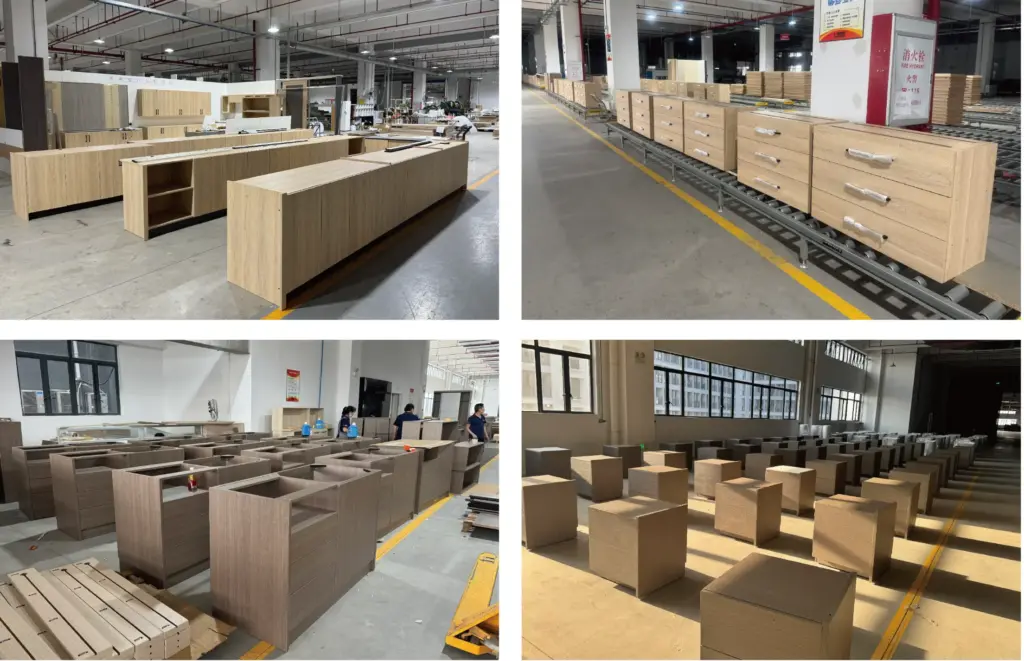
A common error in hotel budgeting is focusing exclusively on the manufacturing cost of items. A complete procurement model must include the costs required to move, store, assemble, and anchor the furniture securely within the building structure.
Shipping and Ocean Freight Volatility
Hospitality furniture is highly voluminous. Furnishing a 100-room hotel typically requires between 12 to 18 forty-foot High Cube (40ft HC) shipping containers, depending on the complexity of the public spaces. Budgets must account for sea freight rates, port demurrage, customs clearance fees, and domestic inland transport. Factoring in a 10% to 15% freight buffer protects the project pro forma from seasonal market spikes.
White-Glove Installation Labor
Hospitality installation is a specialized commercial trade. Residential movers lack the skills needed to correctly anchor heavy headboards to metal-stud drywall, align modular wardrobes on uneven floors, or handle delicate back-lit vanity mirrors safely. Hiring a certified, insured hospitality installation team ensures that your furniture warranties remain valid and protects your underlying real estate assets from damage during assembly.
The 10% Contingency Mandate
No real estate development project runs perfectly. Construction sites frequently experience timeline shifts that force incoming furniture containers to be placed in bonded warehouses, incurring unexpected storage fees. Alternatively, building dimension changes might require unexpected on-site adjustments by local carpenters. Maintaining a dedicated 5% to 10% cash contingency budget ensures the project can handle these unexpected challenges without stopping construction progress.
FF&E vs OS&E: Understanding the Difference
Two budget lines are frequently mixed up during planning, which creates funding gaps close to opening day. Knowing which is which keeps the hotel furniture budget accurate:
- FF&E (Furniture, Fixtures & Equipment): capital expenditure with a 7–10 year asset life — beds, case goods, lighting, carpets, and restaurant equipment. This is the budget this guide covers.
- OS&E (Operating Supplies & Equipment): operating expenditure replaced every 1–3 years — linens, towels, amenities, tableware, and small appliances. OS&E typically adds 10–20% on top of the FF&E budget.
Keep the two budgets in separate accounts: FF&E is capitalized, OS&E is expensed, and both must be locked before pre-opening purchasing begins. For a line-by-line OS&E breakdown, see our Hotel OS&E Procurement Guide.
Common Budgeting Mistakes in Hospitality Procurement
Over the course of managing multiple multi-million-dollar projects, asset management teams frequently encounter repeatable mistakes that drain contingency funds. Recognizing these pitfalls early is critical to protecting project margins and staying within your hotel furniture budget.
- Ignoring Fabric and Material Lifespans: Choosing residential-grade fabrics because of a lower initial cost leads to quick surface wear, fabric tearing, and staining within the first 12 months of operations. Always verify that materials meet heavy-commercial durability ratings.
- Failing to Account for Spatial Tolerances: Ordering large case goods based purely on theoretical design sketches without verifying the final, on-site construction dimensions can lead to furniture blocking doors, windows, or light switches.
- Omitting Back-of-House (BOH) Requirements: Forgetting to budget for employee breakrooms, administrative office desks, secure linen storage racks, and industrial laundry sorting tables can create a major budget deficit late in the project.
The Definitive Hotel FF&E Planning Checklist
To keep project phases aligned across developers, design groups, and builders, procurement teams use this structured timeline workflow:
- Schematic Design Stage (12 Months Out): Establish the macro budget ceilings based on target hotel tiering. Finalize the initial Room Matrix and total Key counts.
- Design Development Stage (9 Months Out): Review and approve final material boards, fabric rub tests, and hardware samples. Cross-reference furniture layouts with mechanical, electrical, and plumbing (MEP) drawings.
- Prototyping & Mockup Review (7 Months Out): Manufacture a complete sample package for a single model room. Assemble the pieces on-site to verify manufacturing tolerances, finish quality, and real-world spatial flows before starting mass production.
- Mass Production Window (6 Months Out): Release initial deposits to start mass manufacturing. Establish weekly quality tracking gates with production engineers directly on the manufacturing floor.
- Logistics Planning Phase (3 Months Out): Secure shipping container space and organize delivery windows with the construction team. Confirm that local warehouses are ready if site access is delayed.
- On-Site Installation (1 Month Out): Deploy specialized installation teams to unpack, assemble, and anchor furniture systematically floor by floor. Execute final quality inspections and sign off on completed keys.
How Skyline Trading Helps Hotels Manage Furniture Procurement
Skyline Trading Co., LTD is a hospitality procurement and China sourcing partner for hotel owners, developers, and project managers. Our role is to keep the hotel furniture budget predictable from first estimate to final installation:
- Budget modeling: project-specific FF&E cost models built from your room count, hotel tier, and brand standards.
- Factory coordination: direct work with major Chinese manufacturing clusters, backed by factory audits before and during production.
- Quality verification: structured QC gates, prototype approval, and punch-list support so warranties stay valid through installation.
- Logistics consolidation: container planning, packing, and delivery scheduling that protect your landed cost and opening date.
Frequently Asked Questions
Commercial-grade hotel furniture is built for a 7 to 10-year operational lifecycle. Upholstered seating and mattresses generally require replacement around year 7 due to high traffic, while heavy wood case goods can last up to 10 years if maintained properly before a Property Improvement Plan (PIP) is required.
Logistics, customs clearance, warehousing, and local inland transport generally account for 10% to 15% of the total furniture manufacturing budget, depending on the project’s distance from major manufacturing hubs and current ocean freight rates.
Residential furniture lacks the structural reinforcement, high-pressure laminates, and specialized joint stabilization needed to withstand continuous use by guests. It also rarely meets local commercial fire safety standards, such as CAL 133, which can expose owners to legal risks.
A mockup room is a full-scale prototype of a standard guestroom built before mass production begins. It allows developers, architects, and installers to test the design layout, check real material finishes, and resolve any engineering issues before mass manufacturing starts.
FF&E covers permanent fixtures — furniture, lighting, and fixed equipment — with a 7–10 year asset life, treated as capital expenditure. OS&E covers consumable supplies like linens, amenities, and tableware with a 1–3 year cycle, treated as operating expenditure. Both are critical for hotel pre-opening budgets.
Raw material costs (MDF, plywood, performance fabrics) have increased 8% to 12% since 2024 due to global supply chain adjustments and rising energy costs in manufacturing hubs. However, efficiency improvements in Chinese factories — particularly automated CNC routing and streamlined finishing lines — have partially offset these increases. Overall, 2026 hotel furniture costs are approximately 5% to 8% higher than 2024, with logistics being the most volatile variable.
The most common mistake is underestimating logistics and installation costs. Many developers budget only for manufacturing and are surprised when freight, customs, warehousing duties, and white-glove installation add 18% to 22% to the total project cost. A 100-room hotel can require 12 to 18 shipping containers, and unexpected storage fees from construction delays often blow the contingency budget.
A complete hotel furniture budget covers five cost groups: guestroom furniture (beds, headboards, case goods, seating, and lighting), public and F&B spaces, back-of-house areas, built-in millwork, and logistics with a 5-10% contingency. Most budget overruns happen when developers budget for guestrooms only and overlook public areas, freight, and installation.
Hotels estimate furniture costs by anchoring a per-room budget for their tier ($3,300-$15,000 per room in this guide), multiplying by room count, then adding public-area furniture, 18-22% for freight and installation, and a 5-10% contingency. The estimate is refined once a full furniture inventory and supplier quotations exist.
For furniture alone, the average is roughly $3,300 per room for mid-scale properties and $6,500-$15,000+ for full-service and luxury hotels, covering case goods, seating, bedding, and lighting within the room. Total FF&E budgets that include public areas and back-of-house run significantly higher.
Yes, for most hotel projects. China’s manufacturing ecosystem delivers custom FF&E at a meaningfully lower cost than local production, with production lead times of 8-14 weeks plus 2-4 weeks of freight. Savings depend on order volume, logistics routing, and quality control, which is why factory audits and a single sourcing partner matter.
Conclusion: Managing Capital for Long-Term Value
Furnishing a 100-room property demands a careful balance of clear cost visibility, strong engineering standards, and tight logistics management. A well-planned hotel furniture budget protects your investment returns not by hunting for the cheapest possible products, but by optimizing total landed costs and investing in durable, long-lasting assets.
Ensure your project capital delivers maximum value. Skyline Trading Co., LTD assists commercial hospitality developers, architects, and asset managers in executing successful procurement projects globally. Our team works directly with major manufacturing clusters to deliver custom hospitality furniture packages that balance long-term durability with precise budget goals. To review your furniture project specifications or speak with an engineering coordinator, Request a hotel furniture quotation today.
Get Your FF&E Budget Estimate
Send us your project details and receive a tailored cost breakdown within 48 hours:
- Room count — number of keys
- Hotel tier — mid-scale, full-service, or luxury
- Country — delivery destination
📩 [email protected] — include room count, tier, and country
Related Resources
- 5-Star Hotel Furnishing Cost Guide — Full per-key FF&E cost breakdown including public areas, design, and project management
- Hotel OS&E Procurement Guide (2026) — Operating supplies & equipment cost breakdown, waste analysis, and procurement strategy
- Hotel Procurement from China — Full sourcing process for FF&E, OS&E, and kitchen equipment
- Commercial Kitchen Equipment — Restaurant and hotel kitchen procurement guide
- Factory Audit Guide — Verify supplier capabilities before committing capital
- China Sourcing Risks — Common procurement pitfalls and mitigation strategies
- hotel FF&E cost planning
Need an accurate FF&E budget for your hotel project? Get a project-specific cost breakdown based on your hotel size, brand requirements, and design specifications.
Get FF&E Budget Sheet (Excel) → | Get furniture quote → | Get mockup room pricing →