
How Much Does It Cost to Furnish a 5-Star Hotel in 2026?
The cost to furnish a 5-star hotel in 2026 typically ranges from $35,000 to $120,000+ per key depending on design level, location, room size, and procurement strategy — this figure covers FF&E (furniture, fixtures, lighting, and soft furnishings) including the property’s share of public areas. A standard 100-room five-star property typically allocates $4 million to $8 million for FF&E, before OS&E (operating supplies) adds another 10–20%. Total development cost per key for luxury hotels runs from about $800,000 to over $1.05 million — and furniture is one of the most controllable parts of that figure.
The wide range is not a cop-out. It reflects four variables that swing every five-star budget by tens of thousands per room: room size and suite mix, the level of customization, material and finish standards, and where you buy from. This guide breaks the cost down line by line — per room, per public area, per kitchen — using 2026 industry benchmarks and real procurement data, so you can build a budget that survives contact with your brand standards and your lender.
You will also find the parts most cost guides skip: what the money actually buys, how China sourcing changes the math, and how to protect the budget with factory audits and quality control before anything leaves the port.
Key Takeaways (2026)
- 5-star FF&E cost per key: $35,000–$120,000+ (most projects cluster at $40,000–$70,000)
- Furniture only, per guest room: $6,700–$19,300
- FF&E is 10–20% of total development cost per room
- Public areas absorb 20–30% of the furnishing budget
- Logistics, freight & installation add 12–18% on top of manufacturing cost
- China sourcing saves 30–50% on contract-grade furniture vs local production
- Lead time from China: 8–14 weeks production + 2–4 weeks freight
Executive Summary
If you only take one number from this guide: plan on $45,000–$65,000 per key for a standard five-star FF&E package sourced at contract quality, and add 12–18% for logistics, freight, and installation. Premium design, heavy suite mix, or flagship brand standards push you toward the top of the $35,000–$120,000+ range.
| Metric | Value |
|---|---|
| Average cost per key (5-star FF&E) | $35,000–$120,000+ |
| Typical working range | $45,000–$65,000 |
| 50-room hotel total | $2.5M–$3.6M (FF&E + OS&E) |
| 100-room hotel total | $5.0M–$7.3M (FF&E + OS&E) |
| 200-room hotel total | $10.1M–$14.6M (FF&E + OS&E) |
| OS&E (operating supplies) | +10–20% on top of FF&E |
| Logistics, freight & installation | +12–18% on top of manufacturing |
Three numbers shape every decision in this guide. FF&E equals 10–20% of total development cost per room. Public areas absorb 20–30% of the furnishing budget. China sourcing saves 30–50% on contract-grade furniture versus local production. Read the full breakdown below to understand where each line comes from — and what it takes to protect it.
From Our Sourcing Team
“Most five-star owners budget for the furniture and forget the system around it — quality control, inspection, freight, and the cost of reordering a failed batch from across the ocean. In our Gulf hotel projects we’ve seen budgets stretch 20–30% simply because those lines were missing. If you plan the FF&E as one system, not a pile of SKUs, the number holds.”
— Senior Procurement Specialist, Skyline Trading Co., LTD
What Does It Mean to Furnish a 5-Star Hotel?
“Furnishing” a hotel is not the same as furnishing a house, and it is not the same as building one. In hospitality budgeting, furnishing means delivering every piece of Furniture, Fixtures, and Equipment (FF&E) that a property needs to open and operate — inside guest rooms, through every public space, through the kitchen, and across the back of house.
A five-star standard changes what those words mean:
- Guest rooms get coordinated case goods and seating engineered for continuous use, not residential showroom pieces.
- Public areas carry heavily customized, high-traffic furniture where a single lobby sofa can cost more than a dozen guestroom beds.
- Specification matters more than style. Five-star brand standards dictate materials, rub counts, fire ratings, and finish tolerances. Residential-grade furniture fails these tests quickly — and replacements are the hidden cost that kills underfunded budgets.
It is useful to separate three budget layers, because suppliers, estimators, and lenders each talk about a different one:
| Budget Layer | What It Covers | 2026 Benchmark (5-Star) |
|---|---|---|
| Furnishing / FF&E | Furniture, fixtures, lighting, artwork, window treatments | $35,000–$120,000+ per key |
| FF&E + OS&E | Above plus operating supplies (linens, amenities, tabletop, guestroom consumables) | Add ~10–20% on top of FF&E |
| Total development cost | Construction, land, MEP, interior fit-out, FF&E, pre-opening | $800,000–$1,100,000+ per key |
When someone asks “how much does it cost to furnish a 5-star hotel,” they usually mean the first layer. That is the number this guide centers on.
What Does Furnishing a 5-Star Hotel Actually Include?
A five-star furnishing package is a full building of coordinated products, not a furniture order. Before you can cost it, you need the scope. The standard scope for a five-star property covers:
- FF&E: furniture, fixtures, lighting, artwork, and window treatments across the whole property.
- OS&E: linens, amenities, tableware, and operating supplies for pre-opening.
- Guest rooms: beds, case goods, seating, lighting, and soft goods per room type.
- Suites and penthouses: living zones, dining areas, millwork, and statement pieces at 1.5–3x the standard room cost.
- Lobby and reception: the highest-value square footage in the hotel.
- Restaurants, bars, and banqueting: commercial-grade furniture plus kitchen equipment.
- Commercial kitchen: cooking lines, cold storage, warewashing, and stainless fabrication.
- Spa and wellness: treatment rooms, lounges, and wet-area furniture.
- Outdoor areas: terraces, pools, and gardens in weather-rated contract grade.
- Back of house: offices, staff areas, laundry, and storage that never appear in photos but must be furnished.
Each of these spaces has its own cost curve. Guest rooms are standardized and price-efficient; lobbies and spas are customized and expensive. Knowing the full scope is what turns a budget into a budget that holds.
Difference Between FF&E and OS&E
Procurement teams split the opening budget into two very different buckets. Mixing them up is one of the most common budgeting errors in hotel development.
| FF&E (Furniture, Fixtures & Equipment) | OS&E (Operating Supplies & Equipment) | |
|---|---|---|
| Examples | Beds, case goods, seating, lighting, carpets, artwork, restaurant equipment | Linens, towels, bath amenities, tableware, small appliances, irons, luggage carts |
| Budget nature | Capital expenditure (CAPEX) | Operating expense (OPEX) |
| Lifespan | 7–10+ years | 1–3 years, constantly replaced |
| When procured | During construction / fit-out | Pre-opening, often 6–9 months out |
| Share of furnishing budget | ~85–90% | ~10–15% |
| Typical 5-star value per key | $35,000–$120,000+ | $2,500–$6,000 |
Why the distinction matters: OS&E is easy to underestimate because it does not show up in renderings. A 100-room five-star hotel can burn through $250,000–$600,000 on OS&E alone, and you cannot defer it to “later” — it must be on the shelf before opening day. Budget both at the same time, from the same spreadsheet, or the first operating month will eat into working capital.
Average Cost to Furnish a 5-Star Hotel in 2026
Across 2026 industry data — including HVS development cost surveys, European benchmark platforms, and manufacturer price books — the furnishing ranges by property class are:
| Hotel Class | Typical FF&E Cost Per Key (2026) |
|---|---|
| Budget / 2–3 star | $4,000–$12,000 |
| Midscale / 4 star | $12,000–$35,000 |
| Upscale / boutique | $20,000–$45,000 |
| Luxury / 5 star | $35,000–$120,000+ |
| Ultra-luxury / flagship | $80,000–$250,000+ |
Within the five-star band, most projects cluster between $40,000 and $70,000 per key for a standard mix of rooms and a reasonable share of suites. Three factors push properties to the top of the band:
- Suite and villa density — suites carry 1.5–3x the furnishing cost of a standard room, with separate living zones, more millwork, and statement pieces.
- Custom millwork — bespoke headboards, wall panels, and joinery cost 25–40% more upfront than catalog pieces but hold value longer and match brand identity.
- Material grade — the difference between a $30,000 key and a $70,000 key is usually one material decision: real marble versus marble-effect composite, solid wood versus veneer, premium leather versus contract-grade vinyl.
Planning anchors for a five-star project in 2026:
- FF&E typically equals 10–20% of total development cost per room.
- Furniture alone is roughly 30–40% of the FF&E figure, with the rest going to fixtures, lighting, and equipment.
- Public areas absorb 20–30% of the total furnishing budget despite covering a fraction of the square footage.
- Logistics, freight, and installation add 12–18% on top of manufacturing cost.
Cost Per Hotel Room (Cost Per Key)
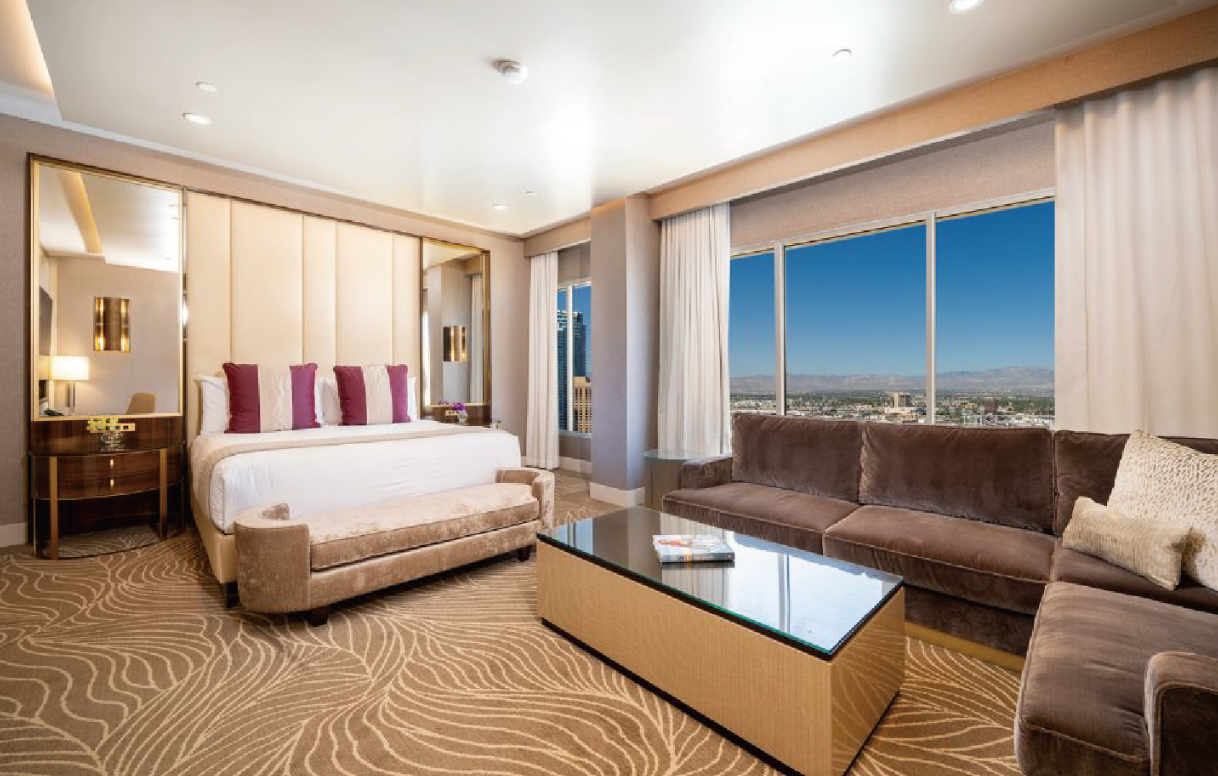
“Cost per key” is the unit every lender and consultant uses, because it normalizes a full property into a comparable number. For a five-star hotel, that number includes the room’s own furniture plus an allocated share of lobbies, corridors, F&B outlets, meeting rooms, and back-of-house.
A realistic per-key breakdown for a standard five-star room, China-sourced at contract quality, looks like this:
| Item | Estimated Cost | Notes |
|---|---|---|
| Bed frame | $500–$1,200 | Hospitality-grade frame, reinforced joinery, headboard fixing points |
| Mattress | $280–$600 | Hotel-grade pocket-spring or hybrid; never residential grade |
| Headboard | $800–$2,500 | Upholstered or paneled, often with built-in lighting pockets |
| Nightstands (2) | $400–$1,200 | Soft-close drawers, integrated charging in modern specs |
| Wardrobe / closet system | $800–$2,200 | Full-height or walk-in; fire-rated materials, 100K-cycle hardware |
| Desk | $300–$800 | Writing desk with cable management and durable top |
| Chair | $200–$600 | Ergonomic task chair, 100,000+ double-rub commercial fabric |
| Lounge seating | $500–$1,800 | Lounge chair, ottoman, bench; the pieces guests photograph |
| Lighting | $600–$1,800 | Ambient, task, accent layers; increasingly smart-controlled |
| Curtains & window treatments | $400–$1,200 | Blackout + sheer, motorized adds 15–20% |
| Bathroom furniture | $700–$2,000 | Vanities, mirrors, fittings; stone-effect tops common |
| Artwork & accessories | $500–$1,500 | Carpets, cushions, framed art — the most forgotten line |
| Guest room furniture subtotal | $6,700–$19,300 | China-sourced contract quality |
| Allocated public-area and kitchen share | $12,000–$40,000 | 20–30% of total furnishing spend |
| Design, PM, QC, logistics allocation | $6,000–$20,000 | 12–18% logistics + 5–8% PM + QC |
| Total FF&E per key (indicative) | $35,000–$80,000+ | Standard five-star room, mid-range spec |
Two practical notes. First, a “standard” five-star room with a mid-size footprint lands around $45,000–$55,000 per key including its public-area share, when sourced efficiently from China. Second, luxury markets in Western Europe and tier-1 North American cities run 20–35% above global averages — those premiums come from installation labor, union logistics, and local surcharges, not from the furniture itself.
Budget Examples: 50, 100, and 200 Rooms
Realistic total FF&E budgets for five-star new-builds, using a working range of $45,000–$65,000 per key (suites and public areas included):
Why these numbers differ from our older budget guide. If you have read the Hotel Furniture Budget Guide (100-Room), you may see figures around $15,000 per key for a luxury tier and wonder about the gap. The difference is scope, not a correction: the older guide prices guest room case goods and seating only (bedroom furniture per key), while this guide covers full FF&E per key — guest room furniture plus the room’s allocated share of lobbies, corridors, restaurants, kitchens, spa, and back-of-house, plus design, project management, quality control, and logistics. When you strip this guide’s number down to guest room furniture alone, it lands at $6,700–$19,300 — in line with the older guide’s $15,000 benchmark. Use one consistently: per-room case goods if you are pricing furniture only, full per-key FF&E if you are setting the total furnishing budget.
50-Room 5-Star Hotel
| Item | Low | High |
|---|---|---|
| FF&E (50 keys × $45K–$65K) | $2,250,000 | $3,250,000 |
| OS&E (add ~12%) | $270,000 | $390,000 |
| Total furnishing budget | $2.5M–$3.6M |
A 50-room luxury property is essentially a boutique hotel with hotel-grade specs — fewer rooms means you absorb a disproportionate share of the lobby, kitchen, and MEP costs per key. Expect the public-area share to run closer to 30%.
100-Room 5-Star Hotel
| Item | Low | High |
|---|---|---|
| FF&E (100 keys × $45K–$65K) | $4,500,000 | $6,500,000 |
| OS&E (add ~12%) | $540,000 | $780,000 |
| Total furnishing budget | $5.0M–$7.3M |
This is the sweet spot for volume pricing. At 100 keys you can fill containers efficiently, standardize across room types, and lock production at dedicated factory lines — which is where China-sourced contract manufacturing saves the most versus local or European supply.
200-Room 5-Star Hotel
| Item | Low | High |
|---|---|---|
| FF&E (200 keys × $45K–$65K) | $9,000,000 | $13,000,000 |
| OS&E (add ~12%) | $1,080,000 | $1,560,000 |
| Total furnishing budget | $10.1M–$14.6M |
At 200+ keys, add ballroom, multiple F&B outlets, and spa — each a separate cost center. Plan for phased delivery and floor-by-floor installation, and expect the kitchen and back-of-house share to grow with the F&B program.
Detailed Cost Breakdown
Guest Rooms
The guest room is where most budgets start, and it is also the most standardized line in the project. At five-star level, the furniture itself usually runs $6,700–$19,300 per room, with China-sourced contract quality landing comfortably at the lower end without sacrificing commercial grade.
- Beds & mattresses. The mattress is the single most reputation-critical purchase in a hotel. Five-star properties use hotel-grade pocket-spring or hybrid systems: $280–$600 per mattress in contract volume, $1,200–$2,800 per room once the frame, box, and top layers are included. Never buy residential mattresses — they fail at roughly one-third the service life.
- Headboards. Upholstered and paneled headboards carry much of the room’s design language. Expect $800–$2,500 per room including fabric, acoustical backing, and integrated lighting pockets.
- Wardrobes. Walk-in or full-height closets with built-in storage run $800–$2,200 per room. Key specification points: soft-close hardware, fire-rated materials, and hinges rated for 100,000+ cycles.
- Desks. Five-star rooms pair a writing desk with an ergonomic task chair: $500–$1,400 combined. Desk chairs in commercial fabrics must withstand daily use and 100,000+ double-rub tests.
- Sofas and lounge seating. Lounges, armchairs, and ottomans add $500–$1,800 per room and are the pieces guests photograph — so frame construction and fabric grade matter commercially, not just aesthetically.
- Lighting. Layered lighting (ambient, task, accent) runs $600–$1,800 per room, and increasingly includes smart controls for scenes and energy modes.
- Curtains and window treatments. Blackout + sheer layers with motorization: $400–$1,200 per room. Motorized options add roughly 15–20% but are now expected in five-star rooms.
- Bathroom furniture. Vanities, mirrors, and fittings: $700–$2,000 per room. Five-star bathrooms often take stone-effect tops and brushed finishes.
- Accessories and artwork. Carpets, cushions, throws, and framed art: $500–$1,500 per room. This is the line most buyers forget, then overpay for at pre-opening.
Public Areas
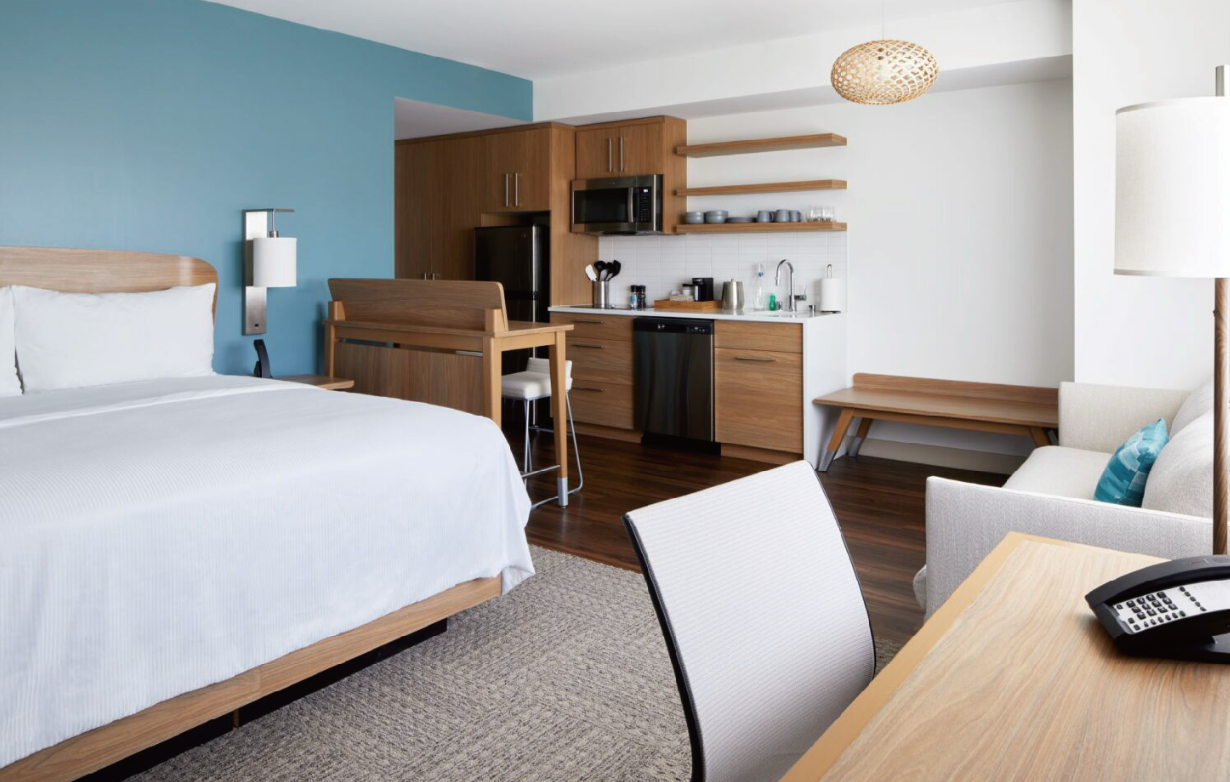
Public areas are the cost multiplier in every five-star budget. They cover a fraction of the square footage and consume 20–30% of the total furnishing spend.
- Lobby and reception. The lobby is a “statement” space. Planning benchmark: $150–$300 per square foot of furnished area, with 15–20% of the lobby budget reserved for signature pieces — the oversized sectional, the sculptural lighting, the reception millwork.
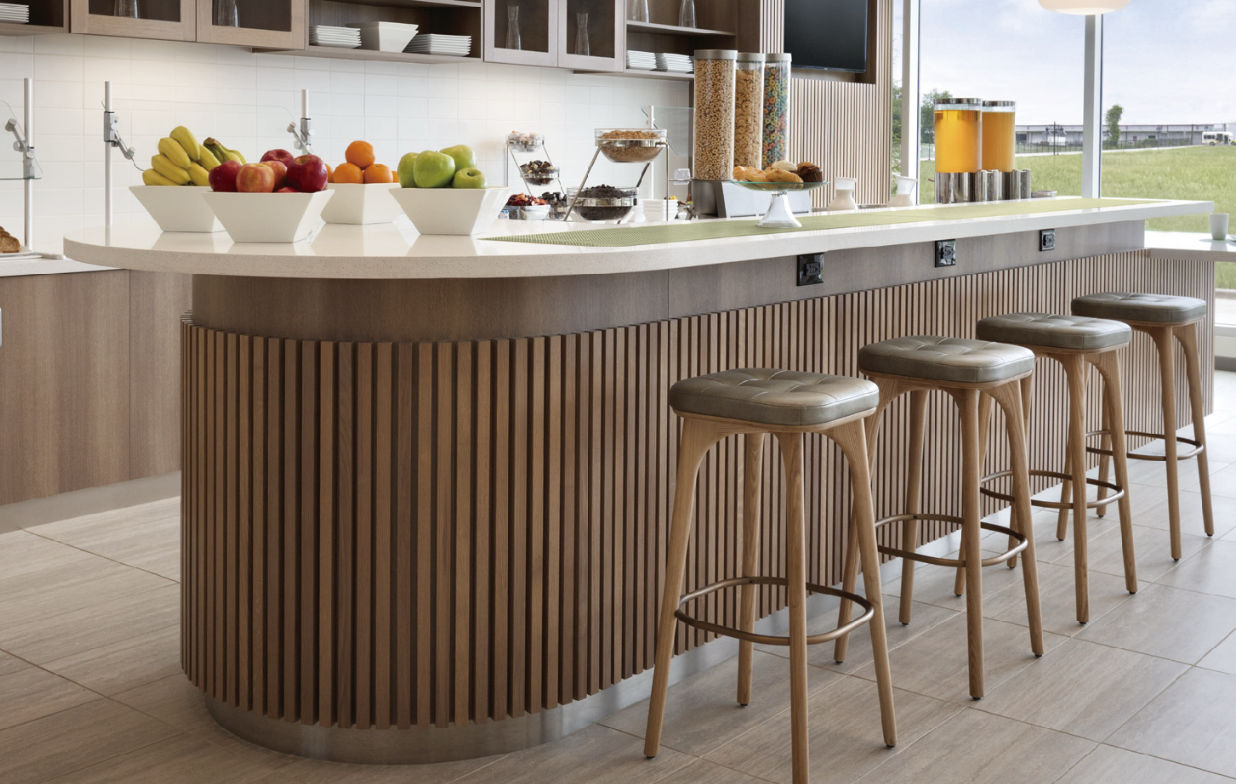
- Restaurants and bars. F&B furniture is specified harder than guestroom furniture because it faces food, heat, and constant movement. Budget for commercial-grade tables, booth seating, and bar stools with reinforced construction and easy-clean finishes.
- Meeting rooms and ballrooms. Stacking chairs, mobile tables, and banquet systems: expect $250–$600 per seat for quality systems, plus joinery and audiovisual-integrated millwork.
- Corridors. Easily overlooked, corridors carry carpet, signage, lighting, and occasionally art programs — often $2,000–$5,000 per floor before guestroom doors.
- Outdoor areas. Terrace, pool, and garden furniture must survive weather and UV: $400–$1,200 per piece in weather-rated contract grade, rising for teak and powder-coated metal systems.
Commercial Kitchen
A five-star hotel’s kitchen and F&B back-of-house is a separate capital project. For a full-service five-star property, plan $600,000–$2.5 million depending on the number of outlets and kitchen type:
- Heavy equipment: cooking lines, combi ovens, grills, fryers, charbroilers.
- Cold chain: walk-in coolers, blast chillers, refrigeration, ice machines.
- Warewashing: dishwashers, glass washers, pot washers.
- Stainless systems: prep tables, shelving, fabrication lines, hoods and ventilation integration.
- Installation: gas, electrical, water, and ventilation hookups typically add 10–15% on top of equipment cost.
A single commercial kitchen outlet can absorb $150,000–$400,000 in equipment alone. If your five-star program has three outlets plus room service and banqueting, the kitchen share of the total budget is real — budget it as its own line item from day one. For a deeper breakdown, read our Commercial Kitchen Equipment Import from China guide.
Other Costs
Furniture is the price you see; the cost of delivering it is where budgets leak.
- Shipping & freight: 8–12% of manufacturing cost for container ocean freight from Asia to major ports (higher for landlocked or island destinations).
- Customs & duties: import duties and tariffs vary by country and product classification — get a landed-cost calculation before you commit to a supplier.
- Installation: skilled labor, sometimes union in some markets, runs 5–10% of product value and is rarely negotiable downward.
- Design changes: every post-approval change to drawings, finishes, or dimensions adds cost and schedule. A well-managed project keeps change orders under 5% of budget; a poorly managed one sees them exceed 15%.
- Project management: professional procurement/PM fees typically run 5–8%.
- Quality inspection: pre-shipment inspection and factory audits cost far less than the defects they prevent — usually under 1% of the furniture budget and frequently recovering 10x that in rejected goods.
Where Does the Money Actually Go?
As a rule of thumb for a five-star project, the furnishing dollar splits like this:
| Share | Where It Goes |
|---|---|
| ~55–65% | Guest room furniture and case goods |
| ~20–30% | Public areas and F&B furniture |
| ~5–8% | Artwork, décor, and accessories |
| ~12–18% | Freight, customs, installation, and PM |
Two conclusions fall out of this split. First, the guest room is where volume leverage lives — standardize it, and you control the largest line. Second, public areas are where differentiation lives — resist the urge to “save” there, because that is where guests form brand opinion. The procurement skill is knowing which is which on every line item.
How to Build a Five-Star FF&E Budget, Step by Step
The most reliable way to cost a five-star furnishing project is not multiplying an average by your room count. It is building a product schedule — a room-by-room, category-by-category list of every piece at your intended specification — and pricing it line by line. Here is the sequence procurement teams use:
- Define the scope. List every room type, every public space, and every F&B outlet. A 100-room hotel with 10 suites, a ballroom, and three restaurants is a different project than one with flat room types and a single outlet.
- Build the product schedule. Count every piece per room: beds, headboards, nightstands, desks, wardrobes, lounge seating, lighting, curtains. Repeat for lobbies, corridors, restaurants, bars, and meeting rooms. This becomes your procurement bible.
- Assign specification tiers. Mark each line as standard contract-grade, custom, or statement. Standard lines are where you buy volume; custom and statement lines are where you spend deliberately.
- Price at the intended quality level. Price the schedule against current 2026 manufacturer rates at your target materials, not against retail or outdated averages. This is where a sourcing partner earns its keep — the same line item can vary 3x between residential-grade and true commercial five-star specification.
- Layer in the multiplier costs. Add kitchen equipment, public-area allocation, OS&E, freight, customs, installation, project management, and a 5% contingency. Most underfunded budgets fail at this step, not at the furniture line.
- Stress-test the number. Re-run the schedule at low, mid, and high material grades. You now have a defensible range for your lender, your architect, and your ownership — not a guess.
A structured product schedule beats any per-key average because it reflects your room mix and your brand standards. The per-key figures in this guide are the starting frame; the schedule is the working budget.
New Build vs Renovation: How the Cost Changes
Whether you are opening a new property or refurbishing an existing one changes the furnishing budget more than any single design decision. The chart below is based on typical five-star projects across markets:
| Factor | New Build | Renovation / PIP |
|---|---|---|
| Furniture cost per key | Base benchmark | 15–25% higher |
| Key drivers | Volume, clean logistics, planned phasing | Access constraints, custom sizing, phased delivery |
| Room closure impact | None (pre-opening) | Revenue loss of $15K–$50K per day while rooms are out of service |
| Brand-mandated upgrades | Design-led from the start | PIP requirements add compliance scope (fire & life safety, brand standards) |
| Best sourcing strategy | Full-package, container-optimized volume order | Floor-by-floor phased production to match closure windows |
Renovations cost more per key because you are working inside a live building: tight doorways and corridors, no staging space, elevator logistics, and rooms that must reopen to paying guests on a fixed date. If you are planning a renovation, our Hotel PIP Cost Guide 2026 covers the per-room breakdown in detail.
Total Landed Cost: The Number That Matters
Factory price is a sales figure. Total landed cost is what the furniture actually costs when it is sitting in your hotel. The components:
- Manufacturing cost (FOB) — the factory price, typically 55–70% of the landed figure.
- Ocean freight and inland transport — 8–12% of manufacturing cost, higher for landlocked or island destinations.
- Customs, duties, and port handling — varies by country and product classification; some markets also apply anti-dumping or tariff lines on specific furniture categories.
- Warehousing and local delivery — often forgotten when the port is not your front door.
- Installation labor — 5–10% of product value.
- Project management and inspection — 5–8% and under 1% respectively.
When you compare a Chinese factory quote against a local supplier, always convert both to landed cost with the same assumptions. Done correctly, China-sourced contract furniture still lands 20–40% cheaper than local production and 40–60% cheaper than Italian imports at the same specification — which is why international operators keep buying there even after freight and duties.
Why Many 5-Star Hotels Source Furniture From China
The largest hotel furniture production capacity in the world sits in China, concentrated in clusters like Foshan (Guangdong) for commercial furniture, plus hubs for metalwork, lighting, and soft goods. That concentration creates three structural advantages:
- Cost. Contract-grade five-star furniture from China typically costs 30–50% less than equivalent European or North American manufacturing, and 40–60% less than Italian imports at the same specification. The savings come from integrated supply chains, purpose-built factories, and scale — not from cutting quality, which is why the largest hotel brands and international operators source there.
- Capacity and speed. A Foshan-scale factory runs dedicated lines for beds, case goods, and seating. A 200-room order that would stretch a local workshop for a year is routine production. Typical timelines: 8–14 weeks production, 2–4 weeks ocean freight.
- Customization at volume. Five-star design requires bespoke pieces — unusual dimensions, branded details, specialty finishes. Chinese contract manufacturers handle custom work as the norm, not as a premium side service.
The legitimate concern is not cost or quality — it is coordination risk: supplier verification, spec control, and QC across an ocean. That risk is manageable with the right process, which we cover next. Buyers who skip the process are the ones who end up with sample-vs-bulk drift; buyers who run it get five-star quality at a fraction of the price.
China vs Local Suppliers: Cost Comparison
Based on 2026 market pricing for equivalent five-star specification (guestroom furniture package, China contract-grade vs domestic and Italian):
| Factor | China Sourcing | Local / Domestic | Italy / Europe |
|---|---|---|---|
| Furniture cost per 5-star room | $15,000–$35,000 | $25,000–$55,000 | $45,000–$72,000+ |
| Custom millwork capability | Strong, standard capability | Good, often limited volume | Excellent, premium |
| Lead time (production) | 8–14 weeks | 4–10 weeks | 12–20+ weeks |
| Freight & duties | Higher (ocean freight + duties) | Low | Higher than local |
| QC requirement | Structured process required | Easier in-person inspection | Structured process required |
| Full-package capability | Very strong (FF&E + OS&E + kitchen) | Partial | Partial |
| Best fit | Large new builds, volume, cost optimization | Tight schedules, small orders | Flagship, heritage brands |
The honest comparison is total landed cost, not unit price. When you compare a China quote with freight, duties, and inspection included, the advantage typically lands at 20–40% versus local manufacturing and 40–60% versus Italy — for the same materials, finish, and fire ratings. That is the number that justifies the coordination effort on a five-star project.
How Skyline Trading Helps Hotel Projects
Skyline Trading is a China-based sourcing and manufacturing partner for hospitality projects — custom hotel furniture, restaurant fit-outs, commercial kitchen equipment, OS&E support, quality control, and logistics. What that means in practice is that a five-star owner gets the China cost advantage without managing Chinese suppliers alone.
The risk-reduction model is concrete:
- One contract, one coordinator for furniture, kitchen equipment, and OS&E — no split orders, no missing pieces, no logistics gaps between five separate suppliers.
- Factory matching to your product mix — we match verified manufacturers (including Foshan furniture hubs) to your room types, finishes, and volume, not the nearest salesperson.
- Specification control — commercial-grade materials and finishes written into the contract, so you do not receive residential-grade bulk product under a hospitality label.
- QC before payment and before shipment — production monitoring, mid-production checks, and pre-shipment inspection against agreed specs.
- Landed-cost transparency — freight, customs path, and documentation managed with clear numbers, not surprises.
Factory Audit Process
Before a single piece is produced, verified factories get audited. A structured audit is the difference between a good supplier and a good supplier on paper. The standard audit covers five areas:
- Capacity and line structure — dedicated production lines, annual output, whether your order fits without displacing other commitments.
- Equipment — CNC machinery, finishing booths, drying kilns, upholstery stations, and whether they can hold your tolerances.
- Certifications and compliance — fire ratings, VOC/emissions documentation, export documentation, and brand-required certificates.
- Process control — how samples are retained, how batch tolerances are checked, and how defects are reworked or rejected.
- Financial and order health — order book load, payment terms, and stability indicators that predict on-time delivery.
For a practical walkthrough of what a real audit report looks like, see our China Factory Audit Guide and Supplier Verification pages.
Quality Control Before Shipment
Sample approval is the milestone that protects your budget — but it only protects the sample. Bulk production drifts. The QC sequence that prevents sample-vs-bulk failure:
- Pre-production meeting. Confirm drawings, materials, finishes, and dimensions in writing before production starts.
- First-article inspection. Check the first finished pieces against the approved sample and your spec sheet, not against the factory’s memory.
- Mid-production inspection. Random sampling of pieces on the line — catches wood-grain, finish, and hardware issues while they are still cheap to fix.
- Pre-shipment inspection (PSI). A final batch check against a defined AQL (acceptable quality level) before containers are sealed.
- Packing and container loading. Verify carton construction, palletizing, moisture protection, and loading order for fragile pieces.
The cost of this sequence is usually under 1% of the furniture budget. The cost of skipping it — a failed batch shipped across an ocean — is an order of magnitude higher. This is the difference between sourcing from China and sourcing well from China.
Custom Furniture Manufacturing Process
A five-star order is rarely catalog furniture. The manufacturing process for custom pieces follows a repeatable path:
- Design and engineering. Your drawings and reference images become production drawings with dimensions, materials, and hardware specified.
- Material selection and costing. Wood grade, veneer, fabric, foam density, and finishes are locked to the budget before any cutting.
- Sample approval. A physical sample is produced, photographed, and approved — this is the reference standard for the entire order.
- Bulk production. Dedicated lines run the order to the approved sample, with QC checkpoints along the way.
- Finishing and QA. Final finishing, hardware fitting, and inspection against the AQL before packing.
- Packing, freight, and delivery. Export packing, container loading, ocean freight, customs path, and delivery coordination.
For the full detail, read our Custom Hotel Furniture Manufacturing Guide and Hotel Furniture Manufacturing Process pages.
Smart Hotel Technology and Furniture Integration
Five-star guests expect technology to be invisible but present — and in 2026 the furniture itself carries it. A smart-enabled room adds a defined premium to the furnishing budget, typically $1,500–$4,000 per key depending on the control layer. Budget it as part of FF&E, not as a separate IT line, or it will be cut first when the project runs tight.
| Integration | What It Covers | Added Cost per Key |
|---|---|---|
| Power and data in furniture | USB-C and wireless charging in headboards, desks, and nightstands | $300–$800 |
| Motorized window treatments | Blackout and sheer automation tied to bedside control | $400–$1,200 |
| Smart bedside control | One-panel control of lighting, curtains, TV, and room modes | $500–$1,500 |
| Guest room automation | Occupancy sensors, climate response, energy reporting | $400–$1,200 |
| Lighting scenes | Programmed scenes, tunable white, mood presets | $300–$900 |
The practical rule: specify the power, data, and control points before furniture production, because cable management and driver housings are built into the case goods and headboards. Retrofitting a wired bedside control panel after the furniture is finished costs three to four times the planned integration. Chinese contract manufacturers routinely build charging, drivers, and low-voltage control into headboards, nightstands, and desks during production — which is one more reason the smart budget goes farther when sourced with the furniture, not after it.
For the broader picture of control systems and building integration, see our Smart Home Technology guide and Building Automation Sourcing page.
Sustainability Considerations in Hotel FF&E
Sustainability is no longer an optional hotel marketing line — it is a procurement requirement. Five-star brands increasingly require certifications, and properties pursue green building standards that have furniture-specific credits. The good news for buyers: sustainable specification at contract scale costs 3–8% more, and is often partially offset by energy savings in lighting and HVAC-linked controls.
- FSC-certified wood and veneers — documentation that material came from certified responsible forestry; a common brand and green-building requirement.
- Low-VOC and GREENGUARD-certified finishes — floor-level air quality that guests and regulators both notice; emissions documentation is now standard in Chinese contract manufacturing.
- Recycled-content metals and fabrics — from aluminum bed frames to PET-recycled upholstery; most large Chinese furniture clusters have dedicated recycling supply lines.
- Durability as a sustainability strategy — a piece that lasts 10 years instead of 3 is the most defensible environmental claim a hotel can make; commercial-grade construction is itself the green choice.
- Packaging reduction — reusable pallets, reduced corrugate, and container-optimized packing cut waste and freight volume together.
Certification documentation is one of the five areas a factory audit verifies, and it must be in the contract before production — retroactive certificates do not exist.
Five-Star FF&E Budget Checklist
Use this checklist when your furniture schedule is being priced. If you cannot tick every line, the budget is not finished:
- Room-by-room product schedule completed for every room type, priced at the intended specification level
- Suite and penthouse costs included at 1.5–3x the standard room rate
- Public areas allocated at 20–30% of total furnishing spend, including lobby at $150–$300 per square foot
- Commercial kitchen and F&B equipment budgeted as a separate line ($600K–$2.5M for full-service)
- OS&E line added at 10–20% on top of FF&E ($2,500–$6,000 per key)
- Freight, customs, warehousing, and local delivery converted to a single landed-cost comparison
- Installation labor at 5–10% of product value
- Project management at 5–8%
- Pre-shipment inspection and factory audit budgeted (under 1% of furniture cost)
- 5% contingency reserved for design changes and material fluctuation
- Production and delivery timeline matched to your opening date, with buffer
For a working tool, Skyline’s Hotel Furniture Budget Guide includes a downloadable interactive estimator covering every line item for a 100-room property — furniture, bathroom, lighting, smart systems, soft furnishing, logistics, and contingency.
How to Choose a Hotel Furniture Manufacturer in China
Cost is the reason buyers go to China; the manufacturer is the reason budgets hold or break. These are the criteria that separate a five-star supplier from a commodity shop:
- Hotel contract experience. Ask for completed five-star and four-star projects with references, not just renderings. A factory that has shipped hotel-grade case goods to international brands understands rub counts, fire ratings, and brand tolerances that a residential shop does not.
- Dedicated production lines. Beds, case goods, and upholstery each need proper equipment — panel saws, CNC routers, finishing lines, sewing and upholstery stations. Visit or audit the lines your order will actually run on.
- In-house finishing and QC. Finishing quality is where most hotel furniture fails. Confirm in-house finishing booths and an inspection process with defined AQL levels, not a loose promise of “we check everything.”
- Export documentation capability. Your project needs correct commercial invoices, packing lists, and certificates for customs. A manufacturer without export experience will stall your delivery, not your design.
- Capacity for your order size. The biggest risk in Chinese sourcing is not quality — it is a factory that accepts your order and deprioritizes it. Audit the order book and the line availability before you commit.
For more on the verification process, see China Factory Audit Guide, China Supplier Verification, and our guide to custom hotel furniture from Foshan.
Common Mistakes Buyers Make
From real projects, these are the recurring mistakes that blow five-star furnishing budgets:
- Budgeting furniture only. Forgetting fixtures, lighting, soft goods, and OS&E. These lines add 40–60% on top of “furniture.”
- Comparing unit price without landed cost. The factory price is not the delivered price. Freight, duties, and inspection decide the real comparison.
- Skipping the physical sample. A render is not a sample. Approving drawings without touching materials invites bulk disappointment.
- Buying residential grade for hospitality use. It fails at roughly one-third the service life and the replacement costs more than the savings.
- No quality inspection before shipment. Rejecting goods after they cross an ocean is the most expensive procurement mistake in the book.
- Treating design changes as free. Every post-approval change adds cost and schedule. Freeze the spec early.
- Ignoring brand standards in the furniture spec. Five-star chains audit compliance at pre-opening. A room that looks right but fails rub counts, fire ratings, or ADA clearances gets reworked — at the developer’s cost.
- Buying artwork and accessories last. These lines run 10–20% of the furnishing budget and are almost always underbudgeted, then rushed at full retail price in the final weeks before opening.
- Splitting one project across too many suppliers. Each new factory means a new MOQ, a new QC visit, and a new chance for finish mismatch. Standardizing across two or three factories saves 10–15% and most of the coordination risk.
- Using a single freight quote. Rates swing with container availability and season. Getting two or three quotes and locking space 6–8 weeks before shipping avoids both premium rates and opening-date slippage.
- Forgetting the phasing plan for renovations. In a live property, floor-by-floor delivery sequencing is not a logistics detail — it is the difference between an open floor and a revenue hole.
- Accepting the lowest quote without a factory audit. The cheapest bid on paper is often the most expensive after defects, delays, and rework. Audit first, then negotiate.
- No contingency for materials inflation. Hardwood, metal, and freight prices move within a booking window. A fixed 5% contingency line protects the whole project from a single commodity spike.
Expert Recommendations
Build the budget as one system. Start with a room-by-room product schedule (count every piece, price every piece at your spec level), then layer on public areas, kitchen, OS&E, and logistics. A product schedule priced in your intended specification is more reliable than any per-key average — it reflects your scope, not an industry mean.
Add a 5% contingency and freeze the spec early. Then use the China advantage deliberately: standardize guest rooms for volume pricing, spend the savings where guests form opinion — lobby, beds, and F&B — and protect every batch with a sample-first QC sequence.
For a complete cost structure at the property level, see our Hotel Furniture Budget Guide (100-Room) and the Hotel PIP Cost Guide. For the full procurement picture, start at the China Procurement Knowledge Hub.
Frequently Asked Questions
How much does it cost to furnish a 5-star hotel in 2026?
Furnishing a 5-star hotel in 2026 costs roughly $35,000 to $120,000+ per room (per key) for FF&E — furniture, fixtures, lighting, and soft furnishings, including the property’s share of public areas. A standard 100-room five-star hotel typically allocates $4 million to $8 million for FF&E before OS&E.
How much does it cost to furnish a 5-star hotel room?
A standard 5-star guest room costs $6,700 to $19,300 in furniture alone, with a total FF&E allocation of $35,000 to $80,000+ per key once public-area share, design, QC, and logistics are included. Suites and penthouses cost 1.5 to 3 times more.
What is the difference between FF&E and OS&E?
FF&E (Furniture, Fixtures & Equipment) is capital expenditure — beds, case goods, lighting, carpets, and restaurant equipment lasting 7–10+ years. OS&E (Operating Supplies & Equipment) is operating expense — linens, amenities, tableware, and small appliances replaced every 1–3 years. OS&E adds 10–20% on top of FF&E.
How much should I budget for a 100-room 5-star hotel?
A 100-room 5-star hotel typically budgets $4.5 million to $6.5 million for FF&E plus roughly $540,000–$780,000 for OS&E — a total furnishing budget of about $5 million to $7.3 million.
Is it cheaper to source hotel furniture from China?
Yes. Contract-grade 5-star hotel furniture from China costs 30–50% less than equivalent European or North American production and 40–60% less than Italian imports at the same specification. After freight, duties, and inspection, the landed-cost advantage is usually 20–40% versus local manufacturing.
How long does it take to manufacture and ship hotel furniture from China?
Typical timelines are 8–14 weeks for production plus 2–4 weeks for ocean freight, depending on order volume, customization, and destination port.
What hidden costs should a 5-star hotel FF&E budget include?
Allocate 8–12% for shipping, customs duties where applicable, 5–10% for installation, 5–8% for project management, and up to 1% for pre-shipment inspection. Budget 12–18% total for logistics, freight, and installation on top of manufacturing cost.
How much does commercial kitchen equipment add to a hotel furnishing budget?
A full-service 5-star hotel’s kitchen and F&B equipment typically costs $600,000 to $2.5 million depending on the number of outlets, with installation adding 10–15% on top.
How much should I allocate for hotel public areas?
Public areas consume 20–30% of the total furnishing budget. A useful benchmark is $150–$300 per square foot of furnished lobby area, with 15–20% reserved for signature statement pieces.
What is a hotel cost per key?
Cost per key is the total furnishing budget divided by the number of guest rooms. It includes each room’s own furniture plus an allocated share of lobbies, corridors, restaurants, meeting rooms, and back-of-house — the standard unit lenders and developers use to compare hotel projects.
How much does it cost to furnish a 50-room 5-star hotel?
A 50-room 5-star hotel typically budgets $2.25 million to $3.25 million for FF&E at $45,000–$65,000 per key, plus $270,000–$390,000 for OS&E. Smaller properties absorb a larger public-area share per key, so the total lands at roughly $2.5 million to $3.6 million.
How much does it cost to furnish a 200-room 5-star hotel?
A 200-room 5-star hotel typically budgets $9 million to $13 million for FF&E, plus $1.08 million to $1.56 million for OS&E — a total furnishing budget of about $10.1 million to $14.6 million. Ballrooms, multiple F&B outlets, and spa facilities add separate cost centers on top.
How do hotels buy furniture from China?
Hotels buy furniture from China through a structured process: define the product schedule and specifications, select and audit factories, approve physical samples, run production with mid-production checks, perform pre-shipment inspection against an AQL, and coordinate freight and installation. A China-based sourcing partner manages these steps as one contract.
Which city in China is best for hotel furniture manufacturing?
Foshan in Guangdong Province is the largest commercial hotel furniture manufacturing cluster in China, with dedicated lines for beds, case goods, seating, and upholstery. Surrounding hubs in Guangdong also supply metalwork, lighting, and soft goods, allowing full-package sourcing from one region.
What is a hotel furniture factory audit?
A hotel furniture factory audit verifies capacity, equipment, certifications, process control, and order health before production starts. It covers production lines, CNC and finishing equipment, fire and VOC compliance documents, batch tolerances, and whether your order can run without being deprioritized.
How does pre-shipment inspection work for hotel furniture?
Pre-shipment inspection (PSI) is a final batch check against an approved sample and your specification sheet, using a defined AQL (acceptable quality level). It is performed before containers are sealed and covers materials, finish, dimensions, hardware, and packing. PSI typically costs under 1% of the furniture budget.
Can Chinese factories produce custom hotel furniture to brand standards?
Yes. Large Chinese contract factories treat custom work as the norm — unusual dimensions, branded details, specialty finishes, and brand-required fire ratings are standard capability, not premium side services. The key is specification control written into the contract and verified through samples and inspection.
What should a hotel furniture sample approval include?
A hotel furniture sample approval should verify materials, finish, dimensions, hardware, fire ratings, and workmanship against your specification — not just a rendering. The approved physical sample becomes the reference standard for the entire bulk production run and the basis for final inspection.
Does China sourcing affect hotel FF&E quality?
Quality depends on the manufacturer and the inspection process, not the country. China’s largest hotel furniture factories supply international five-star brands at contract quality. Buyers who run factory audits, approve physical samples, and inspect before shipment get consistent commercial-grade product; buyers who skip those steps take the risk.
How much should a hotel budget for logistics on FF&E?
Logistics, freight, and installation typically add 12–18% on top of the furniture manufacturing cost. This covers ocean freight (8–12%), customs duties as applicable, warehousing, local delivery, and installation labor. Budgeting these lines from the start prevents 20–30% budget overruns.
Get a Hotel Furniture Cost Estimate
Every five-star project is different — room mix, brand standards, materials, and destination all move the number. If you are budgeting a hotel, resort, or renovation, send your room count, categories, and finish level to the Skyline procurement team. You will get a realistic FF&E budget range, factory-matched sourcing options, and a clear landed-cost picture — no obligation.
Before you write the brief, download the 2026 Hotel FF&E Procurement Guide (PDF) — a working reference of the line items, benchmarks, and checklists in this article, formatted for your project folder.
Request a hotel furniture quotation → | Hotel & Restaurant Solutions | Luxury Villa Furniture