
Hospital Administrative & Staff Area Furniture from China — A Sourcing Guide for Doctors’ Offices, Staff Lockers, Meeting Rooms, and Support Furniture
Last updated: August 2026 | By Angelica ED — General Manager, 15 Years in China Sourcing & Factory Audits
Sources cited: VESA Mounting Interface Standard (MIS-D, MIS-E, MIS-F), EN 1021-1 / EN 1021-2 (upholstered furniture ignitability), BS 5852 and BS 7176 (ignition resistance of non-domestic seating), ASTM D1308 (chemical resistance of coatings), ASTM B117 (salt spray, referenced for coastal locker hardware), ANSI/BIFMA X5.1 (desk and chair durability), industry factory benchmarks, made-in-china.com supplier data.
Key Takeaways — 30-Second Summary
- Scope: This guide covers furniture for hospital staff and administrative areas only — doctors’ offices and consultation desks, staff lockers and changing-room wardrobes, meeting and conference rooms, general office workstations and storage, and TV/monitor wall mounts. It does not cover patient-care furniture, exam room equipment, or clinical devices, which are regulated to different fire and safety standards.
- Materials: Powder-coated steel for frames, hardware, and lockers; melamine-faced board (E0/E1 grade) for desks and cabinetry; solid surface (acrylic) for high-frequency disinfectant wipe-down areas such as consultation counters. All three withstand repeated cleaning with hospital-grade disinfectants when correctly specified.
- Lockers: Powder-coated steel or phenolic laminate bodies, louvered ventilation, and hardware that survives quaternary ammonium and bleach-based wipes. Plan 1,800 × 300 × 450 mm single-tier or 1,800 × 300 × 450 mm double-tier units; choose cam, key, or electronic locks by department risk.
- Meeting rooms: Specify 25 mm-plus melamine or solid-surface tops, steel legs, and mid-back chairs tested to EN 1021-1/-2. Institutional meeting rooms run 24/7, so contract-grade construction beats office-grade in cycle testing.
- TV mounts: Match the mount to the display’s VESA pattern (100×100 to 600×400 mm) and load rating. Fixed mounts suit corridors; articulating mounts suit offices and meeting rooms. Confirm the wall substrate (drywall stud, concrete, or masonry) before ordering, and route cables through an integrated channel.
- Budget: MOQ 10-50 pieces per design for panel furniture, 20-50 for steel lockers. Plan 12-18 weeks from purchase order to site installation. Landed cost is roughly 1.8-2.2× FOB once freight, duty, clearance, and installation are added.
- Introduction: The Category Between Two Disciplines
- Why This Category Gets Overlooked in Hospital FF&E Planning
- Category Breakdown at a Glance
- Doctors’ Office & Consultation Desk Furniture
- Staff Lockers & Changing Room Furniture
- Meeting & Conference Room Furniture
- TV & Monitor Wall Mounts
- Material & Finish Comparison
- Fire Safety & General Institutional Compliance
- Real FOB Pricing Ranges
- Landed Cost Breakdown
- Supplier Comparison & Red Flags
- Cost-Saving Strategies for Institutional Bulk Furnishing
- Factory Verification Checklist
- Quality Control & Inspection Points
- Shipping Timeline
- Step-by-Step Procurement Checklist
- FAQ
- Related Resources
- A Note From the Founder
Introduction: The Category Between Two Disciplines
Hospital furniture procurement splits into two well-trodden lanes. On one side sits clinical furniture — patient beds, exam tables, treatment chairs — governed by strict fire, structural, and anti-self-harm regulations that vary by market and by department. On the other sits standard office furniture, bought against corporate specs that assume an eight-hour day, occasional cleaning, and replacement on a five-to-seven-year cycle.
Hospital administrative and staff furniture lives in neither lane. A doctor’s desk sees the same laptop, documents, and disinfectant wipes as any clinical surface, but nobody tests it to clinical standards. A staff locker room runs three shifts of scrubs, showers, and damp towels through the same bodies of steel every day. A meeting room in a hospital can be booked from 07:00 to 23:00 with barely a break between sessions, a duty cycle that would wear out a typical corporate boardroom table in a couple of years. And a corridor wall TV in a hospital gets cleaned with aggressive chemicals that strip cheap powder coating and corrode zinc hardware.
The result is an “in-between” category that is easy to under-specify. Buyers either import general office furniture and discover it fails the cleaning regime, or they over-specify patient-area furniture and pay for certifications and construction they do not need. Getting this category right means understanding three things: which cleaning chemicals the furniture must survive, how many hours a day it will actually be used, and where the line sits between general institutional compliance and the stricter patient-care regulations that this guide deliberately does not cover.
This guide is written for hospital procurement managers, healthcare facility developers, contractors, and FF&E consultants sourcing non-clinical furniture for hospital staff and administrative areas from Chinese manufacturers. It covers doctors’ offices, staff lockers, meeting and conference rooms, general workstations and storage, and TV/monitor wall mounts — with material selection, real FOB pricing ranges, landed-cost math, factory verification, inspection points, and a shipping timeline you can plan against.
If you are sourcing hospital staff-area furniture and need help writing a specification or vetting a Chinese factory, email our procurement team for a complimentary supplier assessment.
Why This Category Gets Overlooked in Hospital FF&E Planning
In most hospital projects, the FF&E budget is written around what visitors and regulators see first: patient beds, examination equipment, treatment rooms, and the departments that generate revenue. Those line items are specified early, reviewed carefully, and given long lead times. Administrative areas — the doctors’ offices, staff changing rooms, meeting rooms, and back-office workstations — are treated as an afterthought, often consolidated into a single lump line on the budget sheet and left for the procurement team to resolve in the final weeks before handover.
That is the precise moment problems get baked in. When administrative furniture is bought late, it is bought from whatever supplier can deliver fastest, not from the supplier that actually builds the right product. The result shows up as a specific pattern across healthcare facility projects across the Gulf: rust on locker frames within eighteen months, delaminating desk tops in heavily cleaned consultation offices, meeting chairs with broken gas lifts after a year of continuous bookings, and wall TVs held by mounts that were never checked against the display’s VESA pattern.
There are structural reasons this category keeps falling through the gaps. The clinical procurement team usually has clinical expertise but no office-furniture spec book. The facilities team has a maintenance schedule but no purchasing authority. The architect specifies the room layouts but rarely the furniture in them. Nobody owns the staff-area spec end to end, so the weakest supplier wins by default.
The fix is not complicated. It is the same fix that applies to any procurement line: write the specification before you need the delivery, verify the factory against that spec, and build the timeline backward from the site handover date. Because staff-area furniture is high-volume and low-complexity compared with clinical equipment, it is also one of the most cost-effective places in a hospital project to save money — provided the spec is written correctly in the first place.
One more reason the category gets overlooked deserves attention. Administrative furniture failures are quiet. A corroding locker does not trigger a clinical incident; a delaminating desk does not stop a surgery. Because the failures are cosmetic and gradual, they slip past punch lists and handover inspections, and the replacement cost is absorbed into the operating budget later. That is why the discipline required here is about lifespan and total cost of ownership, not about passing a single inspection.
Category Breakdown at a Glance
The table below summarises the five categories covered in this guide — what each typically includes, the usual materials, indicative FOB ranges, and expected lifespan under daily institutional use. FOB figures are typical ranges from Chinese factories; your actual quote depends on volume, finish, and customisation.
| Category | Typical Items | Common Materials | Typical FOB (USD) | Expected Lifespan |
|---|---|---|---|---|
| Doctors’ office furniture | Desks, consultation desks, return units, bookshelves, task chairs | Melamine-faced board, powder-coated steel, solid surface tops | $120-500 per desk; $60-130 per task chair | 8-12 years |
| Staff lockers & changing rooms | Single/double-tier lockers, wardrobes, benches, laundry carts | Powder-coated steel, phenolic laminate, HDPE for wet areas | $80-150 per single-tier unit | 10-15 years |
| Meeting & conference furniture | Conference tables, meeting chairs, media credenzas, lecterns | 25 mm+ melamine or solid-surface tops, steel legs, upholstered chairs | $180-650 per table; $35-130 per chair | 7-12 years |
| General workstations & storage | Workstations, pedestals, filing cabinets, shelving | Melamine-faced board, steel frames, HPL tops | $60-300 per station; $80-200 per cabinet | 8-12 years |
| TV & monitor wall mounts | Fixed, tilt, and articulating mounts for TVs and monitors | Cold-rolled steel, aluminum, stainless hardware | $8-60 per mount | 10+ years |
Doctors’ Office & Consultation Desk Furniture
Doctors’ offices are the most over-thought rooms in a hospital and the most under-specified. The furniture looks simple — a desk, a visitor chair, some storage — but the operating conditions are specific. The desk top is wiped with disinfectant several times a day. The desk hosts one or two monitors, a keyboard, a phone, and frequently a dictation station. The drawers hold files that must not be visible to visitors. And the person using it may be there for twelve-hour shifts with a visitor sitting across the desk for much of that time.
Desk and Storage Configurations
The workhorse configuration is an L-shaped or straight desk 1,400-1,600 mm wide with a pedestal unit that can be locked. A consultation desk serving one doctor usually pairs a 1,200-1,400 mm writing surface with a return unit carrying the monitor and keyboard, which keeps the writing surface clear for notes and forms. Drawer fronts should be full-extension on ball-bearing slides rated for daily use; cheap roller slides fail in the first year of hospital work.
Storage is where most office-grade products fall short. A doctors’ office needs at least one lockable pedestal drawer for sensitive documents, plus shelving for reference books and supplies. Specify drawer locks on at least the top drawer of every desk; keyed-alike locks across a department simplify key management considerably. Bookshelves should be melamine-faced board with adjustable shelves rated for the weight of medical references, which are heavy.
Material Choices for the Worksurface
Three surfaces dominate hospital administrative worksurfaces, and each has a place. Melamine-faced board (E0 or E1 formaldehyde class) is the default: affordable, available in hundreds of finishes, and its sealed surface resists the alcohol and quaternary ammonium wipes used in most offices. Its weakness is the edge — a poorly sealed melamine edge absorbs moisture and lifts within a couple of years of heavy wiping. When you specify melamine, ask for 2 mm-thick edge banding on all exposed edges, not the 0.5 mm tape used on budget furniture.
High-pressure laminate (HPL) tops add a denser, more impact- and chemical-resistant surface for roughly 20-30% more than melamine. They suit consultation desks and nurse station counters that see constant wiping. Solid surface (acrylic, Corian-type) is the premium option: non-porous, seamless, repairable, and the easiest to keep looking clean under daily disinfectant. It costs the most, but for the handful of high-visibility counters and consultation desks where appearance matters, the premium is justified.
Cable Management for Dual-Monitor Setups
Dual-monitor setups are the norm in hospital administrative offices, and cable management determines whether a desk looks like a professional workspace or a tangle. Specify desks with a cable tray or grommet system at the rear of the worksurface and a vertical channel down the leg to the floor. A 50 mm grommet is the practical minimum for two monitor cables plus keyboard, mouse, and a dock. Require an integrated power module if the desk is freestanding — floating desks with no clear route to a wall outlet become trip hazards and a permanent eyesore.
Task chairs deserve their own mention. Doctors sit for long periods, so specify ergonomic chairs with adjustable lumbar support, seat height, and armrests, tested to ANSI/BIFMA X5.1 or EN 1335. Fabric should be a high-wear contract textile of 50,000+ Martindale rubs; avoid open-weave mesh on the seat pan in humid climates where it traps moisture. Gas lifts on contract-grade chairs should carry a five-year warranty; budget chair gas lifts fail within eighteen months under continuous use.
Staff Lockers & Changing Room Furniture
Staff lockers are the highest-wear, highest-quantity item in this category, and the one most likely to be bought on price alone. That is a mistake. A locker bank for a department of sixty staff runs sixty doors, and each door is opened and closed dozens of times a day, in a room full of humidity, damp scrubs, and chemical cleaning agents. The difference between a locker that lasts twelve years and one that rusts in eighteen months is a small specification difference at ordering time.
Material and Construction
Powder-coated steel is the standard for hospital staff changing rooms. Specify cold-rolled steel in 0.8-1.0 mm body thickness with a full powder-coat finish — doors at 1.0 mm, bodies at 0.8 mm is the common contract specification. The coating is what does the real work: a quality polyester powder coat with proper pre-treatment resists the quaternary ammonium and bleach-based wipes used in healthcare. Demand confirmation of the coating thickness (60-90 microns is typical) and ask whether the factory pre-treats with an iron phosphate or zinc phosphate bath before coating; skip this pre-treatment and the coating chips off within months in a humid changing room.
For changing rooms directly adjacent to showers or pools, consider HDPE or solid plastic lockers for the wettest bays. HDPE is impervious to water and will not corrode, at a higher unit price. Phenolic laminate lockers sit between steel and plastic: chemical-resistant, moisture-resistant, and widely used in healthcare locker rooms, though heavier and pricier than steel.
Ventilation and Moisture Resistance
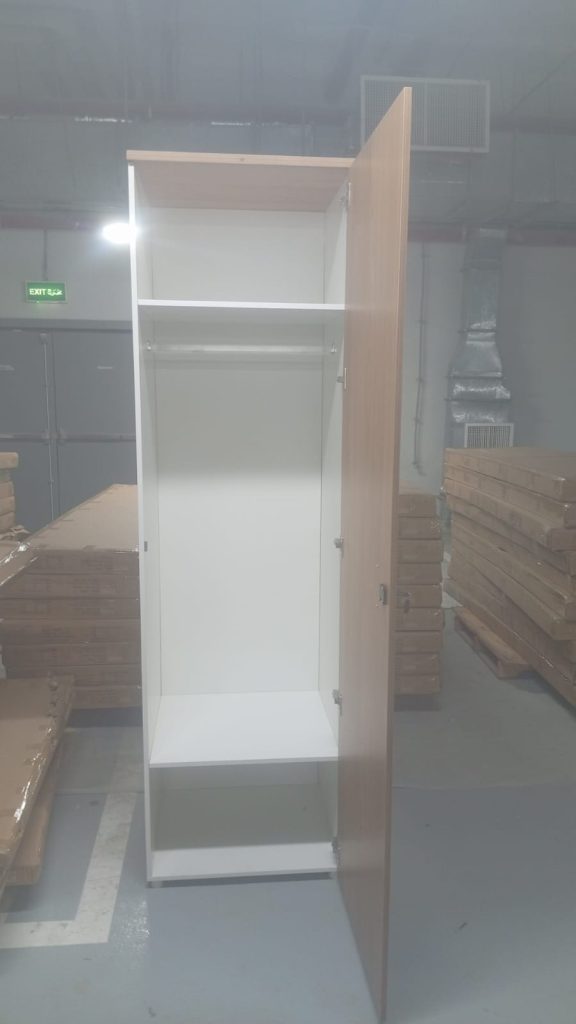
Ventilation is not optional in hospital staff lockers. Wet scrubs and shoes go in at the start of a shift, and without airflow the locker becomes a mold and odor reservoir that no cleaning regime fully fixes. Specify louvered doors — louvres in the upper and lower door sections create a natural convection path that dries contents and prevents stale air. Doors with a single small vent panel are a common cost-cutting compromise that does not move enough air. If the changing room is air-conditioned (as most Gulf hospital staff areas are), the louver pattern also matters for air exchange; a 6-inch-wide louver band on each door is the practical specification.
Moisture resistance extends beyond the door. Hinges and catches should be stainless steel or zinc-plated steel, not raw steel; specify nylon door bumpers to stop metal-on-metal wear. The locker base should be raised on 100 mm legs so floor washdowns and spills do not sit against the body, and the bottom shelf should be solid (not slatted) so small items do not fall through.
Lock Mechanisms
Lock choice follows department risk, not fashion. For most staff changing rooms, a cam lock with two keys per locker is the economical standard, with keyed-alike or master-key options so facilities can open any locker in an emergency. Padlock-compatible hasp-and-staple fittings let staff supply their own padlocks — common in industrial and some clinic settings. Electronic or combination locks add cost but remove the key-management burden and suit departments where staff turnover is high, such as junior doctors and rotating residents.
Whatever the lock, insist on hardware that survives disinfectant. Zinc die-cast locks corrode quickly under hospital cleaning chemicals; specify brass or stainless components for the lock and handle, and confirm this in writing with the factory. The officefurniture2go reference in our sources flags this exact issue: healthcare locker hardware must be stainless steel or solid brass, not zinc die-cast, because zinc corrodes under hospital disinfectants.
Typical Configurations and Sizing
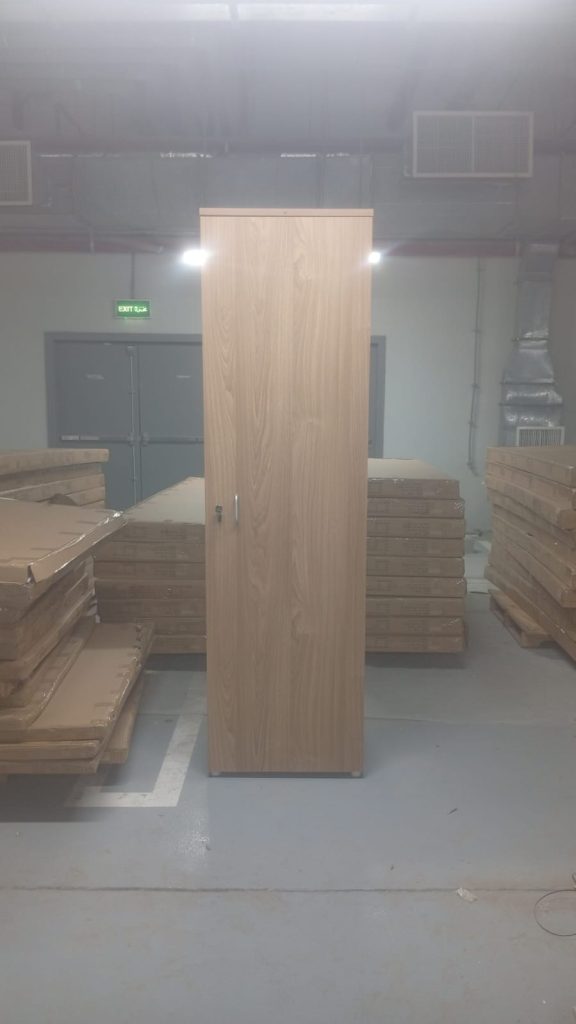
Standard staff lockers are 1,800 mm high × 300 mm wide × 450 mm deep, in single-tier (one door per user, full height for hanging garments) or double-tier (two compartments, each with a shelf, for shorter shifts or lighter storage). Single-tier units include a garment rail and a top shelf; double-tier units trade hanging space for density. For a hospital department, the planning rule of thumb is: full-height single-tier for staff who change into uniforms or scrubs daily, double-tier where lockers hold light personal items between shifts.
Nested banks — multiple units bolted together side by side and top to bottom — maximise floor efficiency. Ask the factory for a bank layout drawing against your actual room dimensions before confirming the order, and remember that every bank needs anchoring to the wall or floor for safety. Include a few half-width or half-height units in every bank run to handle uneven room widths.
Meeting & Conference Room Furniture
Hospital meeting rooms are used differently from corporate meeting rooms, and the difference is the duty cycle. A corporate boardroom is booked for two-hour slots a few times a week. A hospital meeting room is booked continuously — morning handover, department reviews, training sessions, vendor presentations, and evening committee meetings can put ten sessions a day across the same table. The furniture has to survive hundreds of cycles a month, and it has to look professional under lighting that shows every scratch.
Table Construction for Heavy Daily Use
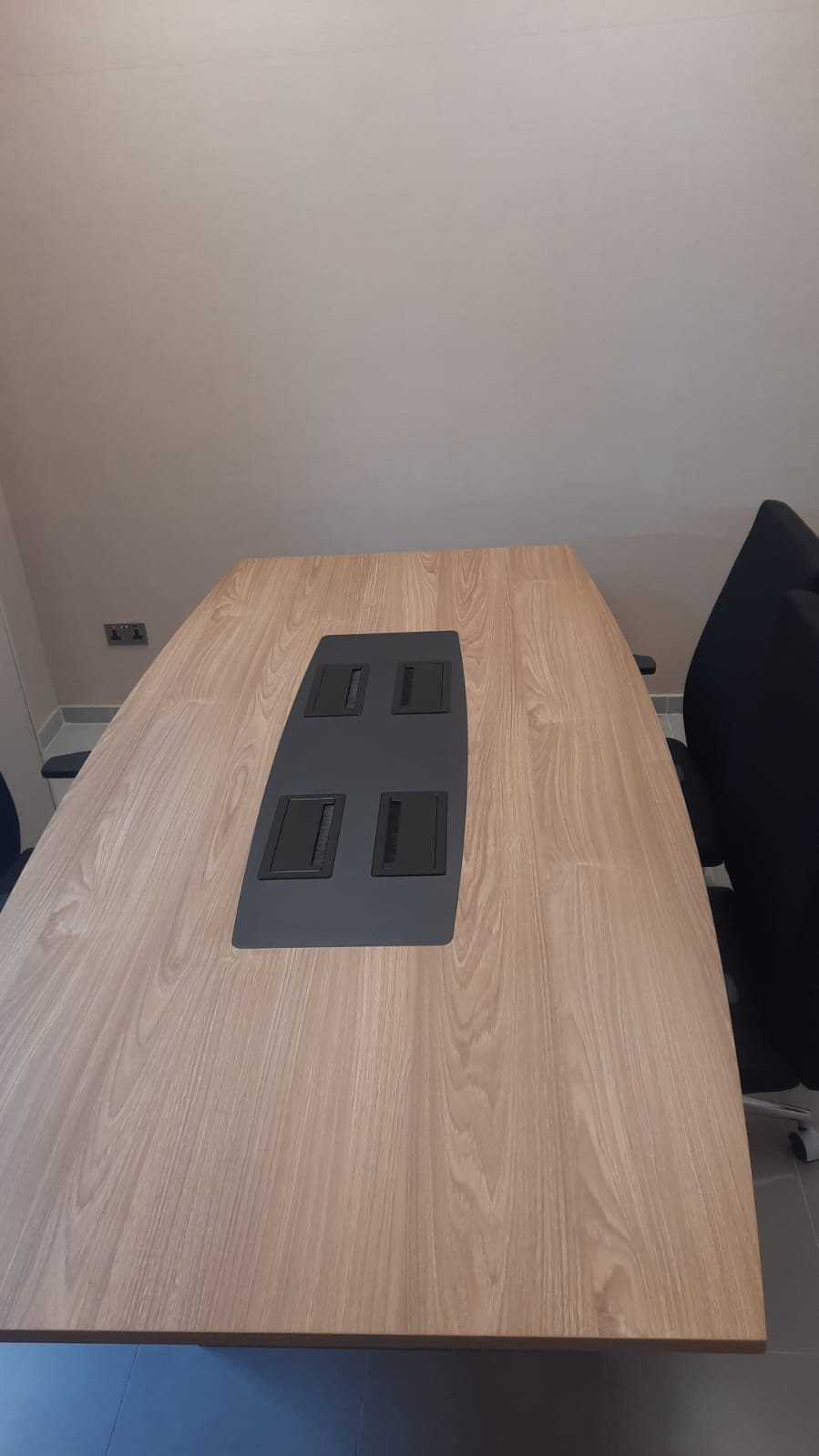
Specify conference tables with a 25 mm or 30 mm melamine-faced board top on a solid steel leg frame — not a thin 18 mm board on plastic legs. The leg frame carries the real load: steel legs with a fixed crossbar spread the load and prevent rocking, which is the failure mode you see in budget meeting tables after a few months of continuous use. If the table is used for teleconferencing, the top needs a grommet or recessed media box at each seat position plus a central cable hatch for the room’s AV equipment.
Boat-shaped and racetrack tables are the standard for video-conferencing rooms because they put every seat within the camera’s field of view. For rooms with an integrated wall screen, specify a table shape that keeps the screen unobstructed — avoid circular tables directly facing a screen mounted in the corner. For training and multi-use rooms, folding or nesting tables on locking castors give the room flexibility; specify tables with a locking brake on at least two castors and a 250 kg+ load rating.
Chair Durability
Meeting chairs in hospitals take a beating. Specify mid-back chairs with a steel or reinforced polyamide base, a five-star base (not four), and a gas lift rated for continuous use. The upholstery should be a contract-grade textile or PU leather that passes EN 1021-1 and EN 1021-2 ignitability tests — the fabric is tested as a composite with the foam, so confirm the factory uses FR foam, not just FR fabric. Stacking chairs for training rooms should have a published stack of 10-15 and welded, not riveted, steel frames.
Video-Conferencing and AV Integration
Video-conferencing rooms need furniture that works with the AV, not around it. Specify a media credenza or AV unit sized for the room’s equipment — a 19-inch rack depth is a practical standard for AV components. Confirm cable routes from the table to the credenza before the furniture order, so the installer does not have to cut channels into a finished floor. If the room has a wall-mounted display, the display height and the table position must be coordinated; a common failure is a display mounted so high that the camera sits above eye line, making participants look down at the far end.
For large boardrooms and committee rooms, add a lectern or presentation stand with a fixed height that matches the presenter’s eyeline to the display, and a locking internal compartment for laptop connections. Specify the lectern in the same material family as the room’s furniture for visual consistency.
TV & Monitor Wall Mounts
TV and monitor wall mounts are the easiest line item in this category to get wrong, because the failure is invisible until something falls off a wall. Mounts are specified on size (“for a 55-inch TV”) rather than on the two numbers that actually matter: the VESA pattern and the load rating.
VESA Standards and Load Ratings
VESA (Video Electronics Standards Association) defines the mounting interface standard for flat displays. The pattern is the horizontal × vertical distance in millimetres between the four mounting holes on the back of the display. The practical scale runs from 75×75 mm and 100×100 mm (small monitors, up to about 14 kg) through 200×200 mm and 300×300 mm (up to about 50 kg), to 400×400 mm and 600×400 mm (large displays, up to roughly 114 kg for MIS-F mounts).
Two rules matter more than any other. First, match the mount’s supported VESA range to the display’s actual pattern — most mounts list a range, and the display’s pattern must fall inside it. Second, check the load rating against the display’s real weight, not its diagonal size. A 55-inch commercial display can weigh 30-40 kg depending on the panel and build; a cheap “55-inch” mount rated for 25 kg is out of spec the day it is installed. The standard also specifies the screws (M4, M6, or M8 depending on the MIS class), and many mount failures trace to using the wrong screw length for the display’s mounting depth.
Fixed vs. Tilting vs. Articulating Mounts
Fixed mounts hold the display flat against the wall, sit lowest-profile, and are the right choice for corridors and public areas where the viewing angle is fixed. Tilting mounts add 5-15 degrees of vertical tilt, useful for displays mounted above eye line. Articulating (full-motion) mounts extend, retract, tilt, and swivel, which suits offices and meeting rooms where the display must serve different viewing positions — at the cost of a deeper profile and a lower load rating at full extension.
For a hospital, the practical split is: fixed mounts for corridor information displays, patient-call screens at staff stations, and waiting-area TVs; articulating mounts for meeting rooms and doctors’ offices where the display must be angled toward the desk. Confirm the mount’s UL or equivalent listing if the project spec requires it, and check whether the factory provides the specific adapter brackets for common display brands — proprietary displays sometimes need an adapter that does not ship with a generic mount.
Wall Substrate and Cable Concealment
The wall is half the mount. A mount rated for 40 kg is only as strong as the wall it is screwed into. In hospitals, corridor walls are often concrete block or drywall over studs; office partitions can be glass or thin metal stud. Confirm the substrate before ordering, and specify the right fixings — concrete anchors for block, toggle bolts or stud-anchored fixings for drywall. The mount spec sheet should state the substrate its load rating assumes; if it does not, ask the factory.
Cable concealment is where hospital installations go untidy fast. Specify mounts with an integrated cable channel, or plan a channel cover from the mount to the floor. Corridor installations should include a route for power and signal cables that does not cross doorways at floor level, and the power outlet position should be set at the same time as the mount position. In humid Gulf coastal hospitals, specify stainless or plated hardware on mounts that will sit in air-conditioned corridors — this is a salt-air durability question, referenced in our sources as ASTM B117 salt-spray testing for coated hardware.
Material & Finish Comparison
The material decision in this category is really a cleaning-frequency decision. The table below compares the three dominant surface families across the factors that matter for hospital staff areas: resistance to repeated disinfectant wipe-down, cost, durability, and the maintenance trade-offs. This is explicitly about staff-area cleaning frequency — a few wipe-downs a day — not clinical infection control, which is outside this guide’s scope.
| Factor | Powder-Coated Steel | Melamine / Laminate (MFC/MDF) | Solid Surface (Acrylic) |
|---|---|---|---|
| Best for | Frames, lockers, legs, hardware | Desk tops, cabinetry, shelving, wardrobes | Consultation counters, high-wipe surfaces |
| Cleanability under daily disinfectant | Excellent — sealed coating resists alcohol and quaternary wipes; keep chemicals off bare edges | Good — sealed surface wipes clean; edges are the weak point | Excellent — non-porous, seamless, easiest to keep looking new |
| Chemical resistance | High when coating is intact; chips expose steel to corrosion | Good to moderate; aggressive solvents can dull the surface over time | High; resists bleach and alcohol, repairable with fine sanding |
| Relative cost | Low to medium | Lowest per square metre | Highest (2-3× melamine) |
| Durability | High in dry areas; rusts if coating is damaged in humid rooms | 8-12 years with sealed edges; edge swell is the failure mode | 10-15+ years; repairable, no repainting |
| Fire class | Non-combustible | Class A/B depending on core | Class B typical |
| Watch-outs | Bare metal at cut edges; zinc hardware corrosion under hospital chemicals | Edge banding quality; moisture ingress at joints | Heat and direct cutting mark it; dark colours show wear |
The practical specification across a hospital staff floor looks like this: powder-coated steel for all frames, legs, lockers, and hardware; melamine-faced board for desk tops, workstations, bookshelves, and wardrobe bodies; HPL where a surface sees heavy wiping (consultation desks, nursing counters); and solid surface for the handful of reception and consultation counters where appearance is part of the brief. Nothing else is required to survive a daily wipe-down regime, and nothing less will hold up to it.
Fire Safety & General Institutional Compliance
Fire safety for hospital staff and administrative furniture is real, but it is important to be precise about what applies and what does not. Patient-care areas — treatment rooms and patient bedrooms — are held to stricter flammability and anti-self-harm standards, including ligature-resistance requirements that have no place in an administrative office. This guide does not cover that category and does not claim expertise in it.
For general non-patient areas, the applicable expectations are those that apply to any institutional building: upholstered furniture should resist ignition from smouldering cigarettes and small flames. The two European standards that dominate contract furniture supply are EN 1021-1 (cigarette test) and EN 1021-2 (match flame test). A chair, meeting chair, or waiting-area seat that passes both is the baseline for office and institutional use. The UK’s BS 5852 / BS 7176 framework adds a higher “Crib 5” test for medium- and high-hazard areas; offices and general staff areas sit in the medium-hazard band, while patient-care settings fall into higher hazard bands that this guide does not cover.
The practical consequence for procurement is straightforward. Ask the factory for EN 1021-1/-2 test reports on every upholstered chair, and confirm the report tests the composite — fabric plus foam — not the fabric alone. For lockers, cabinets, and tables, confirm the materials are non-combustible or low-flame-spread (steel and melamine boards typically qualify) and that any foam in seating is flame-retardant grade. Confirm local code compliance with the project’s fire consultant, because building codes vary by jurisdiction and by the building’s occupancy class.
One warning worth repeating: do not let a supplier substitute a single-ignition-source test for the composite test, and do not accept a fabric-only certificate for a full chair. These are the two most common ways fire compliance gets overstated on budget contract furniture.
Real FOB Pricing Ranges
FOB (Free On Board) prices are what a Chinese factory charges for the goods loaded on the vessel, excluding freight, insurance, and destination costs. The ranges below are typical market figures for contract-grade institutional furniture from Chinese factories, based on factory listings and sourcing benchmarks. Treat them as planning numbers, not quotes — volume, finish, and customisation move every line both ways.
| Item | Typical FOB (USD) | Notes |
|---|---|---|
| Doctors’ office desk (melamine, 1,400-1,600 mm) | $120-250 | With pedestal and cable tray; 2 mm edge banding |
| Executive / consultation desk (HPL or solid surface top) | $250-500 | Denser top, lockable pedestal, full-extension drawers |
| Task chair (ergonomic, BIFMA/EN 1335) | $60-130 | Contract fabric, five-year gas lift warranty |
| Staff workstation (single station, melamine) | $60-200 | Frames and modesty panel included |
| Steel filing cabinet (4-drawer) | $80-160 | Full-extension, keyed-alike locks |
| Meeting chair (mid-back, upholstered) | $35-80 | EN 1021-1/-2 composite tested |
| Conference table 8-10 seat (melamine top, steel legs) | $180-350 | Boat/racetrack shape, cable hatches |
| Conference table 12+ seat (HPL or veneer top) | $350-650 | Media box at each seat, central hatch |
| Steel locker, single-tier (1,800 × 300 × 450) | $80-150 | Louvered door, powder coat, cam lock |
| Steel locker, double-tier | $110-180 | Two compartments, shelf each |
| HDPE / phenolic locker (wet area) | $150-300 | Moisture-impervious, hospital-grade |
| Fixed TV/monitor wall mount | $8-25 | Load-rated to display weight, VESA-matched |
| Articulating TV/monitor wall mount | $25-60 | Full-motion, cable channel, rated substrate fixings |
MOQ matters as much as unit price. Panel furniture (desks, workstations, wardrobes) typically starts at 10-50 pieces per design depending on the factory. Steel lockers and cabinets usually carry an MOQ of 20-50 units per design because the factory sets up a line for the batch. Fully custom OEM work — custom sizes, colours, and branding across a whole program — typically starts around 100 sets per model and drops with volume. Ask each shortlisted factory for its MOQ per line item, because a low unit price behind a high MOQ is not the deal it appears to be.
Landed Cost Breakdown
Landed cost is what the furniture actually costs you on site, and it is a multiple of FOB. The percentage breakdown below is a working model for a sea-freight program from China to the Gulf or Middle East, expressed as a share of total landed cost. Percentages shift with freight rates, duty rates, and installation scope; use them to sanity-check a quote, not as a substitute for a full cost build-up.
| Cost Component | % of Landed Cost |
|---|---|
| FOB factory price | 50% |
| Ocean freight (per container share) | 10% |
| Marine insurance | 1% |
| Import duty / customs | 8% |
| Port handling & clearance | 5% |
| Inland delivery to site | 4% |
| Installation & assembly labour | 12% |
| Contingency, spares & buffer | 10% |
| Total | 100% |
Check the math against a real example. At a 50% FOB share, a $100 FOB item lands at roughly $200 all-in, which matches the 1.8-2.2× FOB range quoted in our Key Takeaways. The two components buyers most often underestimate are installation labour (12%) and the contingency buffer (10%). Installation in a live hospital is not like an empty building: it happens in occupied wings, around staff schedules, often after hours. Budget the labour and the buffer honestly, or the landed-cost model will be the least accurate number on your project sheet.
Supplier Comparison & Red Flags
This category attracts a specific kind of bad supplier: the trading company that resells budget office furniture with “hospital-grade” claims pasted on. The red flags below separate a real contract-furniture factory from a reseller with a good catalogue photo.
- No spec sheet, just photos. A real factory can name its board thickness, coating type, and MOQ per line. If a supplier can only send catalogue images, it does not control production.
- “Hospital-grade” with no supporting detail. Ask what that means — cleaning regime, fire standard, coating spec. A serious answer names EN 1021, coating microns, and steel gauge. Vague answers mean marketing.
- MOQ is zero for everything. Every factory has a minimum that scales with customisation. A universal “no MOQ” usually means the supplier is a middleman aggregating stock, not a manufacturer.
- Test reports that test the wrong thing. Fabric-only fire certificates, salt-spray reports without a standard, coating claims without a micron value. Ask for the exact standard and the exact test object.
- No factory address you can verify. A real manufacturer has an address that appears on its own site, its export documents, and its registration. Cross-check the address independently.
- Payment terms that front-load all risk on you. Standard is a deposit (usually 30%) with the balance against shipping documents. A demand for a large deposit before any spec or sample is a warning.
- FOB quotes that do not state Incoterms version. FOB, CIF, and DAP mean different things; confirm the Incoterms 2020 or your standard version and which port. Ambiguity here is where hidden costs arrive.
Cost-Saving Strategies for Institutional Bulk Furnishing
Administrative furniture is one of the few hospital categories where disciplined cost control does not compromise the product. The savings come from standardisation and timing, not from buying worse furniture.
- Standardise across departments. One desk spec, one task chair, one locker spec, one meeting table for the whole facility buys volume that no department-by-department order can reach. Every variation you add — a different colour here, a different size there — resets the MOQ and the tooling.
- Use a single colour and finish family. Two finishes across the facility instead of six means the factory runs longer batches and you carry fewer spares. It also makes future top-up orders match without a custom colour match.
- Phase delivery for multi-building campuses. Split the program into construction-phased shipments so furniture arrives as each wing completes. You pay freight per shipment, but you avoid holding a building’s worth of furniture in storage while another wing is still under construction.
- Buy KD (knock-down) where installers exist. Flat-packed furniture ships denser, cutting freight by up to a third. Only worth it when you have on-site assembly labour; for a live hospital, factor the assembly time into the schedule honestly.
- Order spares in the same run. 2-3% extra pieces of lockers, chair gas lifts, and castors in the original production run costs pennies compared with a later small order that triggers a new MOQ.
- Consolidate with one forwarder. One logistics partner handling all shipments earns rate leverage and cleaner documentation than several ad-hoc freight arrangements.
Factory Verification Checklist
Before placing a deposit, verify the factory against the checklist below. This is the point where a contract-furniture factory separates from a reseller, and the point where a small verification investment prevents a large recovery problem.
- Business registration and export license. Confirm the legal entity matches the name on the contract, and that the export license covers furniture.
- ISO 9001 (or better) certification, current. Ask for a copy and check the certificate’s validity date and scope.
- Factory visit or third-party audit. A video walkthrough is a starting point, not a substitute. A third-party audit report is stronger.
- Line capacity for your program. Confirm the factory can run your order within your timeline without displacing a bigger client’s production.
- Material certificates. Board E0/E1 certificates, steel mill certs, coating powder certs from the material suppliers.
- Test report access. The factory should share EN 1021 reports, coating spec sheets, and any BIFMA or EN 1335 test data on request, not as a negotiation concession.
- Warranty terms in writing. Typical contract furniture warranties run 5-10 years on frames and structure, 1-3 years on moving parts. Get the warranty scope in the contract, not a verbal promise.
- Sample policy. A real factory produces a pre-production sample against your spec before bulk runs, and charges a fair, often refundable sample fee.
Quality Control & Inspection Points
Inspection for this category is not about catching defects on arrival; it is about verifying the spec was actually built. The points below are the ones that matter for lockers, office furniture, and wall-mounted items.
- Coating and pre-treatment. Verify powder-coat thickness (60-90 microns) and confirm pre-treatment happened. Check bare metal is not exposed at cut edges — the single most common cause of early rust.
- Board grade and edge banding. Confirm the actual board thickness against spec (18/25/30 mm) and that 2 mm edge banding is applied on all exposed edges.
- Drawers and slides. Open every drawer in the sample batch; check full extension, alignment, and that locking drawers actually lock.
- Locker doors and hardware. Check door alignment, louver coverage, hinge and lock material (stainless or brass, not zinc die-cast), and that the bank bolts together square.
- Chairs. Verify the gas lift brand, base type (five-star), and that the upholstery fabric and foam match the EN 1021 report — swatch against the certified sample.
- Mounts. Verify the VESA range stamped on the mount, the load rating, the fixings supplied, and the hardware material.
- Packaging. Confirm KD furniture is packed flat with corner protection, and that assembled units are stretch-wrapped and edge-protected. Specify an inspection at mid-production and again at pre-shipment.
Run the inspection with a third-party inspector (or your own team in China) at two points: mid-production, when 50% of the batch is built and corrections are still cheap, and pre-shipment, against an AQL sampling plan. Ask the inspector to photograph the specific failure-prone points above, not just the general condition of the batch.
Shipping Timeline
Plan a total of 12-18 weeks from purchase order to site installation for a typical hospital administrative furniture program. The breakdown below is the planning baseline; the same 12-18 week figure applies across every timeline reference in this guide.
| Stage | Typical Duration |
|---|---|
| Specification finalisation & sample approval | 2-3 weeks |
| Production (panel furniture / lockers) | 4-5 weeks |
| Mid-production & pre-shipment inspection | 1 week |
| Ocean freight to destination port | 3-5 weeks |
| Customs clearance | 1-2 weeks |
| Inland delivery & installation | 1-2 weeks |
| Total | 12-18 weeks |
The range is wide because two variables dominate: production time and freight. Fully custom OEM programs (new sizes, new colours, tooling) run to the top of the range; standard catalogue items in the factory’s existing finishes ship closer to the bottom. Freight from the Pearl River Delta to the Gulf typically runs 3-5 weeks by sea depending on the service. If you are installing into a live, occupied wing of a hospital, add scheduling margin — installation windows in occupied areas are constrained by foot traffic, infection-control access, and staff hours.
Step-by-Step Procurement Checklist
- Define the scope by area: doctors’ offices, staff changing rooms, meeting rooms, workstations, and wall mounts. Count every piece per area.
- Write the specification per category: materials (melamine/steel/solid surface), thickness, coating spec, MOQ, and the fire standard each upholstered item must meet.
- Confirm the cleaning regime with facilities: which disinfectants, how often, and which surfaces get wiped. This decides the surface material.
- Shortlist 3-5 factories and request quotes on the same spec. Compare on MOQ, lead time, and unit price together — never on unit price alone.
- Verify each shortlisted factory against the factory verification checklist before any deposit.
- Order a pre-production sample against your spec and inspect it against the quality-control checklist.
- Sign a contract that fixes the spec, the Incoterms, the timeline, the warranty, the inspection points, and the payment schedule.
- Schedule mid-production and pre-shipment inspections with a third-party inspector.
- Arrange the shipping, customs documentation, and inland delivery in parallel with production, not after it.
- Plan installation around occupied-wing constraints and set aside spares ordered in the original run.
Frequently Asked Questions
What is the typical MOQ for hospital administrative furniture from China?
Panel furniture such as desks, workstations, and wardrobes typically starts at 10-50 pieces per design. Steel lockers and filing cabinets usually carry an MOQ of 20-50 units per design because the factory sets up a line for the batch. Fully custom OEM programs typically start around 100 sets per model and drop with volume.
How long does it take from order to installation?
Plan 12-18 weeks from purchase order to site installation. The breakdown is roughly 2-3 weeks for specification and samples, 4-5 weeks for production, 1 week for inspection, 3-5 weeks ocean freight, 1-2 weeks customs, and 1-2 weeks inland delivery and installation. Custom OEM programs run to the top of the range; standard items in existing finishes run closer to the bottom.
Can Chinese factories customise sizes and finishes for a hospital program?
Yes. Chinese furniture factories routinely handle custom sizes, colours, and branding on OEM programs. Customisation resets the MOQ (typically 100 sets per model for full custom work) and adds a tooling or setup cost, and custom finishes extend production time. For standardisation, it is cheaper to keep customisation to a minimum and specify standard finishes where possible.
What size staff lockers should I specify?
Standard staff lockers are 1,800 mm high × 300 mm wide × 450 mm deep, in single-tier (one full-height compartment per user with a garment rail) or double-tier (two compartments with shelves). Single-tier suits staff who change into uniforms or scrubs daily; double-tier suits lighter personal storage between shifts. Confirm the bank layout against your actual room dimensions, and plan banks anchored to wall or floor.
What is the right VESA pattern and load rating for a wall mount?
Match the mount to the display’s actual VESA pattern (75×75 to 600×400 mm) and to its real weight, not its diagonal size. Small monitors use 75×75 or 100×100 (up to about 14 kg); mid-size displays use 200×200 or 300×300 (up to about 50 kg); large displays use 400×400 or 600×400 (up to roughly 114 kg for MIS-F mounts). Always confirm the wall substrate — concrete, drywall stud, or metal stud — and use the fixings that match it.
Which material is best for desks in heavily cleaned areas?
For desks that get wiped with disinfectant several times a day, specify high-pressure laminate (HPL) tops or solid surface (acrylic) for the most-used surfaces. Melamine-faced board with 2 mm edge banding is the economical default for the rest. Solid surface is non-porous, seamless, and repairable, making it the premium choice for consultation counters; melamine is the best value for volume desks and shelving.
Do meeting room chairs need special fire certification?
Meeting chairs for hospital staff and administrative areas should pass EN 1021-1 (cigarette) and EN 1021-2 (match flame) as a composite — fabric plus foam. This is the baseline for institutional office and meeting furniture. Patient-care areas carry stricter standards that are outside this guide’s scope. Ask the factory for the composite test report and confirm the foam is flame-retardant grade.
What FOB price should I budget for a staff locker?
Typical FOB for a single-tier steel staff locker (1,800 × 300 × 450 mm, powder-coated, louvered, cam lock) is $80-150. Double-tier steel units run $110-180. HDPE or phenolic lockers for wet changing areas run $150-300. FOB excludes freight, duty, and installation; budget about 1.8-2.2× FOB for total landed cost.
How should I verify a Chinese furniture factory?
Verify the business registration and export license, confirm ISO 9001 certification is current, arrange a factory visit or third-party audit, check line capacity for your program, request material certificates (board E0/E1, steel mill certs, coating powder certs), and confirm test report access and warranty terms in writing. A pre-production sample against your spec is the final check before bulk production.
What is the best time of year to order?
Order early in your own construction timeline and avoid the Chinese New Year production window (typically January-February), when factories close for 2-4 weeks and lead times stretch. For Gulf projects, ordering so freight arrives before the summer heat peak avoids scheduling installation during the hottest months, when site access and air-conditioning work complicate delivery. The 12-18 week total timeline should always be planned backward from the site handover date.
Should I use fixed or articulating TV mounts in a hospital?
Use fixed mounts for corridor information displays, waiting-area TVs, and staff station screens where the viewing angle is fixed. Use articulating mounts for meeting rooms and doctors’ offices where the display must be angled toward a desk. Tilting mounts suit displays mounted above eye line. Confirm the load rating and VESA pattern for every display, and the wall substrate before ordering.
How much should I budget for installation labour?
In the landed-cost model, installation and assembly labour is roughly 12% of total landed cost, with another 10% for contingency and spares. Installation into a live, occupied hospital wing costs more than a new-build because access is constrained by staff schedules and infection-control rules.
What’s the difference between hospital office furniture and regular office furniture?
Regular office furniture is designed for an eight-hour day, occasional cleaning, and replacement on a five-to-seven-year cycle. Hospital administrative furniture has to survive repeated disinfectant wipe-downs, longer duty cycles, and humid staff areas. In practice that means sealed 2 mm edge banding on melamine tops, powder-coated steel with proper pre-treatment, stainless or brass hardware instead of zinc, and upholstered seating tested to EN 1021-1/-2. The products look similar; the specification floor is higher.
Do I need a sourcing agent to buy hospital furniture from China?
Not strictly, but the verification work has to happen somewhere. You can buy directly from a factory if you can write the specification, verify the factory independently, and arrange your own inspection and logistics. A sourcing agent or procurement partner does that work for you: factory verification, sample checking, inspection scheduling, and freight handling, usually against a commission or fixed fee. For a first hospital program, a vetted agent or procurement partner is usually the lower-risk route; for repeat programs, a direct factory relationship becomes viable.
Can I buy hospital staff furniture directly from a Chinese factory?
Yes, hospitals and procurement teams buy directly from Chinese factories all the time. The requirements are the same as buying through an agent, except you take on the verification and logistics yourself: write a complete specification, confirm the factory is a real manufacturer with an export license and current ISO 9001, order a pre-production sample, and run mid-production and pre-shipment inspections. Direct buying saves the intermediary margin but shifts the risk to your own team, which is why the verification and inspection steps in this guide matter most when buying direct.
Related Resources
Internal resources on skyltc.com:
- Hospital FF&E Procurement from China — the wider hospital FF&E sourcing picture this category fits into
- Hotel Office & Business Center Furniture — institutional office furniture patterns for hospitality back-of-house
- Commercial vs Residential Furniture — why contract-grade construction differs from consumer furniture
- Commercial Furniture Manufacturers in China — Complete Sourcing Guide
- China Factory Audit Guide — how to audit a factory before committing
- China Supplier Verification — vetting a manufacturer before the deposit
- China Sourcing Glossary — Incoterms, payment terms, and shipping definitions
- Importing from China — the full import workflow
- China Procurement Risks — what can go wrong and how to plan around it
- Contact Our Procurement Team
- Import Hospital Office Furniture in Arabic Language
External references cited:
- VESA Mounting Interface Standard (MIS-D, MIS-E, MIS-F)
- BS 5852: ignitability of upholstered seating
- ISO 9227: salt spray tests (coastal hardware durability reference)
- ASTM D1308: effect of household chemicals on clear and pigmented coatings
A Note From the Founder
I have furnished administrative and staff areas across multiple hospital projects in Kuwait, and I have watched the same pattern repeat: the clinical furniture is specified to the millimetre, and the staff lockers are left until the last month. Every time, the fix costs more than the original budget would have. The lockers rust faster than they should because nobody specified stainless hardware. The meeting chairs fail early because nobody asked for the fire report. The wall TVs hang crooked because the mount was chosen by screen size alone.
None of these failures is hard to prevent. They all come from treating staff-area furniture as a commodity to be bought cheap at the end of a project, instead of as a specification to be written properly at the start. The material choices, the MOQ logic, the test reports, and the inspection points in this guide are the same discipline I apply to every hospital project we source — and the same discipline I recommend you apply, whether you work with us or with any supplier.
If you are planning a hospital program and want help writing the specification, vetting factories, or checking a quote against these benchmarks, get in touch. We work with procurement teams across the Gulf and beyond, and a conversation costs nothing.
By Angelica ED — General Manager, 15 Years in China Sourcing & Factory Audits
Follow Skyline Trading on LinkedIn for weekly factory audit reports and supplier verification data.