
Custom Hotel Sofa Manufacturing in China — Complete Sourcing Guide for Hospitality Buyers
Last updated: July 2026 | Written by Angie Sami, Procurement Manager, Skyline Trading Co., LTD
industry benchmarks from major B2B sourcing platforms: ASTM D3574 (foam compression testing), ISO 845 (foam density), BS 5852 / BS 7176 (UK fire standards), CAL TB 117-2013 (US), SASO / SABER (Saudi Arabia), UAE Civil Defense, IAF database (lab accreditation), ChinaMakersHub factory data, Alibaba.com supplier benchmarks.
Key Takeaways — 30-Second Summary
- Frame: Kiln-dried hardwood (beech/ash/rubberwood) at 8-12% moisture content. 18 mm minimum rail thickness. Reinforced corner blocks. Reject MDF or particleboard in any load-bearing area.
- Suspension: Sinuous wire (4 mm gauge) for mid-market; pocket coil for luxury (+25-40% cost). Webbing is not acceptable for commercial seat support.
- Foam: HR35-HR40 / 35-50 kg/m³ for seats, ILD 30-40 lb. Three-layer cushion construction. Request ISO 845 test reports per batch.
- Fire compliance: BS 7176 Crib 5 (UK), CAL TB 117-2013 (US), SASO/SABER (Saudi), UAE Civil Defense BS 7176. Composite testing required — fabric + foam + interliner tested together.
- Budget: 12-22 weeks from PO to destination port. MOQ 30-50 units per design. Unit cost $250-1,200 FOB depending on materials and complexity.
- Critical rule: Never skip the physical prototype. Approve a mock-up before bulk production begins.
- Why Sofas Are Sourced Differently
- Why China Dominates Contract Sofa Manufacturing
- Types of Commercial Sofas
- Anatomy of a Contract-Grade Sofa
- Real FOB Pricing
- Complete Landed Cost Breakdown
- Country-Specific Duties & Compliance
- TCO Analysis
- Illustrative Cost Example
- Hidden Costs
- How to Compare Supplier Quotes
- 10 Cost-Saving Strategies
- Factory Verification Checklist
- Quality Control
- Shipping Timeline
- Definitive 10-Step Procurement Checklist
- FAQ
- Related Resources
Most hotel procurement guides treat all furniture the same. A bed frame is a bed frame. A table is a table. But a custom hotel sofa is the hardest piece to get right when sourcing from China, because the visible quality depends entirely on what is inside the frame — and you cannot see that until the container arrives.
This guide is written for hospitality buyers, FF&E managers, and hotel developers who need to specify, budget for, and order custom contract-grade sofas from Chinese manufacturers. It covers frame anatomy, foam specifications, fire compliance across five markets, the full customization process, landed cost calculations, supplier verification, and the mistakes that separate a successful project from a costly one.
If you are sourcing for a 50+ room hotel project and need help vetting a Foshan factory or writing a specification, email our procurement team for a complimentary supplier assessment.
Why Sofas Are Sourced Differently Than Other Hotel FF&E
Hard furniture — tables, casegoods, bed frames — is relatively straightforward to specify. The material is visible, the joinery is exposed or semi-exposed, and the factory’s workmanship is apparent in the finished piece. Sofas are the opposite: the structural core is buried under foam, fiber, and fabric. A buyer can approve a fabric swatch, sit on a showroom sample that feels excellent, and receive a bulk order where the frame has been downgraded to cheaper plywood and the foam swapped for a lower-density substitute. The sofa looks the same in photographs. It will not perform the same after three months of guest use.
This is not always deliberate corner-cutting. Many Foshan factories run multiple production tiers simultaneously: a residential line using pine frames and standard foam, and a contract line using kiln-dried hardwood and high-resilience foam. If your specification does not explicitly require the contract-grade bill of materials, the factory’s production planner defaults to the residential BOM. The mistake is on the buyer, not the factory.
The solution is a written specification that names every internal component: frame wood type and moisture content, suspension type, foam density and grade, fire retardancy standard, and fabric abrasion rating. Verbal agreements and “same as sample” do not survive the gap between prototype approval and container loading.
Why China Dominates Contract Sofa Manufacturing
China’s dominance in contract sofa manufacturing is not about labor cost alone. Three structural advantages make it the default sourcing destination for hotel FF&E buyers globally.
Cluster density. Foshan’s Shunde and Longjiang districts alone host over 1,500 upholstered furniture factories within a 30 km radius, according to industry estimates. This density creates a specialized supply chain: foam suppliers, frame mills, fabric wholesalers, and hardware distributors all within short delivery distance. A factory in Shunde can source foam, cut wood, and begin upholstery on the same day. No other manufacturing region offers this concentration.
Export infrastructure. The Pearl River Delta ports — Nansha, Yantian, Shekou, and Guangzhou — handle the highest volume of furniture container traffic worldwide. Standard ocean freight from Yantian to Jebel Ali (Dubai) takes 14-16 days, to Los Angeles 14-18 days, to Felixstowe 24-28 days. LCL consolidation services are available for smaller hotel orders that do not fill a full container.
Dual production capability. Foshan factories routinely produce for both Western contract standards (BS 7176, CAL 117) and Gulf civil defense requirements from the same production line, using different material specifications per order. This dual capability is rare outside China. A factory that has exported to Hilton, Marriott, or Accor projects will carry the compliance documentation and inspection protocols that smaller factories lack.
For a broader overview of how the Foshan furniture cluster operates, see our Custom Hotel Furniture Manufacturing Guide.
Types of Commercial Sofas — A Category Breakdown
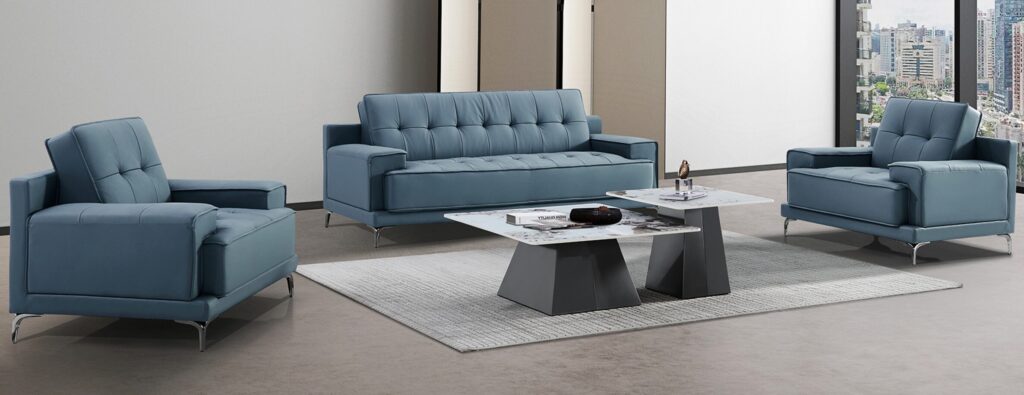
Hotel sofa sourcing is not one category. Each type has different structural requirements, cost profiles, and compliance paths. The table below maps the main commercial sofa categories and their typical specifications.
| Sofa Type | Typical Location | Frame Spec | Fabric Requirement | Fire Standard | Unit Cost FOB |
|---|---|---|---|---|---|
| Lobby / reception sofa | Hotel lobby, lounge | Kiln-dried hardwood, pocket coil | 50,000+ Martindale | BS 7176 / CAL 133 | $600-1,200 |
| Guest room armchair | Guest bedroom | Kiln-dried hardwood, sinuous wire | 30,000+ Martindale | CAL 117 / BS 7176 | $250-500 |
| Guest room sofa / loveseat | Suite living area | Kiln-dried hardwood, sinuous wire | 30,000+ Martindale | CAL 117 / BS 7176 | $350-700 |
| Sleeper sofa (sofa bed) | Suite / family room | Reinforced steel mechanism + hardwood | 30,000+ Martindale | CAL 117 / BS 7176 | $500-900 |
| Restaurant banquette | Dining area | Plywood frame, fixed upholstery | 50,000+ Martindale | BS 7176 | $150-350 / linear ft |
| Poolside / outdoor sofa | Outdoor lounge | Aluminum frame, quick-dry foam | Solution-dyed acrylic | N/A (outdoor) | $400-800 |
| Majlis / GCC floor seating | Gulf lounge | Wide-span hardwood, continuous foam | 50,000+ Martindale | UAE Civil Def / SASO | $400-900 |
| Modular sectional | Lobby / lounge | Kiln-dried hardwood, pocket coil | 50,000+ Martindale | BS 7176 / CAL 117 | $500-1,000 / seat |
Note: Lobby and public-area seating in California is sometimes specified to CAL 133 — the full-scale flammability test for seating in public buildings — which is stricter than CAL TB 117-2013 used for guest room furniture. Confirm which standard your project’s fire consultant requires.
Anatomy of a Contract-Grade Hotel Sofa
Four structural systems determine whether a sofa survives commercial use. Each must be specified independently in your procurement brief.
Frame
For contract-grade hotel sofas, the standard is kiln-dried hardwood — typically beech, ash, or rubberwood — with a moisture content of 8-12%. Below 8%, the wood becomes brittle in transit. Above 12%, it risks warping or cracking in air-conditioned hotel environments. The factory should provide a moisture meter reading for each production batch, not just a certificate that says “kiln-dried.”
Reinforced corner blocks are the joint standard for commercial frames. Frame rails should be joined with a combination of glue, dowels, and corner blocks screwed into both rails.
Avoid factories that rely on staples or nails alone for structural joints — those frames loosen within months under commercial load. Minimum frame rail thickness for a hotel sofa is 18 mm. Thinner stock is residential-grade.
Plywood platforms (the base the seat cushions rest on) should be minimum 12 mm, preferably 15 mm, with cross-support slats or a sinuous wire grid underneath for load distribution. One-piece MDF platforms are common in budget sofas and delaminate quickly in high-humidity environments.
Suspension System
The suspension supports the seat cushions and absorbs guest weight. Three systems are common in Chinese commercial sofa production:
Sinuous wire (zigzag) springs are the most widespread in mid-market hotel sofas. They are economical, durable, and easy to replace. For contract use, specify 4 mm gauge wire with clips at every attachment point. Cheaper 3.5 mm wire loses tension within 12-18 months.
Pocket coil springs are the premium option. Each spring is individually encased and responds independently to pressure. They provide better weight distribution and last longer than sinuous wire, but they add 25-40% to the production cost and require a more skilled assembly line. Pocket coil is standard in luxury hotel suites and branded residences.
Webbing suspension (elastomeric straps) is the lowest-cost option and the least durable for commercial seating. If a factory proposes webbing for seat support in a hotel sofa, reject it unless the sofa is purely decorative.
Foam Layering
Foam specification is where most hotel sofa purchases go wrong. Density and firmness are not the same. Density (kg/m³) measures how much material is in the foam and predicts its lifespan. Firmness (ILD/IFD) measures how it feels to sit on. For hotel use, you need both high density and appropriate firmness.
For seat cushions, specify HR (high-resilience) or CMHR (combustion-modified high-resilience) foam at 35-50 kg/m³, with an ILD of 30-40 lb. This range resists sagging through 50,000+ compression cycles per ASTM D3574. The most common grades are HR35 and HR40. For back cushions, use 24-32 kg/m³ with an ILD of 18-25 lb.
A proper contract-grade cushion uses three layers: a support core of HR35-HR40 foam, a transition layer of slightly softer foam (28-32 kg/m³), and a comfort layer of fiber or a thin memory foam topper (2-3 cm).
This three-layer construction prevents the “bottoming out” feel that happens when a single-density cushion compresses fully under a heavier guest.
Do not accept foam labeled only by firmness (e.g., “high density” without a number). Require the factory to state the density in kg/m³ and the grade (HR35, HR40, CMHR). Request ISO 845 density test reports for each batch.
Fabric and Abrasion Resistance
Hotel upholstery fabric should meet minimum 30,000 Martindale cycles for guest room seating and 50,000+ cycles for lobby and public-area sofas. Below 30,000, the fabric shows visible wear within 12-18 months. Specify the test standard (Martindale or Wyzenbeek) and the minimum cycle count in your contract.
For fire-rated applications, the fabric, foam, and any interliner must be tested as a composite, not individually. A fabric that passes fire testing with one foam may fail with another. The factory should provide composite test reports from an accredited laboratory.
Real FOB Pricing — What You Should Expect to Pay
Pricing below reflects typical FOB ranges quoted by Foshan contract factories in Q2 2026. All figures are FOB (Free On Board) China port, meaning the price includes the product and delivery to the port of loading. Freight, insurance, duties, and inland transport are not included.
For a full explanation of FOB, CIF, and other Incoterms 2020, see our China Sourcing Glossary.
| Product Configuration | Fabric Grade | Suspension | Foam Grade | MOQ | Unit Price FOB (USD) |
|---|---|---|---|---|---|
| Standard 2-seater sofa | 30k+ Martindale | Sinuous wire 4 mm | HR35 | 50 | $280-380 |
| Standard 3-seater sofa | 30k+ Martindale | Sinuous wire 4 mm | HR35 | 50 | $350-500 |
| Lobby lounge armchair | 50k+ Martindale | Pocket coil | HR40 + CMHR | 30 | $400-600 |
| Lobby 2-seater (premium) | 50k+ Martindale | Pocket coil | HR40 + CMHR | 30 | $600-900 |
| Sleeper sofa (queen) | 30k+ Martindale | Sinuous wire + steel mech | HR35 | 50 | $500-800 |
| Modular sectional (per seat) | 50k+ Martindale | Pocket coil | HR40 | 30 | $500-1,000 |
| Leather upgrade (aniline) | Full-grain leather | Any | Any | 30 | +$300-600 add-on |
Definition: FOB (Free On Board) means the seller delivers the goods to the named port of shipment. The buyer bears all costs and risks from that point forward. CIF (Cost, Insurance, Freight) includes ocean freight and insurance to the destination port. Most Foshan factories quote FOB. Ask for a CIF quote to get a clearer landed-cost picture.
Complete Landed Cost Breakdown
Buyers who budget only the FOB price face surprises when the final invoice arrives. Landed cost includes every expense from the factory gate to your warehouse. The table below shows typical cost components for a hotel sofa order shipped from Nansha Port (Guangzhou) to Jebel Ali (Dubai), Los Angeles, or Felixstowe.
| Cost Component | % of FOB Value | Notes |
|---|---|---|
| Product (FOB) | 100% (base) | Negotiated unit price × quantity |
| Export packaging | 3-5% | Heavy-duty carton + plywood crate for sofas |
| Ocean freight (FCL) | 8-15% | $2,500-5,500 per 40 ft container |
| Insurance | 0.5-1% | Typically 110% of CIF value |
| Import duty | 4-12% | Varies by destination and HS code (9401.61) |
| VAT / GST / Sales tax | 5-20% | Destination-country rate on CIF + duty |
| Customs broker fee | 1-2% | $200-500 per shipment |
| Port handling / THC | 1-2% | Terminal handling charge at destination |
| Inland transport | 2-5% | Port to warehouse or hotel site |
| Pre-shipment inspection | 0.5-1% | $300-800 per order (third-party QC) |
| Mid-production inspection | 0.3-0.5% | Check frames before upholstery |
| Total landed cost | 120-145% of FOB | Budget 25-45% above FOB price |
Request our free Sofa Landed Cost Calculator with your quantities and destination port.
Country-Specific Import Duties & Compliance
Import duties on upholstered furniture (HS code 9401.61 — wooden framed upholstered seats) vary significantly by destination. Fire compliance requirements differ even more. The table below maps the duty rate and fire standard for the major hotel furniture importing markets.
Duty rates in this table are based on WTO tariff concessions and national customs schedules as of Q2 2026. Verify with a licensed customs broker before finalizing your budget, as rates change and preference programs may apply.
| Destination | HS Code 9401.61 Duty | Fire Standard Required | Additional Compliance |
|---|---|---|---|
| United States | 0-4.5% (depends on origin) | CAL TB 117-2013 | Section 301 tariffs may apply — verify current rate |
| United Kingdom | 0% (GSP preference) | BS 7176 Medium Hazard / Crib 5 | UKCA marking for post-Brexit compliance |
| European Union | 0-4% (GSP) | EN 1021-1 / EN 1021-2 | CE marking (informational, not mandatory for furniture) |
| Saudi Arabia | 5% + 15% VAT | SASO / SABER + BS 7176 equivalent | SABER product registration before shipping |
| UAE / Dubai | 5% + 5% VAT | UAE Civil Defense (BS 7176 ref) | Civil defense approval per emirate |
| Qatar | 5% | QS / Civil Defense | Qatar General Organization for Standards |
| Kuwait | 5% | Kuwait Civil Defense | PAI (Public Authority for Industry) approval |
| Australia | 5% | AS/NZS 4088 | RCM mark for electrical (if applicable) |
| Canada | 0-8% (depends on origin) | CAN/CGSB equivalent | ULC listing may be required |
Total Cost of Ownership (TCO) Analysis — Budget vs Premium
The cheapest sofa at purchase is rarely the cheapest over five years. The table below compares a budget-grade, mid-range contract, and premium contract sofa across purchase price, lifespan, and per-year cost.
| Specification Tier | Unit Cost FOB | Expected Lifespan | Annual Cost | Typical Failure Mode |
|---|---|---|---|---|
| Budget / residential grade | $150-250 | 12-18 months | $100-200/yr | Foam sagging, frame loosening, fabric wear |
| Mid-range contract | $350-600 | 3-5 years | $70-200/yr | Fabric pilling, sinuous wire tension loss |
| Premium contract (hotel spec) | $600-1,200 | 5-8 years | $75-240/yr | Cosmetic wear only — structural integrity holds |
The premium contract sofa costs 3-5x more upfront but only 0.75-1.2x the annual cost of the budget option, because it lasts 4-6x longer. For a 200-room hotel project, this difference can translate to USD 50,000-150,000 in replacement cost savings over a five-year operating period.
Illustrative Cost Example — 150-Room Hotel Suite Sofa Order
To make the numbers concrete, here is a realistic budget breakdown for a 150-room hotel project sourcing custom 2-seater suite sofas from a Foshan contract manufacturer.
| Line Item | Calculation | Amount (USD) |
|---|---|---|
| Sofa unit price (FOB) | 150 units × $450 | $67,500 |
| Export packaging (crate) | 5% of FOB | $3,375 |
| Mid-production inspection | Flat fee | $550 |
| Pre-shipment inspection | Flat fee (AQL 2.5) | $650 |
| Ocean freight (40 ft HC × 2) | $3,800 per container | $7,600 |
| Insurance | 0.5% of (FOB + freight) | $375 |
| Import duty (5% destination) | 5% of CIF value | $3,774 |
| Customs broker + THC | Flat fee per container | $800 |
| Inland transport to hotel | $400 per container | $800 |
| Prototype / mock-up (one unit) | Charged separately | $900 |
| Total landed cost | $86,324 |
Total landed cost per sofa: $575 (28% above FOB unit price). This is within the typical 25-45% range. The buyer saves roughly 35-45% compared to sourcing the same specification from a Western contract manufacturer.
Get a personalized landed cost estimate for your project with your quantities and destination.
Hidden Costs That Blow the Budget
Based on common mistakes we observe in our work with GCC and Western buyers, here are five cost categories that first-time importers consistently underestimate or miss entirely.
1. Sample revisions. Each revision cycle adds 1-3 weeks and may carry a new sample charge ($200-500 per round). Lock the design and materials before the first prototype is built.
2. Fabric overage. Pattern-matching fabrics (stripes, geometric prints, large motifs) require 15-25% more material than plains. If your fabric choice requires pattern matching, the factory will charge for the overage. Ask for the cutting plan before confirming the price.
3. Demurrage and detention. If your shipment arrives at the destination port before your customs paperwork is ready, the container incurs demurrage charges — typically $50-150 per day after the free time period (usually 3-7 days). Have your customs broker engaged before the vessel departs.
4. Fire testing per composite. Each fabric-foam-interliner combination must be tested as a composite. If you change the fabric or foam after the test certificate was issued, a new test is required ($500-2,000 per composite). Finalize all materials before ordering fire tests.
5. Reject and replacement logistics. If a pre-shipment inspection finds defects exceeding the AQL 2.5 threshold, the factory must rework or remake the affected units. Return shipping of defective goods is rarely economical. Negotiate the remedy (discount, credit, or replacement) in the contract before production starts.
From Our Sourcing Team — A common scenario: a buyer approves a prototype, then requests a fabric change after the fire test certificate has been issued. The new fabric requires a new composite test (typically $1,200) and pushes production back by three weeks. If the hotel opening is on a fixed schedule, that delay can cost more than the entire sofa order. Lock your specification before testing begins.
How to Compare Supplier Quotes
When you send the same specification to 3-5 Foshan factories, you will receive quotes that vary by 30-50%. The variance is rarely random — it reflects differences in frame quality, foam grade, fabric tier, and inspection rigor. Use this comparison table to evaluate quotes on more than just price.
| Criteria | Ask This Question | Red Flag |
|---|---|---|
| Frame wood type | “What species and moisture content?” | “Plywood + solid wood” (non-specific) |
| Foam density | “What kg/m³ and grade (HR35/HR40)?” | “High density” without a number |
| Fire certification | “Which lab conducted the composite test?” | Certificate from unrecognized lab |
| Fabric source | “What brand and Martindale count?” | “Our own fabric, imported quality” |
| MOQ per design | “What is the minimum per SKU?” | MOQ below 20 for fully custom |
| Lead time | “How long for prototype and bulk?” | Promise faster than 6 weeks custom |
| Inspection access | “Can we inspect frames before upholstery?” | “Only finished goods inspection” |
| Export experience | “Which hotel brands have you supplied?” | “We supply many hotels” (no names) |
For a full walkthrough of supplier verification, see our Supplier Verification Guide.
10 Cost-Saving Strategies Without Cutting Quality
- Use the factory’s standard frame. Semi-custom (existing frame + your fabric/finish) cuts MOQ by 50-60% and reduces prototype cost.
- Consolidate multiple designs into one container. Mixing lobby sofas, guest room armchairs, and banquettes in one 40 ft container spreads the freight cost across more units.
- Negotiate payment terms. Standard is 30% deposit + 70% before shipping. Offer a larger deposit (40-50%) in exchange for a 3-5% discount. Factories value the improved cash flow.
- Order fabric from the factory’s existing stock range. Custom-order fabrics from external mills add 2-3 weeks and may carry a surcharge.
- Skip the leather upgrade in low-wear zones. Use contract-grade fabric on guest room sofas and reserve leather for lobby and suite pieces.
- Book mid-production and pre-shipment inspection with the same company. Bundling inspection services typically saves 15-25% on inspection fees.
- Avoid peak shipping seasons. Freight rates from China to the US and Europe spike 20-40% between August and October. Book production to finish between January and April.
- Use compression packing for modular sofas. Vacuum-compressed sofas reduce shipping volume by up to 60%, potentially cutting container count from 2 to 1.
- Specify one fabric across all guest room categories. Single-fabric orders improve the factory’s cutting efficiency and reduce fabric waste from 15% to under 5%.
- Plan for Chinese New Year. Production in January-February is unreliable. Time your PO to arrive at the factory before December or after March.
Factory Verification Checklist — 10 Items to Confirm
Before placing a deposit, confirm these 10 items with every shortlisted factory. This checklist is adapted from our Factory Solutions verification protocol.
| # | Check Item | How to Verify | Acceptable Evidence |
|---|---|---|---|
| 1 | Business license matches manufacturing scope | Request Chinese-language business license | Scope includes “furniture manufacturing” not just “trading” |
| 2 | Factory owns its production facility | Ask for deed or lease agreement (length of lease) | Minimum 5-year lease remaining |
| 3 | In-house frame production | Video call or factory visit | Dedicated woodworking shop on site |
| 4 | In-house upholstery line | Video call or factory visit | Cutting, sewing, and upholstery stations |
| 5 | Fire test certificates from accredited lab | Cross-check lab on IAF database | Composite test report matching your materials |
| 6 | ISO 9001 certification (current) | Verify on ISO certification body website | Valid certificate with matching factory name |
| 7 | BSCI or SMETA social compliance audit | Request recent audit report | Audit conducted within 12 months |
| 8 | Export history to your market | Ask for bill of lading copies (redacted) | At least 3 shipments to similar destination |
| 9 | Inspection access agreement | Include in contract | Written agreement for mid-production + PSI |
| 10 | Reference from buyer at similar scale | Contact the reference directly | Similar order volume (50+ units) |
Quality Control — Inspection Points That Protect Your Order
Two inspections are standard for contract sofa orders: mid-production and pre-shipment. Skipping either one is the most common reason a first order disappoints.
Mid-production inspection (after frame assembly, before upholstery): The inspector checks frame dimensions against the approved CAD drawing, wood moisture content, joint quality (corner blocks, glue, screw count), and suspension tension. This is the only time you can verify the internal structure. Once the upholstery is on, the frame is invisible. Cost: $300-500 per day.
Pre-shipment inspection (on finished goods): The inspector applies AQL 2.5 sampling (normal severity, single sampling plan per ISO 2859). They check dimensions, fabric alignment and seam strength, foam firmness by ILD spot-check, fire label presence, packaging integrity, and carton marking. If defects exceed the AQL threshold, the factory must sort and rework before shipping. Cost: $400-800 per day.
Use a third-party inspection company accredited to ISO 17020. Intertek, SGS, and Bureau Veritas all operate offices in Foshan and can dispatch inspectors within 24-48 hours.
Image placeholder: Foshan furniture factory frame inspection — inspector checking corner joint and moisture content on a kiln-dried hardwood sofa frame for a contract hotel order.
Shipping Timeline — From PO to Delivery
A custom hotel sofa order follows roughly 12-22 weeks from purchase order to destination port arrival. The table below breaks each phase by duration.
| Phase | Duration | Key Activities |
|---|---|---|
| 1. Specification & technical drawing | 1-2 weeks | CAD drawings, material selection, fire standard confirmation |
| 2. 3D render & sample approval | 1 week | Fabric swatch, foam sample, finish sample shipping |
| 3. Prototype (mock-up) build | 2-3 weeks | One complete unit built and shipped for buyer approval |
| 4. Prototype approval & revisions | 0-2 weeks | May require one revision cycle |
| 5. Material procurement | 1-2 weeks | Factory orders fabric, foam, frame wood in bulk |
| 6. Mass production | 4-8 weeks | Frame build → upholstery → finishing → packing |
| 7. Pre-shipment inspection | 3-5 days | Third-party AQL 2.5 inspection |
| 8. Ocean transit | 3-5 weeks | Varies by destination port |
| Total (PO to destination port) | 12-22 weeks | Plan 5 months from PO to site delivery |
Definitive 10-Step Procurement Checklist
Use this checklist as your project management framework. Complete each step before moving to the next.
- Define the specification. Write a technical brief covering dimensions, frame material, foam grade + ILD, suspension type, fabric abrasion, and fire standard. Include dimensional drawings if possible.
- Confirm the fire compliance path. Identify the required standard for your destination market (BS 7176, CAL 117, SASO/SABER, UAE Civil Defense). Communicate this to the factory before quoting.
- Shortlist 3-5 factories. Use Alibaba, Made-in-China, or a sourcing agent. Confirm each is a manufacturer (not a trading company) using the verification checklist above.
- Request identical quotes. Send the same specification to all shortlisted factories. Compare not only price but also MOQ, lead time, included certifications, and inspection access.
- Order a physical prototype. Pay for one complete unit. Test it in your actual environment. Check seat height, depth, firmness, fabric color under your lighting, and overall proportion.
- Approve the prototype in writing. Sign off on dimensions, materials, and finish. Include photos and measurement records in the approval document.
- Schedule mid-production inspection. Book a third-party inspector to check frames before upholstery. This is your last chance to verify the internal structure.
- Schedule pre-shipment inspection. Apply AQL 2.5 on finished goods. Reject the batch if the defect rate exceeds the threshold.
- Prepare customs documentation. Engage a licensed customs broker at the destination. Provide the commercial invoice, packing list, bill of lading, and fire test certificate before the vessel arrives.
- Inspect on arrival. Open crates within 72 hours of delivery. Photograph any damage. Notify the factory and your insurance provider immediately if there is transit damage.
Download this checklist as a PDF: request the procurement checklist PDF.
Frequently Asked Questions
What MOQ should I expect for custom hotel sofas from China?
For fully custom designs (new frame, new dimensions, custom fabric), expect 30-50 identical units per design from most Foshan contract factories. For semi-custom (factory’s standard frame with your fabric and finish), MOQ can drop to 10-20 units. Orders below 10 units are typically charged at a premium or redirected to a jobbing workshop.
How long does the full process take from order to delivery?
Typically 12-22 weeks: 2-4 weeks for specification and prototype, 4-8 weeks for production, 1 week for inspection, and 3-5 weeks for ocean transit depending on destination. Rushing any stage increases the risk of specification errors. Plan 5 months from PO to site delivery.
Is it cheaper to buy sofas from China than from local suppliers?
For mid-range contract-grade sofas, sourcing from China typically saves 30-50% compared to Western or Gulf suppliers when comparing identical specifications. For premium luxury sofas with leather and pocket coil, the savings are closer to 20-35%. For budget residential-grade sofas, the gap narrows to 10-20%, making local sourcing more attractive when you factor in shipping time and communication overhead.
What is the difference between FOB and CIF pricing?
FOB (Free On Board) means the price includes the product and delivery to the Chinese port. The buyer pays all freight, insurance, and duties from that point. CIF (Cost, Insurance, Freight) means the price includes ocean freight and insurance to the destination port. Most Foshan factories quote FOB. Always ask for both to calculate your landed cost accurately.
Which fire standard do I need for Gulf / GCC hotel projects?
Most GCC hotel projects reference BS 7176 Medium Hazard (Crib 5) as the minimum fire standard. Saudi Arabia additionally requires SASO/SABER product registration. UAE Civil Defense accepts BS 7176 test reports from accredited labs. Qatar and Kuwait have separate civil defense approval processes. Always confirm with the project’s civil defense consultant, as individual emirates may have additional requirements.
Can I visit the factory before placing an order?
Yes, and we recommend it for orders above $50,000. Most Foshan factories welcome buyer visits. Schedule 2-3 days in Foshan to visit 4-5 factories. If you cannot travel, commission a third-party inspection company to conduct a factory audit on your behalf, including a production capability assessment and business license verification.
What is the best time of year to order from China?
The best ordering window is March-June and September-November. Avoid Chinese New Year (January-February, 2-week shutdown), Labour Day (May, 1 week), and National Day (October, 1 week). Plan your PO to arrive at the factory at least 4 weeks before Chinese New Year to avoid production gaps.
Do Chinese sofa factories use fire-retardant materials by default?
No. Standard Chinese domestic production uses GB 20286 (China domestic fire standard), which is not equivalent to BS 7176 or CAL 117. You must specify the required fire standard in your brief. The factory will source CMHR foam and fire-rated fabric as a special order. This typically adds 10-20% to the material cost and requires composite testing.
Can I supply my own fabric?
Yes — this is called COM (Customer’s Own Material). Most Foshan contract factories accept COM. The advantages are that you control the fabric specification, brand, and fire rating. The disadvantages are that you are liable for any fabric defects, and the factory will require additional lead time to test the composite (your fabric + their foam) for fire compliance.
How do I know if a Foshan supplier is a real factory or a trading company?
Three checks. First, ask for the Chinese-language business license and verify the registered scope includes “furniture manufacturing.” Second, ask for a live video call of the production floor — a trading company cannot show you a workshop it does not own. Third, check whether the address on the license matches the factory location. Trading companies in Foshan commonly register at commercial building addresses, not industrial parks.
What is the standard payment term for custom sofa orders?
The industry standard is 30% deposit (T/T) upon contract signing, with the 70% balance paid after pre-shipment inspection and before loading. For new supplier relationships, some buyers negotiate 30% / 40% / 30% across three milestones (deposit, mid-production, pre-shipment). Letters of credit (L/C) are used for large orders above $100,000 but add 1-3% in bank fees.
How is hotel sofa quality inspected?
Two-stage inspection is standard. Mid-production: the inspector checks bare frames for wood moisture content, joint quality, and suspension tension — before upholstery. Pre-shipment: finished goods are inspected using AQL 2.5 sampling per ISO 2859, checking dimensions, fabric alignment, seam strength, foam firmness, fire labels, and packaging. Both stages should be contracted to an ISO 17020-accredited third party.
What foam density do I need for a hotel sofa?
For seat cushions, specify HR35-HR40 (35-50 kg/m³) with an ILD of 30-40 lb. For back cushions, 24-32 kg/m³ with ILD 18-25 lb. Do not accept foam described only as “high density” without a number. Require ISO 845 test reports per production batch. A three-layer cushion construction (support core + transition + comfort layer) significantly extends lifespan.
Can I order a single sample sofa before committing to bulk?
Yes — this is standard practice and strongly recommended. The factory charges a sample fee (typically the unit cost + shipping, $400-1,500 depending on complexity). This fee is often deducted from the bulk order if you proceed. The sample should be built to the exact production specification — same frame, same foam, same fabric — so you can test it in your actual environment.
What packaging is used for export sofa shipping?
Contract-grade sofas should be packed in individual 5-ply corrugated cartons with foam corner protectors, moisture-absorbing desiccants, and a polyethylene inner wrap. For leather sofas, a breathable dust cover replaces the plastic wrap to prevent condensation damage. The carton must be marked with the hotel name, room number, and handling instructions. Insist on a packaging specification in the contract.
Can Chinese factories match specific brand fire standards or do I need to certify locally?
Many Foshan factories that export to Hilton, Marriott, and Accor projects already hold composite test reports for BS 7176 and CAL 117 from accredited labs (Intertek, SGS, Bureau Veritas). Ask for the existing test report that matches your proposed fabric-foam combination. If no existing report matches, the factory can commission a new composite test, which takes 2-4 weeks and costs $500-2,000.
Related Resources
Internal resources on skyltc.com:
- Custom Hotel Furniture Manufacturing Guide — FF&E procurement for complete hotel projects
- Hotel Procurement China Guide — Overview of sourcing categories and services for hotel projects
- Hotel and Restaurant Solutions — Complete hospitality fit-out capabilities
- FF&E Solutions for Hotels & Resorts — Full package procurement
- China Sourcing Glossary — Incoterms, payment terms, and shipping definitions
- Contact Our Procurement Team
External references cited:
- ISO 845: Foam density testing standard
- ASTM D3574: Foam compression and IFD testing
- British Furniture Confederation: Contract Flammability Guide
- BS 7176: Fire safety for non-domestic seating
- Intertek: Furniture testing services
3 supporting articles recommended for topical authority:
- Hotel Sofa Fabric Selection Guide — Comparing Contract-Grade Textiles (Martindale, Wyzenbeek, fire-rated composites, cleanability)
- Compression Sofa Technology: How Vacuum Packing Reduces Shipping Costs by Up to 60%
- Modular vs Fixed Hotel Sofas: Cost, Durability, and Configuration Comparison for Hospitality Projects
Start Your Hotel Sofa Sourcing Project
A custom hotel sofa order is a manufacturing project, not a product purchase. Every specification point must be locked before the factory orders materials. The factories that deliver consistent results are those that expect detailed technical files, build physical prototypes, and submit to third-party inspection at every stage. Any factory that offers to skip these steps is not a contract-grade manufacturer.
Trust elements before you proceed:
- Every project we manage includes factory verification, mid-production inspection, and pre-shipment inspection — contracted to ISO 17020-accredited third parties.
- Based in Guangzhou — we visit your supplier before you commit. No factory passes our qualification process without an in-person audit.
- Our founder has been designing and sourcing contract seating in Foshan since 2012. Our procurement manager Angie Sami oversees every technical specification personally.
Decision points to help you decide your next step:
- If your order is under 20 units, buy locally or use a semi-custom frame from a Foshan factory that stocks standard models. The MOQ surcharge for very small orders typically offsets the China price advantage.
- If your order is 50+ units, importing from China saves 30-50% vs Western contract manufacturers at equivalent specification levels.
- If you cannot visit China, use a sourcing agent with office in Guangzhou or Foshan who can perform factory audits and inspections on your behalf.
Ready to start? Email [email protected] with your project brief — quantities, target specification, delivery destination, and timeline. We will reply within 48 hours with a supplier assessment and landed cost estimate.
For hospitality projects that include outdoor lounges, pool decks, or resort terraces, outdoor seating requires different material specifications than indoor sofas. Our guide on outdoor hotel furniture manufacturing in China explains how aluminum frames, quick-dry foam, HDPE rattan, and weather-resistant fabrics are selected for long-term outdoor performance.