

How to Read a China Factory Audit Report (2026 Step-by-Step Guide)
A factory audit report is not a scorecard you skim and file away. It is a structured risk document that determines whether a supplier can legally, technically, and operationally fulfill your order — and whether your project timeline, budget, and brand reputation are protected once production begins.
Most importers do not fail because they skip audits. They fail because they misread the ones they already paid for, or because they treat a clean set of paperwork as proof that a factory is safe to do business with. A 40-page report gets reduced to a single overall score, the score looks acceptable, and a purchase order gets signed. Three months later the shipment is late, the QC pass rate is unacceptable, or — in the worst cases — the deposit is gone and the factory has gone quiet.
This guide goes beyond a summary explanation of what an audit report contains. It walks through the actual structure of a report section by section, shows what real fraud and real near-misses look like in practice, and gives you the tables, checklists, and decision framework that professional procurement teams use before they release a deposit to a Chinese factory.
Executive Summary
- Audit reports from SGS, Intertek, TÜV SÜD, and QIMA evaluate three risks: legal legitimacy, real production capacity, and quality system reliability — but the appendix data matters more than the cover-page score.
- Legitimate, fully registered companies can still be fraudulent. A clean business license proves the company exists on paper — it does not prove the people running it intend to deliver your order.
- Capacity utilization above 85–95% means a factory is already near its production ceiling, even if sales teams promise otherwise.
- Audit reports themselves can be forged or recycled from a different factory. Always verify a report’s serial number directly with the issuing agency before trusting it.
- A single red flag is rarely disqualifying on its own. Multiple small inconsistencies across different sections usually point to a deeper structural problem.
1. Why Audit Reports Matter in Procurement Decisions
Audit reports from agencies such as SGS, Intertek, TÜV SÜD, and QIMA are designed to evaluate three core risks: legal legitimacy of the factory, real production capacity (not claimed capacity), and quality system reliability (QMS / QC structure).
The mistake most buyers make is treating the final score as the decision factor. An 82/100 score feels reassuring, but that number is built from weighted categories that can mask a serious problem in one specific area. A factory can score well overall while having no functioning incoming-material inspection process, or while subcontracting a meaningful share of the order to a workshop that was never audited at all.
For B2B buyers sourcing hotel furniture, commercial kitchen equipment, or aluminum doors and windows from China, the financial exposure of an unverified supplier is rarely limited to a bad batch of product. It extends to missed installation deadlines on a hotel opening date, fire-rated material non-compliance, and — in the cases we’ll walk through below — the outright loss of a deposit to a company that never intended to manufacture anything. The audit report, read properly, is the cheapest insurance policy in the entire procurement process.
Hospitality and commercial fit-out projects carry a particular form of risk that purely retail or consumer-goods buyers do not face: a fixed opening date that does not move. A late shipment of consumer electronics delays a product launch by a few weeks at most. A late shipment of guestroom furniture or commercial kitchen line equipment can delay a hotel’s entire opening, with daily holding costs, contractual penalties, and lost room revenue stacking on top of the original procurement budget. The audit report sits upstream of all of that risk — it is the point in the process where a problem is cheapest to catch, before tooling, deposits, and production schedules are locked in.

In the dashboard above, notice that the overall score sits in a single large number while the supporting categories — legal, capacity, quality — are compressed into small sub-bars underneath it. This is exactly the layout that causes buyers to stop reading after the headline number. The sub-scores, and the raw appendix data behind each one, are where the real decision-making information lives.
2. The Structure of a Factory Audit Report
Every professional audit report follows a predictable structure, regardless of which inspection agency produced it. Understanding that structure lets you scan a new report quickly and immediately spot where data is missing, generic, or inconsistent — which is usually where a problem, if any, is hiding.
The two boxes at the bottom — photo evidence and auditor’s free-text notes — are the sections buyers skip most often, and the ones experienced sourcing teams read first. A genuine on-site audit produces specific, sometimes awkward observations in plain language, not polished marketing copy. If the auditor’s notes read like a sales brochure, that alone is worth a second look.
3. What a Real Audit Excerpt Looks Like
Explaining audit sections in the abstract only goes so far. Below is a simplified, illustrative excerpt of how the legal and production sections typically read in a genuine third-party report, followed by how an experienced reviewer would interpret each line.
Section 1 — Company Identity (excerpt)
Legal Name: [Factory Name] Furniture Manufacturing Co., Ltd.
Unified Social Credit Code: 91[Province][14-digit code]
Registered Capital: RMB 5,000,000 (paid-in: RMB 3,200,000)
Business Scope: Manufacturing and sale of wooden and metal furniture; import and export of goods
Establishment Date: March 2014
Legal Representative: [Name], holds 60% shareholding
How to read this: “Manufacturing” appears in the business scope, which clears the first hurdle. The gap between registered capital (RMB 5,000,000) and paid-in capital (RMB 3,200,000) is normal and not a red flag on its own — most Chinese companies do not fully pay in registered capital. What matters more is whether the establishment date (2014) is consistent with the years of export experience the factory claims in its sales materials. A factory claiming “15 years of export experience” with a 2014 registration date has a gap worth asking about directly.
Section 2 — Production System (excerpt)
Workshop Area: 6,200 sqm
Employees (production): 142
Key Machinery: 4× CNC routers, 2× edge banders, 1× spray-paint line, 18× sewing stations
Stated Monthly Capacity: 40ft containers — 35 units
Current Order Book: 78% booked for next 60 days
How to read this: Divide stated monthly capacity by employee count as a quick sanity check — 35 containers with 142 production staff is a plausible ratio for furniture manufacturing, whereas the same capacity claimed with 40 staff would warrant questions about subcontracting. The order book figure (78% booked for 60 days) is the single most useful number on this page for a buyer planning a delivery date, and it is the figure most sales teams will not volunteer unless the audit specifically captured it.
4. Legal Verification — and Why “Fully Registered” Is Not the Same as “Safe”
The first risk filter is legal identity. A factory must prove it is a registered manufacturer — not a trading intermediary presenting a partner factory’s facility as its own.
- Unified Social Credit Code must match the code printed on commercial invoices and contracts
- Business scope must explicitly include “manufacturing” (生产/制造), not only “sales” (销售) or “trading”
- Registered Chinese legal name must match the official business license exactly, including the legal entity suffix
- Registered capital and establishment date should align with the scale of operations being claimed
Here is the part most guides leave out: legal verification tells you a company exists. It does not tell you that the people currently running it intend to deliver your order. We have seen this distinction matter in the most expensive way possible.
Case Study: When the Paperwork Is Real but the Company Is Not
In one of our own sourcing engagements, we worked with a factory for the first time and paid a deposit before sending anyone to physically check the facility ourselves. On paper, everything looked correct: a valid, active business license, a registered company name that matched every document, no record of disputes, and no warning signs in a basic background search.
The deposit went through. The factory then went quiet, and it became clear that the entire operation — the “factory,” the production claims, the communication — was effectively a front. The legal registration was genuine, but it had been used as a shell to collect deposits rather than to run a real manufacturing business. We filed a police report, and after some time the individual behind it was located and arrested. Investigators found a pattern of the same scheme run against multiple other buyers, not just us.
The lesson: a clean business license, a real registration number, and no public complaints are necessary checks — but they are not sufficient ones. They confirm the company is legally allowed to operate. They do not confirm that the specific people you are sending money to are operating it honestly. That gap can only be closed by independent, on-the-ground verification before any deposit is released — not a video call, not photos sent by the supplier, but a third party physically present at the registered address.
How to Run the Legal Check Yourself in Under Ten Minutes
- Search the factory’s Chinese legal name on China’s National Enterprise Credit Information Publicity System (国家企业信用信息公示系统) or a commercial mirror such as Qichacha — confirm status shows “存续” (active), not “吊销” (revoked) or “注销” (deregistered).
- Compare the Unified Social Credit Code shown there against the code on the audit report and on any invoice or contract draft you have received.
- Check the “Business Scope” field for manufacturing-related wording, not only trading or sales wording.
- Review the “Judicial Risk” or litigation tab for open lawsuits, enforcement records, or bankruptcy filings — this is the step that would have surfaced prior disputes in cases like the one above.
- Cross-check the legal representative’s name against the person who signs your contract — a mismatch is not automatically disqualifying, but it should be explained.
A related and frequently overlooked check is the factory’s shareholding structure. Two “competing” suppliers that quote different prices can sometimes share the same ultimate parent company or beneficial owner. This is not necessarily a problem on its own, but it should be disclosed and understood before a buyer assumes they are getting independent quotes from independent sources.
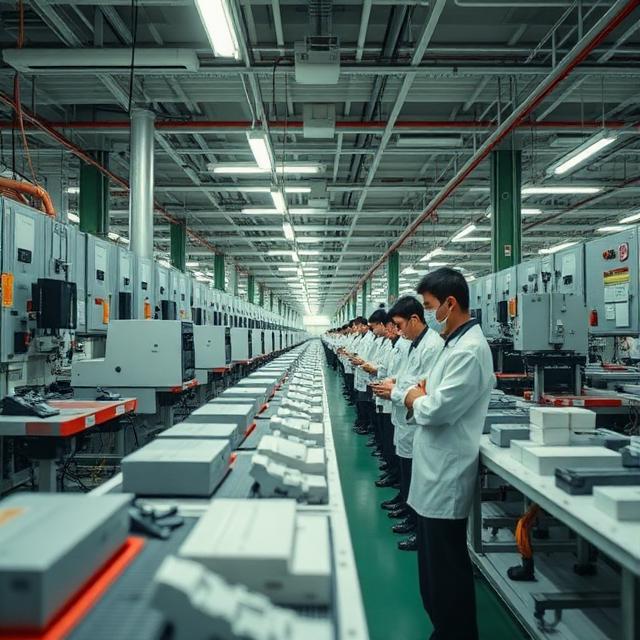
In the production line image above, notice how machine quantity alone does not prove manufacturing capability. Auditors compare machine utilization, maintenance records, and staffing levels per shift before validating production capacity. A row of clean, idle machines with no visible operators or work-in-progress material on the line is one of the most common signs of a facility staged for a single visit rather than a working production floor.
5. Production Capacity vs Reality
Factories routinely overstate monthly output during the sales process. Audit reports help verify real capacity by cross-referencing machine counts, headcount, and utilization rates against the order volume being discussed.
- Active vs idle machinery, and whether idle equipment shows signs of regular use or appears staged for the visit
- Actual throughput per shift compared against the theoretical maximum stated in marketing materials
- Signals of subcontracting, such as inconsistent branding on packaging materials or unexplained gaps in the production schedule
- Current order book and how close existing commitments push the factory toward full capacity
A factory already operating at 85–95% capacity utilization is near its production limits, even if the sales team promises your order can be slotted in without delay. For hospitality projects tied to a fixed opening date, this gap between claimed and real capacity is one of the most common sources of late delivery — not poor workmanship, but simple overbooking.
It is also worth checking whether the audit was conducted during peak season — typically the run-up to Chinese New Year and around major trade fair periods — or during a slower month. A capacity reading taken during a quiet period can look healthier than what a buyer will actually experience when placing an order three months later, during a busy season.
A simple cross-check that costs nothing: ask the factory for their current order book, in writing, and compare the delivery dates they quote against the audit’s stated capacity. A factory claiming six weeks of free capacity while simultaneously showing a fully booked production schedule for the next four months is telling you two different things, and only one of them is true.
Worked Example: Spotting an Inflated Capacity Claim
Take a hotel furniture order requiring 20 containers, with a sales team quoting a six-week production lead time. The audit report shows 60 production staff and a stated monthly capacity of 18 containers. At face value the math looks workable across two months. But the audit’s order-book field shows the factory is already 70% committed to other buyers for the same period. Real available capacity for your order is closer to 5–6 containers per month, not 18 — meaning the realistic lead time is closer to fourteen weeks, not six. This is the exact gap between marketing-stated capacity and audited real capacity that causes missed hotel opening dates.
Regional Differences Worth Knowing
Capacity and quality norms vary meaningfully by manufacturing region, and an audit report read without this context can be misleading. Guangdong (Foshan, Dongguan) carries the deepest furniture and hardware supply chains and the most audit-experienced factories, which generally means cleaner documentation but also more competition driving aggressive capacity claims. Zhejiang factories, strong in metal furniture and aluminum systems, tend to run leaner staffing relative to machinery count, so the employee-to-output ratio check matters more there. Shandong and Jiangsu kitchen-equipment manufacturers often operate larger single-site facilities, where subcontracting risk shows up less in headcount and more in whether stainless steel fabrication and electrical assembly are genuinely done in-house versus farmed out to a neighboring workshop.
None of this changes how you read the audit report itself — but it changes which red flags deserve extra scrutiny for a given product category and region.
6. Quality Control System (QMS)
A strong factory is defined by process control throughout production, not inspection only at the very end of the line. By the time a defect reaches final QC, the cost of the wasted material and labor has already been incurred.
- Incoming material inspection (IQC): Are raw materials and components checked against specification before entering production?
- In-process quality control (IPQC): Are there dedicated checkpoints on the line itself, not just a final station? A genuine IPQC record will show inspection timestamps tied to specific production batches, with rejected-unit counts — not a single blanket “passed” entry for the whole day.
- Final quality control (FQC): What sampling standard is used (AQL 2.5, AQL 1.5, 100% inspection) and is it appropriate for the product category?
- Calibration records: Are measuring instruments calibrated on a documented schedule, with traceable, dated certificates rather than a single undated stamp?
Calibration records are a particularly useful signal because they are tedious to fabricate consistently over time. A factory that takes calibration seriously enough to maintain a clean, dated log for every measuring device — calipers, thickness gauges, tensile testers — usually takes the rest of its quality system just as seriously. The opposite is also reliably true.
Sample IPQC Record Entry (genuine format)
Batch No.: HF-2604-118 | Date: 04/22/2026 | Station: Frame Assembly
Sample Size: 32 / AQL 2.5
Defects Found: 1 (loose joint, corrected on line)
Inspector: [Initials] | Calibration Ref: CAL-0091 (valid until 09/2026)
Compare that to a vague entry that simply reads “Inspected — Passed” with no batch number, sample size, or inspector reference. The first format is what a functioning IPQC station produces daily. The second is what gets written after the fact, specifically for an audit visit.

In the QC lab image above, the detail to look for is not the equipment itself but the paperwork next to it — calibration stickers with legible dates, logbooks with handwritten entries rather than a single printed summary, and visible wear consistent with daily use. A lab that looks photo-ready but shows no sign of daily handling is a lab that may have been set up specifically for the audit visit.
7. Deposits, Payment Risk, and the Most Costly Mistake Buyers Make
Of every risk covered in this guide, the one that causes the largest single financial loss is not a quality defect — it is a deposit paid to a factory that never intended to manufacture anything.
Case Study: The Deposit, Then Silence
In a separate situation, a deposit was paid to a factory to begin production. Shortly afterward, the factory stopped responding, then formally announced it was closing down and declaring bankruptcy. The order was never produced, and the deposit was not recoverable through the factory itself.
This pattern — collect deposits from several buyers in a short window, then close the company and declare insolvency — is a recognized scheme in Chinese manufacturing hubs, sometimes run deliberately and sometimes as a genuine business failure that happens to coincide with newly collected deposits. From the buyer’s side, the financial outcome is the same either way.
Both of these situations involved real, government-registered Chinese companies. Neither would have been flagged by checking the business license alone. What would have changed the outcome, in hindsight, is the same in both cases:
- An independent, on-site verification visit before any deposit was sent — not relying on photos or video supplied by the factory itself
- Checking the factory’s litigation and dispute history on China’s public credit information platforms, which can show prior bankruptcy filings or unresolved judgments
- Structuring payment terms so the deposit is tied to a verified production milestone, rather than paid in full before any work begins
- Using a payment method and contract structure that preserves some recourse, rather than an untraceable transfer with no enforceable agreement behind it
None of these steps are exotic. They are standard practice for any procurement team that has been through this once. The cost of skipping them is almost always higher than the cost of doing them.
Payment Structures That Reduce This Risk
How you pay matters almost as much as who you pay. The table below compares common structures used in China sourcing, from least to most protective.
| Structure | How It Works | Buyer Protection Level |
|---|---|---|
| 100% T/T in advance | Full payment wired before production begins | Low — no leverage once funds are sent |
| 30/70 T/T split | 30% deposit, 70% against shipping documents or pre-shipment inspection | Moderate — deposit exposure capped, balance tied to delivery |
| Letter of Credit (L/C) | Bank releases payment only against compliant shipping documents | High — bank acts as a neutral enforcement layer |
| Third-party trade assurance / escrow | Funds held by a platform or intermediary until milestones are verified | High — independent party confirms before releasing funds |
For a first-time order with a newly audited factory, pairing a 30/70 split (or lower) with an independent pre-shipment inspection is generally the practical minimum. For larger hospitality project orders, a Letter of Credit is worth the additional paperwork — it shifts the enforcement burden onto a bank rather than relying on goodwill or legal recourse after the fact.
Documents Worth Requesting Beyond the Audit Report
- A copy of the business license itself, not just the audit’s summary of it, so you can run your own independent check
- Bank account details that match the registered company name exactly — payments to a personal account or a third, unrelated company name are a serious warning sign
- A signed sales contract with delivery dates, penalty clauses for delay, and a dispute resolution clause specifying jurisdiction
- Recent export records or customs declarations, where available, to confirm the factory has a track record of actually shipping goods, not only producing audit-ready paperwork
8. Comparing the Major Auditing Agencies
Buyers commonly ask whether the choice of inspection agency changes how a report should be read. In practice, the underlying methodology is similar across the major players, but report depth, turnaround time, and typical cost can differ enough to factor into your procurement budget.
| Agency | Typical Report Depth | Typical Turnaround | Indicative Cost Range (USD)* |
|---|---|---|---|
| SGS | Comprehensive, strong on compliance and social responsibility | 5–8 business days | $350 – $600 per audit |
| Intertek | Strong technical/production focus, detailed machinery data | 5–7 business days | $350 – $600 per audit |
| TÜV SÜD | Very strong on engineering and certification cross-checks | 6–9 business days | $400 – $650 per audit |
| QIMA | Fast turnaround, good digital reporting interface | 3–5 business days | $300 – $550 per audit |
*Indicative estimates for the current year based on a standard factory capability audit. Actual pricing varies by factory location, audit duration, and scope — adding social compliance or environmental modules increases cost.
The agency name on the cover page is far less important than the completeness of the appendix data underneath it. A short, generic report from a reputable agency is still a short, generic report, and a thorough report from a smaller regional agency can still be highly useful.
A practical rule for choosing between them: if your priority is turnaround speed because you are evaluating several factories on a tight sourcing timeline, QIMA’s digital workflow tends to be the fastest path to a usable report. If your project involves fire-rating, structural, or engineering-sensitive components — common in aluminum door and window systems — TÜV SÜD’s deeper technical cross-checks are usually worth the extra day or two of turnaround. For a first general capability screen across furniture, kitchen equipment, and aluminum systems together, SGS and Intertek both offer broad, well-rounded coverage at a comparable price point.
9. Interpreting the Score: A Reference Table
Most agencies score on a 0–100 scale or an A–D letter grade. The table below is a general reference for how procurement teams typically translate a score into action — but it should always be read alongside the appendix detail, never in isolation.
| Audit Score | General Meaning | Typical Decision |
|---|---|---|
| 90 – 100 | Excellent — strong systems across all categories | Approve |
| 80 – 89 | Good — minor gaps, usually correctable | Approve with conditions / CAPA |
| 65 – 79 | Moderate risk — inconsistent systems or documentation gaps | Investigate further before approval |
| Below 65 | High risk — significant legal, capacity, or QC failures | Reject or require full re-audit after corrective action |
It is worth repeating the warning from earlier in this guide: a 95 built on incomplete appendix data is more dangerous than a 78 with full, verifiable detail, because the high number creates false confidence right before a deposit is released.
Legal vs Capacity vs Quality — Where to Focus First
| Category | What It Confirms | What It Does NOT Confirm |
|---|---|---|
| Legal Verification | The company is registered and the entity exists | That the people running it are honest, or that they will deliver your order |
| Production Capacity | The factory has the machinery and labor to produce the order | That capacity is actually available for your timeline, not already booked |
| Quality System | Process controls exist on paper and were observed during the visit | That every future production run will maintain the same standard without ongoing inspection |
10. Red Flags Inside Audit Reports
- Borrowed or staged machinery that does not match the production output being claimed
- Missing or inconsistent calibration records for measuring and testing equipment
- Inconsistent employee counts between the auditor’s headcount and the factory’s own HR documentation
- No IPQC stations visible anywhere along the production line
- Warehouse mixing approved and unapproved materials without clear segregation or labeling
- Business license registration date that is suspiciously recent relative to claimed years of export experience
- Auditor notes that contradict the factory’s own self-assessment questionnaire
- Prior litigation, bankruptcy filings, or unresolved judgments visible on public credit information platforms
Multiple small issues spread across different systems usually indicate a deeper structural failure, even if no single item would be disqualifying on its own. A missing calibration record alone might be an oversight. A missing calibration record combined with an inconsistent headcount and a generic compliance section is a pattern.
A few of these are worth explaining further. Borrowed or staged machinery is common in smaller workshops that rent equipment time at a neighboring factory specifically for an audit visit — look for machinery that is unusually clean, has no material residue, or sits idle with no work-in-progress nearby. Inconsistent employee counts usually surface when the auditor’s manual headcount during the walkthrough does not match the number on payroll or social insurance records — a gap of one or two is normal; a gap of 30% or more is not. Warehouse material mixing matters because it signals that unapproved or substitute materials could end up in your order without anyone deliberately deciding to use them — it is often a sign of poor inventory discipline rather than intentional fraud, but the downstream risk to your product is the same either way.
How to Spot a Forged or Recycled Audit Report
A less-discussed risk is the audit report itself being fabricated, altered, or recycled from a different factory entirely. This happens more often than buyers expect, particularly with PDF reports forwarded by email rather than accessed through the agency’s own portal.
- Verify the report serial number directly with the issuing agency — SGS, Intertek, TÜV SÜD, and QIMA all offer a way to confirm a report is genuine using its reference number, independent of the PDF the supplier sent you
- Check that the company name in the photos matches the company name in the text — signage in workshop photos, uniforms, and packaging should be internally consistent
- Compare the audit date against the factory’s claimed certifications — a report dated before a certification was issued, or referencing standards that did not yet exist at that date, is a clear sign of editing
- Look for inconsistent fonts, misaligned tables, or metadata in the PDF that shows the file was edited after the agency issued it
This single verification step — confirming the report directly with the agency rather than trusting the PDF in your inbox — takes a few minutes and closes one of the easiest ways for a problematic supplier to look credible on paper.
11. How to Make a Go / Hold / Reject Decision
- GO: Stable legal identity, verified production capacity, and a working QC system with traceable records
- HOLD: Minor issues that can be addressed through a documented Corrective and Preventive Action (CAPA) plan with a re-check date
- REJECT: Legal risk, missing core machinery for the claimed product category, evidence of falsified data, or an unverifiable audit report
Never approve a supplier based only on score. Always validate operational evidence against the specific scope of your order — a factory well-suited for case-good furniture is not automatically suited for upholstered seating or fire-rated aluminum systems, even if the overall audit score looks similar.
12. Decision Checklist
Before trusting any audit report enough to release a deposit, work through this list in order:
- Audit report serial number verified directly with the issuing agency
- Business scope confirmed as manufacturing, not trading only
- Unified Social Credit Code matches invoices and contracts
- Litigation, bankruptcy, and dispute history checked on public credit platforms
- Capacity utilization rate checked against your order timeline and current order book
- Calibration records present, dated, and traceable
- IPQC stations confirmed on the actual production line, not only in the QC manual
- Auditor’s free-text notes reviewed in full, not only the summary score
- Photographic evidence cross-checked against machinery and headcount claims
- Independent on-site verification completed before any deposit is released
- Payment terms structured against verified milestones, not paid in full upfront
- Any red flags addressed through a CAPA plan with a defined re-audit date
13. Common Buyer Mistakes Beyond the Audit Report Itself
A correctly read audit report still won’t protect a buyer who undermines it at other stages of the process. The mistakes below show up repeatedly across hospitality and commercial procurement projects, independent of how good the underlying audit was.
- Treating the audit as a one-time event. An audit conducted eighteen months ago tells you nothing about a factory’s current order book, current staffing, or current ownership. For any order above a meaningful value, request a refreshed or pre-production audit close to your actual order date.
- Letting the factory choose the inspection agency. When a supplier insists on using one specific small, unfamiliar inspection company and resists alternatives, that resistance itself is worth investigating — it sometimes correlates with a closer, less independent relationship between the factory and the auditor.
- Skipping verification because the factory was “recommended.” A referral from a trade show contact or another buyer is a useful starting point, not a substitute for independent checks. Circumstances change, and a factory that performed well for someone else last year is not guaranteed to perform the same way today.
- Negotiating price down after the audit instead of before. Aggressive last-minute price cuts on an already-thin margin are one of the most common triggers for a factory to quietly substitute cheaper materials or subcontract part of the order — the audit’s QC findings won’t reflect decisions made after the visit.
14. Glossary of Terms Used in Audit Reports
| Term | Meaning |
|---|---|
| IQC | Incoming Quality Control — inspection of raw materials before they enter production |
| IPQC | In-Process Quality Control — checkpoints during production, not only at the end |
| FQC | Final Quality Control — inspection of finished goods before packing |
| AQL | Acceptable Quality Limit — the sampling standard defining how many defects are tolerated per batch size |
| CAPA | Corrective and Preventive Action — a documented plan to fix an identified issue and prevent recurrence |
| DUPRO | During Production inspection — a check performed while the order is still on the line |
| PSI | Pre-Shipment Inspection — a final check before goods leave the factory |
| Unified Social Credit Code | China’s standardized 18-digit business registration number, used across tax, legal, and customs systems |
15. Frequently Asked Questions
How often should a factory audit be repeated?
For an ongoing supplier relationship, an annual re-audit is standard practice. For large hospitality projects with high order values or tight installation deadlines, a pre-production audit close to the order date is recommended in addition to the initial capability audit, since capacity and order books change between visits.
Is a high audit score enough to skip a factory visit?
No. An audit report is a strong filter, but for first orders above a meaningful value, an in-person or independently arranged walkthrough is still recommended, particularly for custom hotel furniture or made-to-order kitchen equipment where tooling and material decisions happen early in the process.
What is the difference between a capability audit and a social compliance audit?
A capability audit focuses on legal status, machinery, and quality systems. A social compliance audit (such as BSCI or SMETA) focuses on labor conditions, working hours, and worker safety. Many hospitality buyers, particularly those supplying branded hotel groups, require both.
Can a factory pass an audit and still produce defective products?
Yes. An audit is a snapshot of systems and capability at a point in time, not a guarantee of every future production run. This is why ongoing inspection during production (DUPRO) and before shipment (PSI) remain necessary even after a factory has passed an initial capability audit.
Can a fully registered, licensed Chinese company still be a scam?
Yes, and this is one of the most misunderstood risks in China sourcing. A valid business license confirms the company is legally registered — it does not confirm that the current operators intend to honor the order. Independent on-site verification before any deposit is released remains the most reliable safeguard, regardless of how clean the paperwork looks.
What should I do if a factory takes a deposit and stops responding?
Document every communication and payment record immediately, check the company’s status on public credit platforms for bankruptcy or deregistration filings, and consider filing a formal police report in China if fraud is suspected — this has led to successful prosecutions in cases involving repeat offenders targeting multiple buyers. A local sourcing partner can also help escalate through the correct channels faster than a buyer acting alone overseas.
Is it worth paying for an audit on a small first order?
For most categories, yes. A standard capability audit typically costs $300–$650, which is a small fraction of even a modest hotel furniture or kitchen equipment order. The cost of an audit is rarely the deciding factor — the time it takes to schedule and review one is usually the bigger constraint, which is why building it into your sourcing timeline from the start matters more than the fee itself.
Who should review the audit report — me, my sourcing agent, or both?
Both, if possible, but for different reasons. A sourcing agent familiar with the product category and region can spot technical inconsistencies in the production and QC sections faster. The buyer should still personally review the legal and financial sections and confirm the report’s authenticity directly with the issuing agency, since that step protects against an agent who may have a financial relationship with the factory being recommended.
16. Final Procurement Insight
A factory audit report is a risk-engineering document. When read correctly — appendix first, summary score second, and never in isolation from independent verification — it prevents production failures, hidden subcontracting, and the kind of financial losses described in this guide before they happen.
When misread, it does the opposite: it creates false confidence at exactly the moment a buyer needs clear judgment most, right before committing budget and timeline to a supplier they have never physically worked with. The two cases shared in this guide both involved companies that looked legitimate on paper. The audit report and the legal documents were the easy part. The verification that actually mattered happened, or should have happened, outside the PDF.
For structured supplier verification systems, see: