
How to Source Custom Pharmacy Shelving Systems from China: Complete 2026 Buyer Guide
Last updated: July 12, 2026 | Reading time: 18 minutes | Coverage: GCC, Africa, Europe
Pharmacy shelving is not a commodity purchase. It is a fixed asset that determines how your staff works, how your products are displayed, and how your customers move through the space. A poorly designed shelving system means slower dispensing, misplaced inventory, and a store layout that works against your workflow rather than with it.
Custom pharmacy shelving systems and pharmacy fixtures from China have become the default sourcing choice for pharmacy chains, hospital procurement departments, and healthcare developers across the GCC, Africa, and Europe. The reason is straightforward: Chinese manufacturers offer a level of customization — bespoke dimensions, integrated lighting, branded finishes, and material selection — at a cost that domestic suppliers in most markets cannot match.
But the cost advantage narrows fast if the wrong factory is selected, materials are mis-specified, or quality control is treated as optional. This guide covers the full procurement process for custom pharmacy shelving systems from China, written for buyers who need to make a technically informed decision, not just find the lowest price.
Executive Summary
- Custom pharmacy shelving from China typically costs $800–$3,500 per linear meter depending on material grade, complexity, and finish. Standard gondola units range from $150–$400 each.
- Cold-rolled steel with powder coating is the standard structural material. Stainless steel (SS304) is recommended for prescription areas and wet zones. MDF with laminate finishes is used for decorative panels and end caps.
- Lead times range from 20–60 days depending on customization level, plus 15–35 days for international shipping depending on destination.
- Factory verification — not just document checks — is the single most important step before releasing a deposit. A business license confirms registration, not reliability.
- Most cost overruns in pharmacy shelving projects come from three sources: mid-production specification changes, inadequate packaging causing transit damage, and underestimating installation complexity.
Who This Guide Is For:
- Pharmacy owners opening new branches or refurbishing existing locations
- Pharmacy chain procurement teams managing multi-location rollouts
- Hospital procurement managers equipping pharmacy departments
- Healthcare developers and project managers overseeing pharmacy fit-outs
- Retail developers and architects designing pharmacy spaces
- Distributors and importers adding pharmacy shelving to their product line
If you fall into any of these categories, this guide covers the technical, commercial, and logistical decisions you will face when sourcing from China — written from the perspective of someone who manages these projects hands-on, not from a sales brochure.
1. Why International Buyers Source Pharmacy Shelving Systems from China
China has been the world’s largest manufacturer of retail shelving systems for over two decades. The concentration of steel processing, powder coating, and metal fabrication in the Pearl River Delta — particularly in Foshan, Guangzhou, and Dongguan — means that the supply chain for pharmacy shelving components is deeper, faster, and more cost-efficient than anywhere else globally.
Four structural advantages drive international buyers to Chinese manufacturers for pharmacy shelving:
Manufacturing capability at scale. The same factories producing gondola shelving for large international retail chains also produce pharmacy-specific systems. The tooling, stamping lines, and powder coating facilities exist already. The marginal cost of producing a pharmacy variant of a standard product is low because the production infrastructure is already paid for by the retail shelving volume.
Customization as standard, not premium. In most markets, custom dimensions, branded colors, and integrated signage carry a significant premium. In China’s shelving manufacturing hubs, these are routine. The minimum order quantities for custom colors (typically 200–500 units) are driven by powder coating batch sizes, not by a factory’s unwillingness to customize. Once the batch is running, changing the RAL color costs almost nothing.
OEM and ODM advantages. Most established Chinese shelving manufacturers operate both OEM (build to your specifications) and ODM (design and build based on your requirements) models. If you have detailed technical drawings, they build to them. If you only have a store layout and product categories, they design the shelving system, produce 3D renderings, and manufacture to their own proven designs with your branding applied.
Cost efficiency through vertical integration. The manufacturers that consistently deliver quality pharmacy shelving at competitive prices are those that control their own steel processing, powder coating, and tooling. Factories that outsource any of these steps add 15–25% to the final cost while losing control over quality and lead time. Identifying vertically integrated manufacturers during the sourcing process is one of the highest-leverage actions a buyer can take.
For a broader overview of how China manufacturing compares across different product categories, see our China Procurement Hub.
2. Types of Pharmacy Shelving and Medicine Storage Shelving Available from China
Chinese manufacturers produce the full range of pharmacy shelving configurations. Understanding which type suits each zone of the pharmacy is the first step in preparing a correct specification.
| Shelving Type | Best For | Key Advantages |
|---|---|---|
| Wall-mounted shelving | Perimeter dispensing areas, behind-counter storage | Maximizes floor space, clean professional look, customizable height and depth |
| Gondola shelving / pharmacy gondola shelving | Retail floor displays, OTC products, front-of-store | Double-sided access, adjustable shelf heights, base deck for bulk storage |
| Island display units | Promotional products, seasonal items, impulse buys | 360-degree visibility, lower profile for sightlines, easily reconfigurable |
| Prescription counter systems | Dispensing area, pharmacist workstation | Integrated work surfaces, drawer systems, lockable cabinets, cable management |
| Medicine storage cabinets | Behind-counter Rx storage, narcotics, cold chain | Lockable, stackable, often with temperature-controlled compartments |
| Display showcase cabinets | High-value products, cosmetics, supplements | Glass front and sides, integrated LED lighting, lockable sliding doors |
| Modular pharmacy systems | Complete pharmacy fit-outs, chain rollouts | Standardized components that reconfigure across different store footprints |
Most pharmacy and medical store fixture projects use a combination of these types. A typical 120 sqm community pharmacy might use wall-mounted shelving for the dispensing area, gondola units for the retail floor, a counter system for the prescription zone, and glass showcases for high-margin products. The compatibility of these different systems — both visually and structurally — depends on whether they come from the same manufacturer with matched finishes, or from different suppliers with coordination risks.
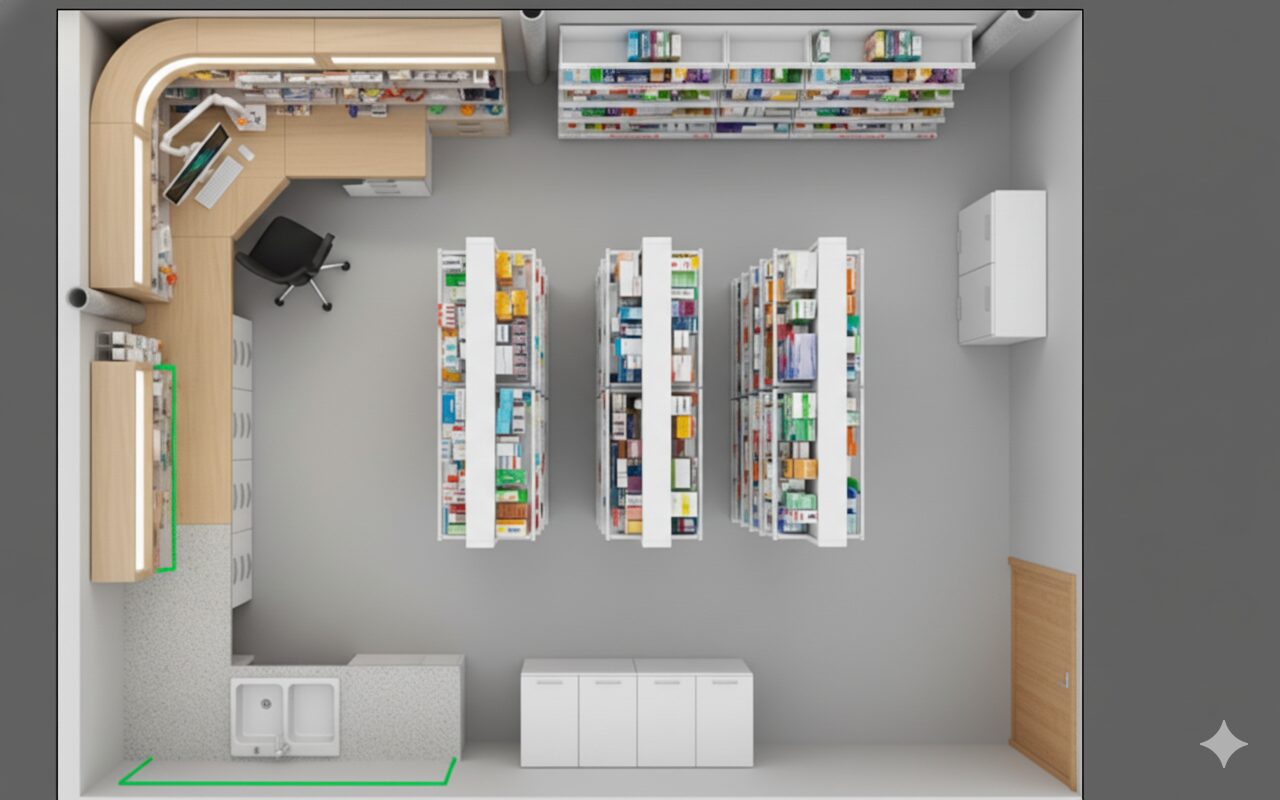
3. How to Choose the Right Pharmacy Shelving Manufacturer in China
Not every Chinese metal furniture factory is equipped to manufacture pharmacy shelving. The requirements are more demanding than standard retail shelving: pharmacy environments involve frequent cleaning with chemical disinfectants, strict product segmentation (prescription vs OTC vs cold chain), and often specific regulatory requirements for display and storage.
Six criteria separate a capable pharmacy shelving manufacturer from a general metal shelving factory that happens to accept pharmacy orders:
1. Factory experience with pharmacy or healthcare projects. A manufacturer that has produced shelving for hospital pharmacies, pharmacy chains, or healthcare facilities understands the specific requirements: easy-clean surfaces, chemical-resistant powder coating, and layouts designed around dispensing workflow rather than general retail. Ask for photographs of completed pharmacy installations, not just their standard product catalog.
2. Production capacity and equipment. Vertically integrated factories with in-house steel stamping, powder coating lines, and tooling departments deliver more consistent quality than factories that outsource any of these stages. Key equipment to confirm: automatic powder coating line (manual spraying produces inconsistent thickness), CNC punching machines for precise hole placement, and a bending capacity that matches your panel sizes.
3. Completed project references. Request references for pharmacy or healthcare retail projects of comparable size. A manufacturer producing gondola shelving for supermarkets is not automatically qualified for pharmacy shelving — the material grades, finish standards, and dimensional precision requirements are different. Verify 2–3 references, ideally in your region.
4. Certifications. ISO 9001 is the baseline. For GCC markets, SABER/SASO certification is required. For European buyers, CE marking is essential. If the factory claims to have these, verify the certification numbers with the issuing body — certification fraud exists in the Chinese manufacturing sector and is not limited to small workshops.
5. Quality control processes. A serious manufacturer will have documented IQC (incoming raw material inspection), IPQC (in-process quality control at each production stage), and FQC (final inspection before packing). Ask specifically about their powder coating thickness testing (recommended: 60–80 microns), steel gauge verification, and color matching process using spectrophotometers rather than visual comparison.
6. Export experience to your market. A factory that has shipped pharmacy shelving to Saudi Arabia, the UAE, Kenya, or Germany understands the documentation, packaging, and certification requirements specific to that destination. First-time exporters to your market may quote lower prices but introduce customs clearance risks that offset the savings. For more on export documentation requirements, refer to our China Factory Audit Guide.
4. Materials and Quality Standards for Pharmacy Shelving
Material selection is the single most important technical decision in a pharmacy shelving project. The wrong material choice leads to rust, surface degradation, or structural failure within 12–18 months of installation — and replacement costs far exceed the initial savings.
Cold-rolled steel (SPCC) is the standard structural material for gondola shelving, wall-mounted systems, and display units. It provides the strength-to-weight ratio needed for loaded shelving. The key specification is steel thickness: 0.6mm–0.8mm for light-duty cosmetic shelving, 1.0mm–1.2mm for standard pharmacy shelving, and 1.5mm+ for heavy-duty systems storing bulk inventory. Quality manufacturers clearly specify the steel gauge in their technical data sheets — if the gauge is not stated, assume the thinnest possible option.
Stainless steel (SS304) is the recommended material for prescription counter work surfaces, wet preparation areas, and any surface that undergoes frequent chemical cleaning. SS304 contains 8–10.5% nickel and 18–20% chromium, providing corrosion resistance that cold-rolled steel with powder coating cannot match. Some manufacturers offer SS201 as a lower-cost alternative — it contains only 3.5–5.5% nickel and will show surface corrosion within 3–6 months in a pharmacy environment with regular alcohol-based cleaning. The price difference is typically 35–45%, and it is not worth the saving for any surface that must remain sanitary.
Medium-density fiberboard (MDF) with laminate or melamine finish is used for cosmetic panels, end caps, and decorative elements. The quality range is wide: low-density MDF (under 650 kg/m³) absorbs moisture and swells, while high-density MDF (750–800 kg/m³) performs well in dry pharmacy environments. For GCC countries where humidity in coastal areas regularly exceeds 70%, laminate-clad MDF or PVC-finished panels are preferable to melamine, which is more susceptible to edge swelling.
Powder coating is the standard finish for steel shelving components. Quality is determined by three factors: surface preparation (degreasing and phosphating before coating), coating thickness (60–80 microns is the target range), and curing temperature and time. A powder-coated surface that passes a cross-hatch adhesion test and a 500-hour salt spray test will last 5–8 years in a normal pharmacy environment. Ask specifically for salt spray test reports — if the manufacturer does not have them, they are not testing their coating quality systematically.
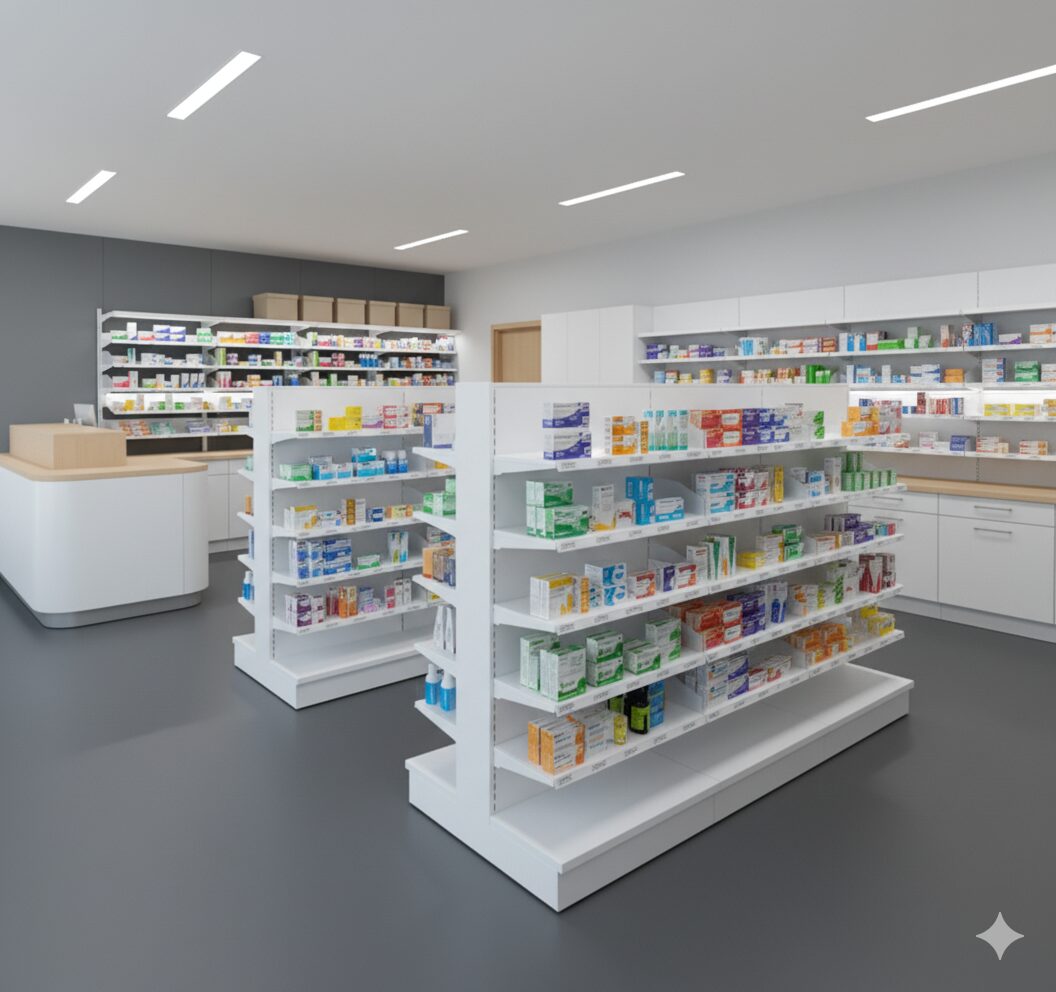
5. Custom Pharmacy Shelving Manufacturing Process
Understanding the manufacturing sequence helps buyers identify where quality risks appear and where inspection efforts should be concentrated. The process for custom pharmacy shelving typically follows this sequence:
1. Design and specification phase. The manufacturer converts your store layout, product categories, and workflow requirements into technical drawings. This phase produces: a 3D rendered layout showing every shelving unit in position, detailed elevation drawings for each unit type, and a bill of quantities listing every component with material specifications. Review these drawings for dimensional accuracy, aisle widths (minimum 900mm for wheelchair access in many markets), and sightlines from the prescription counter to the retail floor.
2. Material procurement and incoming inspection. The factory orders steel coils, MDF boards, powder coating materials, and hardware. The raw material batch should be tested: steel gauge verification, MDF density and moisture content, and powder coating chemical composition. This is the stage where material substitution happens most often — SS201 instead of SS304, or a lower-density MDF than specified.
3. Cutting, punching, and forming. Steel sheets are cut to size, punch holes for shelving brackets and shelf supports, and bent to shape on CNC press brakes. The precision of this stage determines whether components assemble correctly. Dimensional tolerance should be ±1mm for hole spacing and ±2mm for overall panel dimensions. Larger tolerances create assembly problems during installation.
4. Welding and fabrication. Frames, brackets, and support structures are welded. Weld quality is critical for load-bearing components. Spot welds should be uniform, continuous welds should show no porosity, and all welds should be ground smooth in visible areas. A factory that does not grind welds on visible components is signaling its general quality level.
5. Surface treatment and powder coating. Components go through a pretreatment line (degreasing, rinsing, phosphating) before powder coating. The powder coating is applied electrostatically and cured in an oven. Key quality indicators: no visible orange peel texture, consistent gloss level across all components, and no bare spots on corners or edges where powder may not have reached during spraying.
6. Assembly and hardware fitting. Shelving components are test-assembled, and hardware such as shelf clips, brackets, locks, and hinges are fitted. Drawers are tested for smooth operation, doors checked for alignment, and locking mechanisms verified.
7. Final QC inspection. Every component is checked against the approved sample and technical drawings. Color is verified using a spectrophotometer (not by eye). Dimensions are measured. Packaging integrity is confirmed. Components that fail are either reworked or rejected at this stage.
8. Packing and container loading. Flat-pack components are wrapped, cartoned, and palletized. The container loading plan should sequence items so that first-unloaded items (installation-priority items) are accessible without unpacking the entire container.
Manufacturing errors are cheapest to catch at stage 3 (cutting/punching), moderately expensive at stage 6 (assembly), and most expensive after stage 8 (shipped). Inspection timing matters more for cost control than the inspection itself.
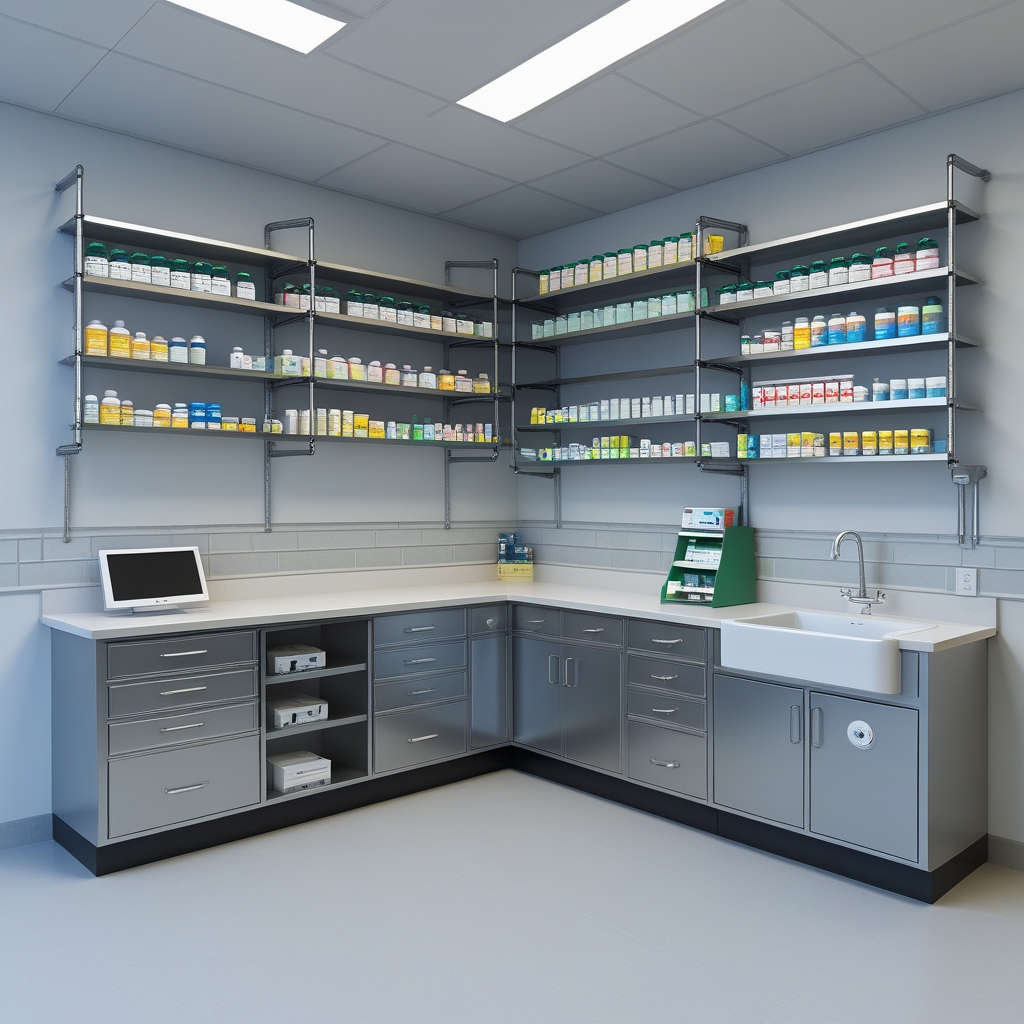
6. How the Custom Ordering Process Works — From Floor Plan to Factory
One of the most common questions from first-time pharmacy buyers is not about materials or pricing — it is about how the process actually works from the buyer’s side. The commercial process for custom pharmacy shelving from China follows a structured sequence that protects both the buyer and the manufacturer.
Step 1 — Submit floor plan and requirements. The buyer provides the pharmacy floor plan with dimensions, product categories to be displayed, and any brand-specific requirements. This can be as simple as a hand-drawn layout with measurements or as detailed as architectural CAD files. The more detail provided at this stage, the more accurate the design and pricing will be.
Step 2 — Design and layout proposal. The manufacturer or procurement partner produces a full 3D design and layout showing every shelving unit in position, with elevations, dimensions, and product recommendations. This stage typically takes 3–7 working days depending on complexity. The design fee is charged upfront but is fully refundable — it is deducted from the final invoice if the client proceeds with the order. This structure ensures the buyer receives professional design work without financial risk while the manufacturer’s design time is respected if the project does not move forward.
Step 3 — Design approval and pricing. Once the design is approved, the manufacturer issues a formal quotation with a detailed bill of quantities, material specifications, unit prices, and delivery timeline. The buyer reviews, requests adjustments if needed, and confirms the final scope. Changes at this stage are free — changes after payment incur costs.
Step 4 — 30% deposit and order confirmation. After the design and price are both approved, the buyer pays a 30% deposit to begin production. The deposit secures the production slot and covers raw material procurement. The remaining balance is calculated as: total invoice − design fee (refunded) − deposit paid. This means the design fee is effectively transferred from being an upfront cost to a credit against the final payment.
Step 5 — Production, inspection, and shipping. Manufacturing begins after deposit confirmation. The buyer receives production updates, mid-production inspection reports, and pre-shipment photos. The balance payment is due before shipment, typically against the Bill of Lading or pre-shipment inspection approval.
This process exists because the most expensive mistake in custom pharmacy shelving is approving a design without seeing pricing, or committing to pricing without seeing a design. Separating design from pricing, and making the design fee refundable against the order, removes the risk from both sides.
7. How Much Does Custom Pharmacy Shelving Cost from China?
Pricing for custom pharmacy shelving from China varies significantly based on materials, dimensions, finish quality, and quantity. The ranges below reflect current market rates from verified manufacturers in Foshan and Guangdong for standard-grade materials.
| Item Type | Standard Grade | Premium Grade | Key Variables |
|---|---|---|---|
| Wall-mounted shelving (per linear meter) | $350–$700 | $800–$1,500 | Depth, load rating, material, finish |
| Gondola shelving (per bay, double-sided) | $150–$280 | $300–$400 | Height, shelf count, base deck type |
| Prescription counter (per linear meter) | $800–$1,500 | $1,800–$3,500 | Work surface material, drawer count, locking system |
| Island display unit | $180–$350 | $400–$700 | Size, glass shelving, lighting |
| Medicine storage cabinet (per unit) | $200–$500 | $550–$1,200 | Lock type, size, shelf configuration, material |
| Glass display showcase | $400–$900 | $1,000–$2,500 | Size, LED lighting, tempered vs standard glass |
| Complete pharmacy fit-out (per sqm of sales area) | $180–$350 | $400–$650 | Scope, ceiling height, custom fabrication ratio |
Note: Prices above are FOB (Free on Board) Chinese port, excluding shipping, customs duties, and installation. Actual pricing should be obtained through a detailed RFQ process with technical drawings.
Factors that affect pricing beyond the base unit cost:
- Steel thickness: Moving from 0.8mm to 1.2mm steel increases material cost by approximately 35–50%.
- Powder coating color: Standard RAL colors are cost-neutral. Custom Pantone-matched colors typically add 5–10% to the coating cost due to minimum batch requirements.
- Integrated lighting: LED strip lighting with drivers, wiring, and diffusers adds $40–$120 per linear meter depending on quality and certification (CE, UL).
- Branding and signage: Custom logo printing, acrylic sign holders, and backlit panels add 8–15% to the project total depending on complexity.
- Packaging: Export-grade packaging with plywood crating and foam interlayering adds 5–10% but reduces transit damage risk significantly.
- Quantity: MOQs of 50–100 units per design apply for custom colors and finishes. Below MOQ, factories typically charge a 15–25% premium.
A typical 120 sqm community pharmacy fit-out with medium-grade materials, including wall shelving, gondola units, a prescription counter, and glass showcases, will fall in the range of $25,000–$45,000 FOB. A 500 sqm pharmacy chain store with premium finishes and full integration will range from $90,000–$180,000 FOB. These ranges exclude shipping, which adds $3,000–$8,000 per 20ft container to GCC ports and $4,000–$10,000 to African or European destinations.
8. Case Study: A Multi-Branch Pharmacy Rollout in Kuwait
Skyline Trading Co LTD has managed the complete procurement and delivery of custom pharmacy shelving systems for a multi-branch pharmacy chain in Kuwait. The project covered several branches ranging from 150 to 200 sqm each. This case study documents the scope, challenges, and measurable outcomes.
Scope of Supply
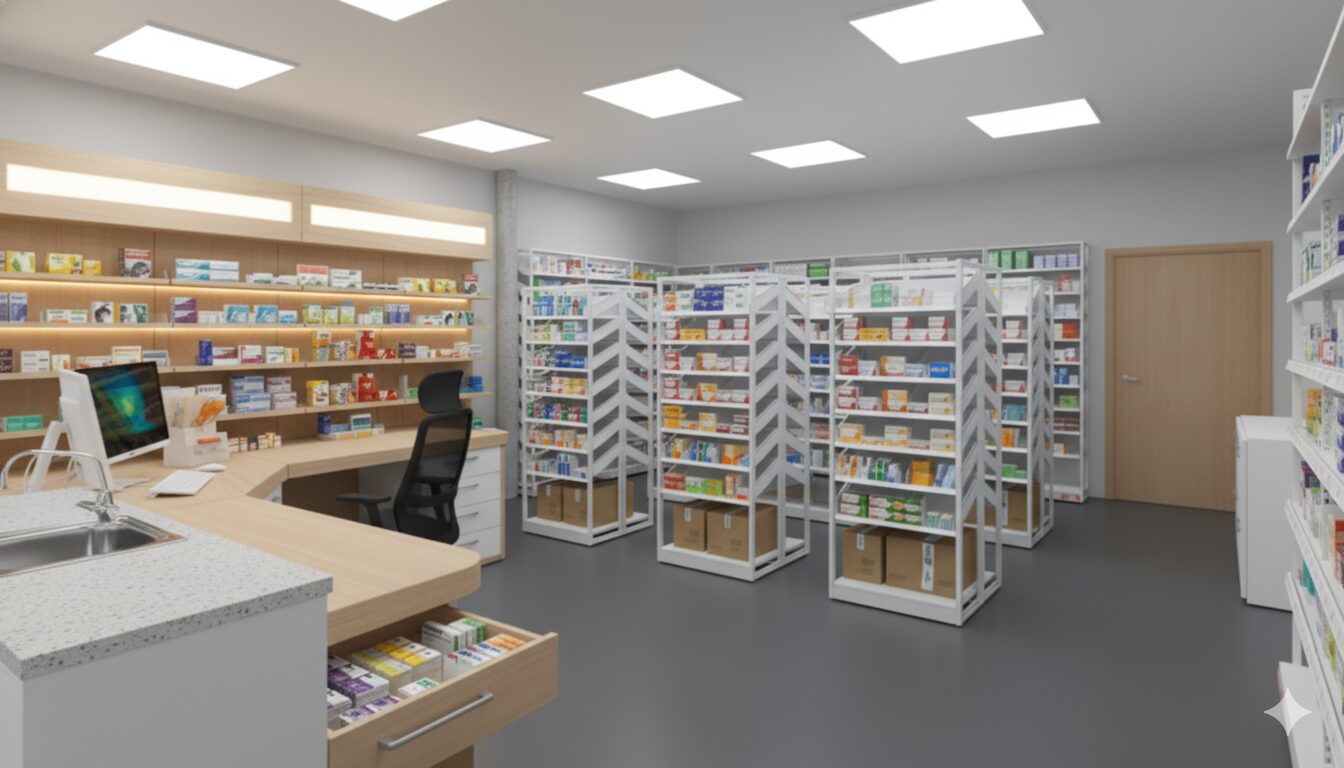
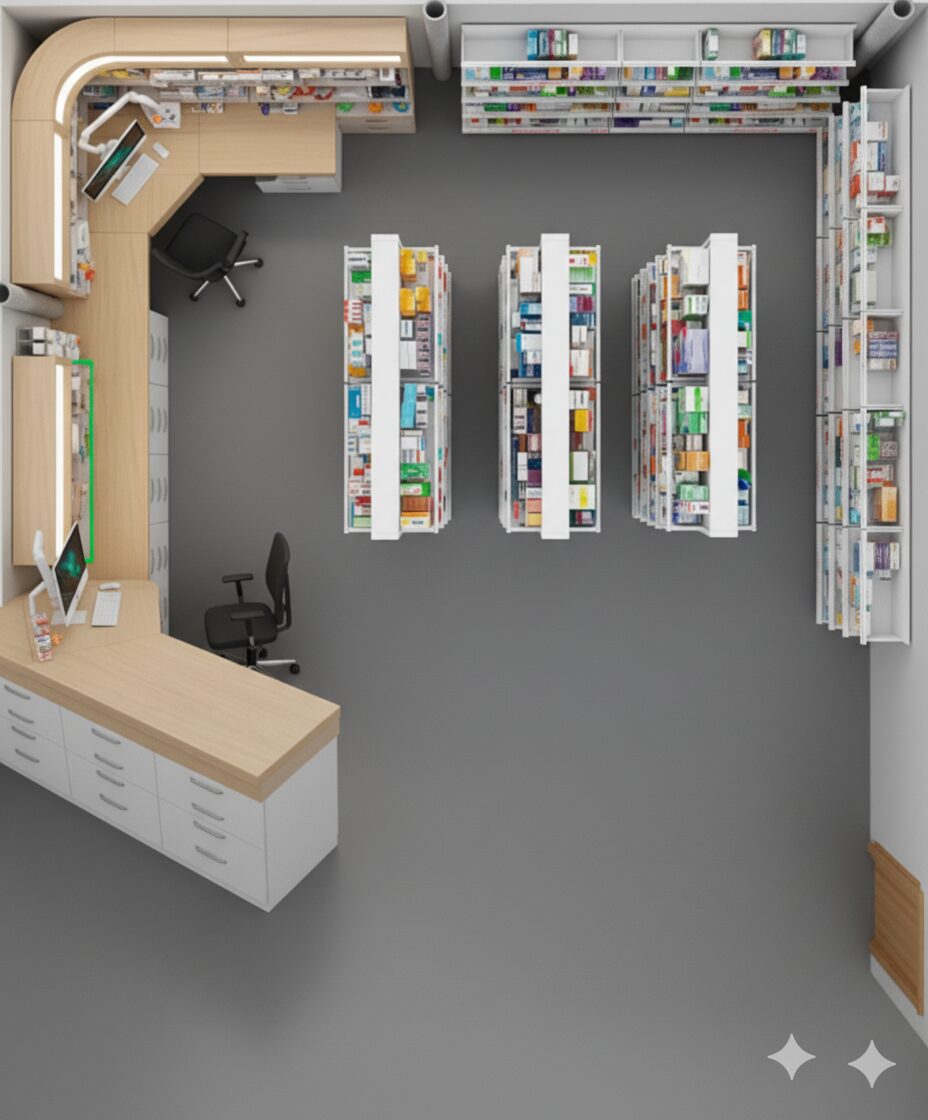
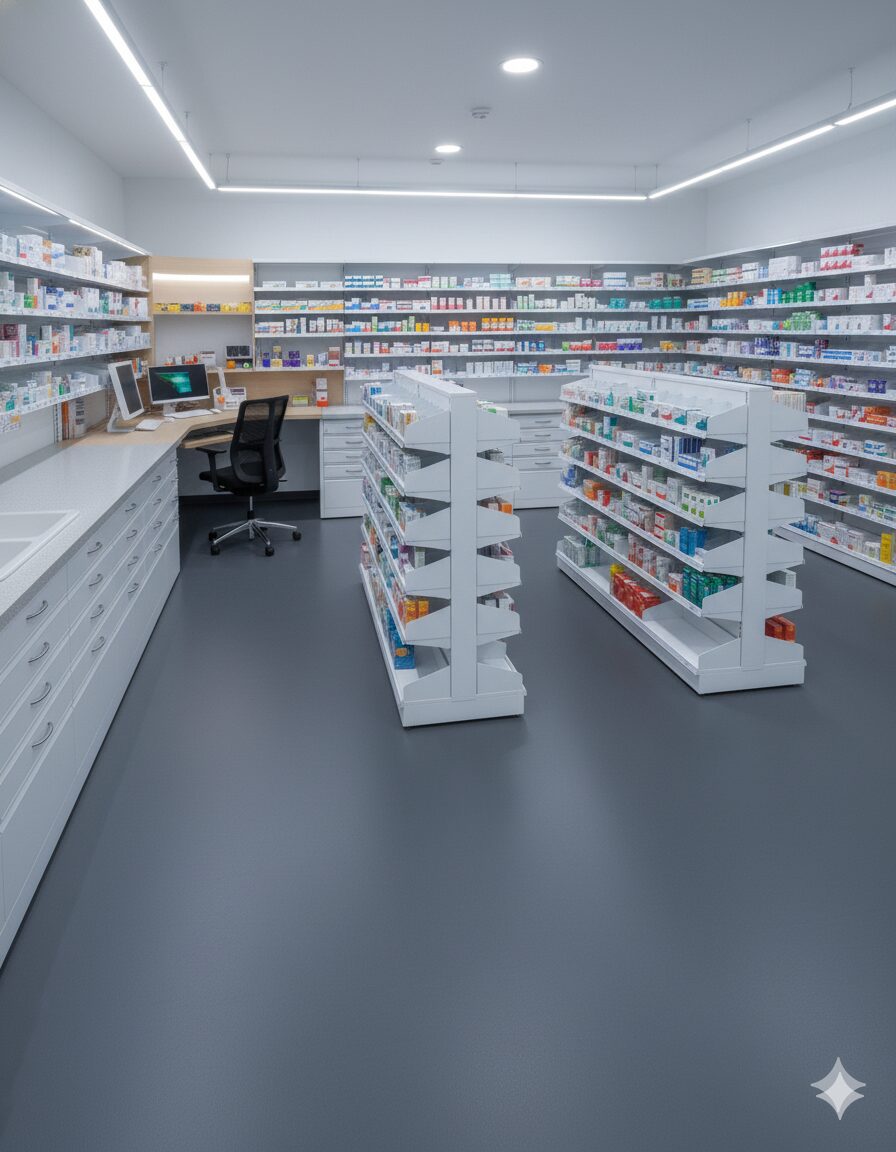
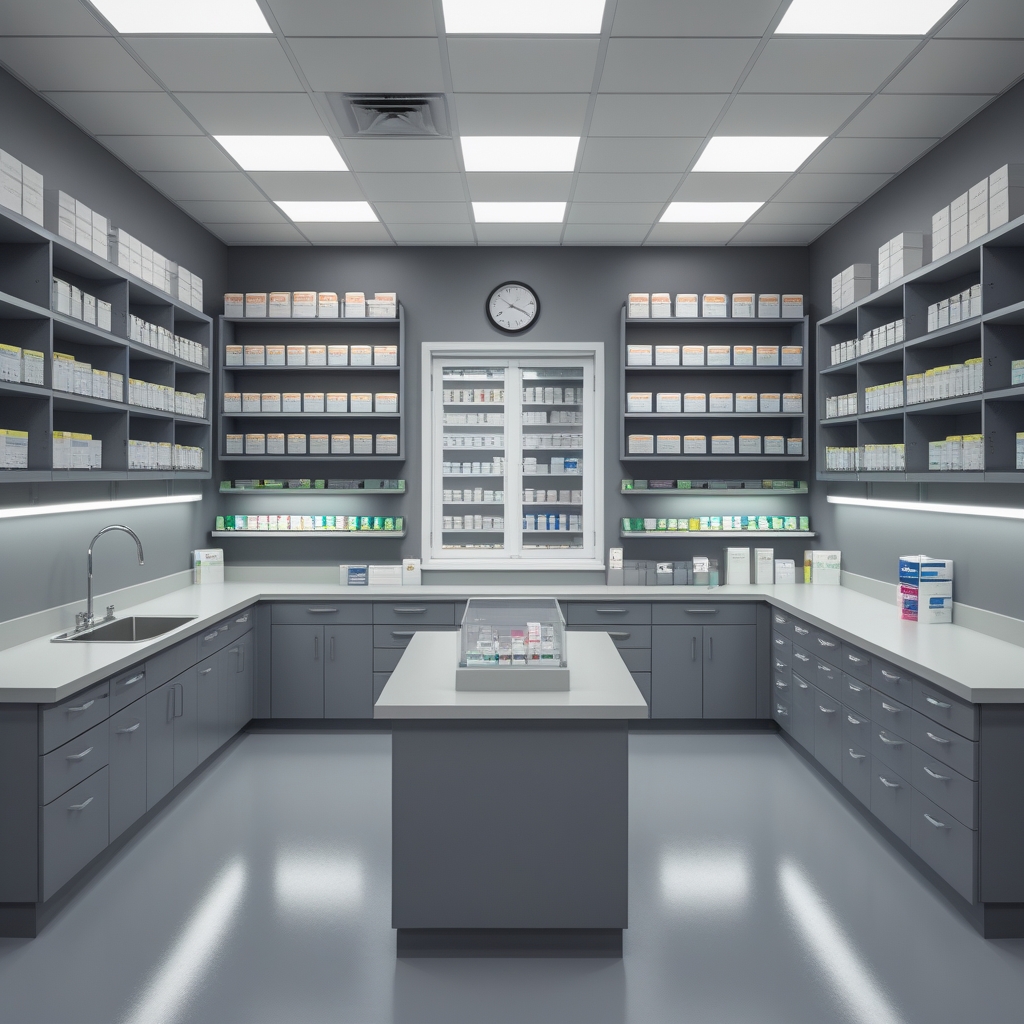
Each branch received a complete interior fit-out including: wall-mounted shelving systems for perimeter dispensing areas, glass display shelving for high-value products and cosmetics, rolling display racks for promotional and seasonal merchandise, cabinets and drawer units for behind-counter storage, counters and workstations for the prescription dispensing area, showcases with integrated LED lighting, and gondola shelving units for the retail floor. All components were custom-manufactured to the chain’s brand specifications, including matched RAL colors, logo integration, and standardized module dimensions across all locations.
Key Challenge: Glass Transport Across Borders
The single most technically demanding aspect of this project was the glass shelving and display components. Glass elements for retail pharmacy displays require specific handling — they must be cut to precise dimensions, edge-polished, tempered, and packaged in a way that prevents breakage during sea freight and road transport. Shipping glass shelving from China to Kuwait involves: container-vibration during a multi-week sea voyage, temperature fluctuations in the container (glass is sensitive to thermal stress during transit), and multiple handling points during loading, unloading, and customs inspection.
We resolved this through: custom-built plywood crates with foam interlayering for each glass panel, edge protectors on all four corners, vertical loading only (glass panels shipped standing, never flat), and explicit handling instructions in both Chinese and Arabic on every crate. The result: zero breakage across all branches — every glass panel arrived intact.
Logistics Coordination
All shelving components for the branches were consolidated into a single container shipment from a Guangdong port to a Kuwaiti port. Consolidating multiple branches into one shipment required precise labeling: each carton was marked with its branch number, installation zone, and contents description. The container loading plan followed the installation sequence so that priority items for the first branch were accessible without unloading the entire container.
Measured Results
- Cost savings: The China-supplied cost per square meter was substantially below the equivalent from local suppliers for comparable quality and customization — the client’s procurement team confirmed that domestic suppliers could not match the pricing for custom-branded, modular systems at this scale.
- Single shipment: All branches were delivered in one consolidated container — simplifying customs clearance, reducing freight costs, and enabling the client to schedule all installations from a single delivery.
- Zero glass breakage: Despite the complexity of shipping glass components internationally, proper packaging and handling protocols resulted in zero breakage across the entire order.
- Brand consistency: Every branch received identical shelving components with matched colors, finishes, and branding — the same system design applied across multiple locations and store footprints.
What This Project Proves
Multi-branch pharmacy rollouts from China are achievable in a single consolidated shipment when the specification is standardized, the packaging is engineered for the product type, and the logistics are coordinated from factory floor to installation site. The cost saving compared to local GCC suppliers was not achieved by reducing quality — it was achieved by designing a modular system that could be replicated across multiple locations, manufactured in one production run, and shipped in one container. The client now operates identically-fitted branches with consistent brand presentation, standardized staff workflows, and a single spare-parts inventory for all locations.
9. Common Mistakes When Buying Pharmacy Shelving from China
Sourcing pharmacy fixtures from Chinese manufacturers surfaces the same patterns of failure repeatedly. The mistakes below are drawn from documented procurement projects across the GCC and Africa.
Choosing the cheapest supplier on Alibaba or Made-in-China. The lowest-priced bid for pharmacy shelving almost always comes from a manufacturer that will cut material thickness, use a lower steel grade, or apply a thinner powder coating. The savings disappear within 12 months when shelving begins to rust, powder coating peels, or structural components bend under load. If a quote is 30% or more below the average of other bids, it is not a bargain — it is a specification that has been silently reduced.
Skipping the design and drawing review phase. The most expensive change is a change made after production begins. Investing in a proper design review with 3D drawings and elevation plans prevents dimensional mismatches, clearance problems, and installation conflicts that are expensive to fix once steel has been cut. For a guide on how to prepare procurement-ready specifications, see our Supplier Verification Checklist.
No independent inspection at any stage. Relying on the factory’s own QC department is the equivalent of having the student grade their own exam. Even manufacturers with ISO 9001 certification produce defective batches. An independent third-party inspection (SGS, Intertek, QIMA) at the mid-production and pre-shipment stages costs a fraction of the order value and catches the majority of defects before they ship.
Unclear or incomplete specifications. “Pharmacy shelving, white, 1800mm high” is not a specification. A proper specification states: material grade and thickness, powder coating type and minimum thickness, load rating per shelf, color reference (RAL or Pantone), dimensional tolerance, and packaging standard. The more ambiguity in the specification, the more room the factory has to reduce cost by reducing quality.
Wrong material selection for the environment. Powder-coated cold-rolled steel is adequate for most indoor pharmacy environments. But in coastal GCC cities where ambient humidity regularly exceeds 70%, and in pharmacies where surfaces are wiped with alcohol-based disinfectants multiple times daily, stainless steel (SS304) for work surfaces and frequent-touch areas is not optional. The cost difference is substantial but the replacement cost of rusted shelving within two years is higher.
Ignoring installation complexity. Pharmacy shelving from China ships flat-packed. The assumption that local contractors can assemble and install it without guidance is often wrong. Request installation drawings, assembly videos, and — for large projects — on-site installation supervision from the manufacturer or a qualified local installer. Installation costs typically represent a significant portion of the product cost and should be budgeted from the start, not treated as an afterthought.
10. Factory Verification Checklist for Pharmacy Shelving Suppliers
A proper factory verification goes beyond checking business licenses and ISO certificates. The checklist below covers the specific risks relevant to pharmacy shelving procurement.
| Verification Item | What to Check | Red Flag |
|---|---|---|
| Business license | Explicit “manufacturing” (制造) wording in business scope, not only “trading” or “sales” | No manufacturing wording — the supplier is a trading company, not a factory |
| Factory address match | Address on business license matches the actual factory location | Different address — audit visit is going to a different facility than the registered one |
| Production equipment | In-house powder coating line, CNC punching, press brakes, welding stations | No powder coating line — coating is outsourced, losing quality control |
| Steel thickness verification | Manufacturer specifies gauge (0.8mm, 1.0mm, 1.2mm) and can verify with micrometer | No gauge specification in quotation — expect thinner material |
| Powder coating testing | Cross-hatch adhesion test, salt spray test (500+ hours), thickness gauge available | No testing equipment visible — coating quality is unverified |
| QC documentation | IQC records for incoming steel, IPQC records from production line, FQC records for finished goods | No traceable QC records — QC is performed after the fact for audit visits |
| Export records | Customs declaration records showing previous exports of shelving products | No export history for shelving — this would be a first-time export project |
| Litigation check | Search Chinese legal name on Qichacha or National Enterprise Credit Information System for lawsuits, bankruptcy, enforcement records | Open lawsuits from suppliers or customers — indicates payment or quality disputes |
| Reference projects | Pharmacy or healthcare shelving installations with client contact information | Only retail shelving references with no pharmacy-specific experience |
| Sample quality | Produced sample matches specification exactly — not a “sample special” made by hand | Hand-made sample that cannot be replicated in mass production |
For a more general factory audit framework that applies across product categories, see How to Read a China Factory Audit Report.
11. Shipping and Installation Planning
Pharmacy shelving is volume-freight. A typical 120 sqm pharmacy fit-out requires approximately 20–30 cubic meters of cargo, fitting into a 20ft container with space remaining for smaller items. A 500 sqm chain pharmacy will typically require 2–3 containers.
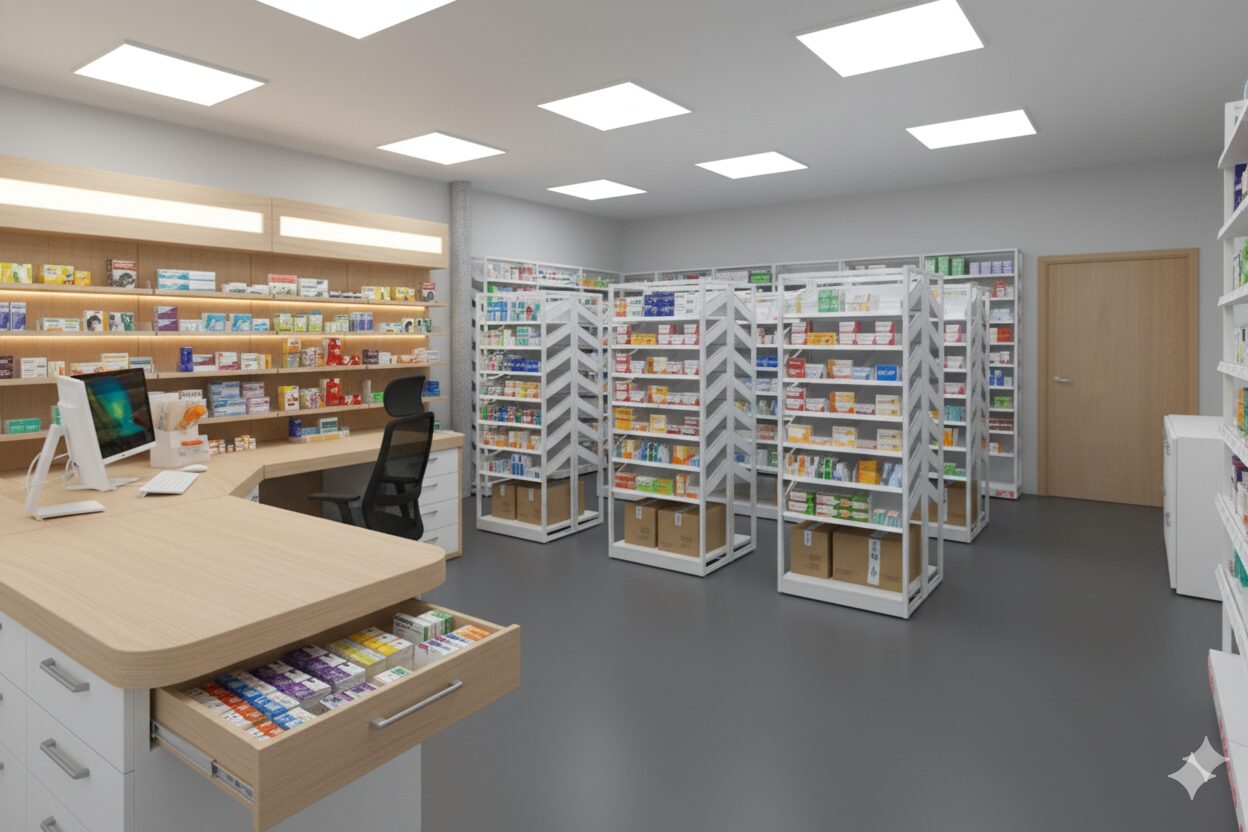
Container planning. Flat-packed shelving components pack efficiently. A 20ft container (approximately 28 CBM usable) holds the shelving for a standard community pharmacy. The container loading plan should group components by installation zone — dispensing area components packed together, retail floor components together — to avoid searching through the entire container during installation. Labeling every carton with its zone, contents, and installation sequence number significantly reduces unpacking time at the installation site.
Packaging standards. Export-grade packaging for pharmacy shelving should include: corrugated cardboard outer carton, foam sheet wrapping for painted surfaces, edge protectors on corners, and plywood crating for heavy or glass components. Each carton should be marked with: manufacturer name, contents description, quantity, carton number (e.g., 1/45), installation zone, and handling instructions. Waterproof pallet wrapping is essential for sea freight, especially for shipments to humid GCC ports.
International shipping timelines. From Shenzhen or Guangzhou ports:
Pharmacy Shelving Cost Estimator
Use the calculator below to estimate the FOB cost of your pharmacy shelving project. Enter your pharmacy sales area in square meters to get a projected price range.
Estimated FOB Cost:
$25,000 – $45,000
* Excludes shipping, customs, and installation. Based on medium-grade materials with standard customization. Premium finishes add 40–60%.
Free Pharmacy Shelving Project Assessment
If you are planning a pharmacy fit-out, chain rollout, or hospital pharmacy project and evaluating Chinese suppliers, we offer a complimentary project assessment. Send us your store layout, product categories, and shelving requirements — we will provide:
- A preliminary bill of quantities and material specification recommendation
- Estimated cost range based on current factory pricing
- Manufacturer recommendations matched to your project scope
- A risk assessment covering specification gaps, shipping, and installation planning
No obligation. No charge. Skyline Trading Co LTD — Foshan, China | Project Office: Foshan, Shunde, China
Request Your Free Project Assessment →